Moment's Notice
Reviews of Recent Media
(continued)
Laura Strobl + Georg Graewe + Mark Sanders
Acutance
Random Acoustics CD044
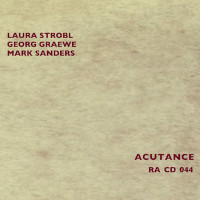 A notably volatile trio debuts on Acutance comprising Viennese violist Laura Strobl, veteran German pianist Georg Graewe, and English drummer Mark Sanders. It is the German who provides the connective tissue between the collaborators. The classically trained Strobl performs in Graewe’s Sonic Fiction Orchestra, while Sanders first appeared with the pianist on Concert In Berlin (Wobbly Rail, 1996). They unite on eleven collective tracks from a November 2025 studio date in which their shared experience engenders chamber modalities that ultimately evade easy genre classification.
It’s entirely fitting that Strobl’s name takes pride of place in the album listing and in the group photo on the sleeve. She is quite simply fabulous. Her diaphanous tones launch the opening “Gambades I,” but the thin high filigree quickly takes on extra dimensions – slight adjustments of pressure, unanticipated variations in volume, pure pitches morphing into scratchy abrasion – in an unaccompanied introduction that is by turns capricious, tentative, exuberant, and meditative. In her oblique juxtaposition of curdled murmurs and singing lines she recalls Mat Maneri, rarely seeking consonance, but always looking to fit in.
Graewe bridges Strobl’s austere abstraction and Sanders’ blend of unconventional texture and asymmetric momentum, creating a singular distillation of elegant figures, sudden spurts and scuttling runs that knit the three disparate personalities together. Although a master improviser, his jazz roots lurk just beneath the surface, evidenced by the occasional syncopated turn of phrase or insistent motifs. Sanders sits in a lineage that includes Paul Lovens and Tony Oxley, but proves a sensitive colorist, especially early on, before ushering the threesome out of the sequestered drawing room and into the harsh light of day.
The program traces an arc towards greater density and emotional intensity as the sequence progresses, notwithstanding the quicksilver changes in pace, focus, and expression that mark the session. The often enigmatic conclusions signal that nothing is settled, the pieces the result of ongoing and unpredictable negotiation. “Warmless Sun” offers an example: beginning with rippling piano, languid viola, and tapping drums, it becomes abruptly caffeine infused, fitful scampers punctuated by angular jolts in a threeway flow, until Graewe switches to a propulsive riffing that generates a lingering tension with the more willfully wayward viola and percussion.
While further full-on outpourings spice the final two cuts, in other places mysterious timbral exchanges dominate, as on the reflective “Raunen” or the Paul Bley-like rumination that begins “Incrementally.” Strobl sits out “Only Then,” leaving a duet that combines both hyperspeed pianism and pensive interludes into just four minutes. But in the end Acutance succeeds not by resolving the differences among its players, but by making that friction a productive resource in itself. The outfit made its first appearance during Mark Sanders’ residency at London’s Café Oto in March this year, but on the basis of this recording it merits a long future existence.
–John Sharpe
Cecil Taylor + Orchestra Humane
At Iridium 2004
Burning Ambulance
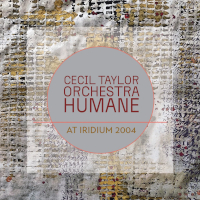 However his art is represented in the post-idealism of 2026, a new virtual box set of Cecil Taylor’s orchestral work prompts revisitation on multiple levels. It demonstrates that he was, above all, a Romantic in the most cosmic sense, a seeker of freedom via formal convergence. In 2004, over six evenings at New York’s Iridium, that liberation was made manifest by 14 sets from the group of collaborators Taylor called Orchestra Humane, now released in its entirety as a mammoth download under Philip Freeman’s Burning Ambulance imprint. This residency, comprising two sets per evening and three on the 26th and 27th, included trumpeters Taylor Ho Bynum, Amir ElSaffar, Stephen Haynes and Tobias Netta, trombonists Steve Swell and Jeff Hoyer, Bill Lowe on tuba, saxophonists Bobby Zankel, Will Connel JR, Elliott Levin, Sabir Mateen, and JD Parran and the rhythm section of bassist Dominic Duval and drummer Jackson Krall. Each set is a narrative of layered departures and returns in varied contexts.
The fact that the music evolves along these lines provides no new insight. The brewing luminosity lies in the changing nature of its moment-to-moment expression, fostering the mystery and its attendant reconsiderations. Context is crucial. More than fifty years after the fact, the opening minutes of Silent Tongues, Taylor’s solo performance at the 1974 Montreux Jazz Festival, remain quietly shocking and prophetic for similar reasons. Arpeggiated chords in octaves delineate G-flat, evoking Scriabin’s favorite key, and then give way to sonorities nearly but never quite shedding tonality’s trappings. Yet, the music dances, syncopates and swings, simultaneously inside and adjacent to intersecting historical precedents. The harmonies and rhythms exist in an ambiguous third space, one avoided by so many descriptions of Taylor’s art, and the ambiguity is the point. Enter Freeman, who observes in his recent Cecil Taylor biography, In the Brewing Luminous (Wolke Verlag, 2024), that the performance highlighted Taylor’s integral position in the jazz tradition. Freeman extends his ideas concerning Taylor’s pedigree and musical associations throughout the book, often and astutely employing the term “Romantic.” The ever-enthralling and enigmatic Ferruccio Busoni’s 1907 pamphlet, Sketch of a New Aesthetic of Music, reinforces Romanticism’s dichotomous nature. For the Italian composer and pianist, the past is dualistic, a space in which to view narrative development as it diverges and converges with itself in the glorious anti-chronology and attendant aesthetics Busoni labels freedom, the destiny of music toward which aspiration leads. Cecil Taylor creates a similarly complex and even contradictory universe in the name of freedom, each performance a snapshot of liberation in flux. These orchestral concerts bring new subtlety and clarity to our understanding of that process.
Though the ensemble name changed, as Bynum wrote in these pages in 2018, many of the participants remained involved during those years of Taylor’s relatively numerous larger ensemble performances and were privy to his language as it developed. Several doubled on other instruments, broadening the sonic pallet. Even the malleability of his ensembles, not to mention their modes of delivery, is a long-fostered component of his complex vision. Returning, after listening to these 14 sets, to the 1962 Café Montmartre concert that heralded the Unit’s stylistic breakthrough, the bassless trio sounds at once more expansive than its size might indicate and yet razor-precise, the semi-familiar emerging amidst what then must have been shocking rhythmic and tonal presumptions. On the portentous and already harmonically daring “What’s New,” aptly titled “I’m Free” when composed in 1938, Jimmy Lyons’ the melody fragments and warps just as the surrounding harmonies blur in the heat of discovery. More than four decades later, following on from benchmark ventures such as 1988’s ululative Legba Crossing, recorded during Taylor’s formative Berlin residency, and the slightly earlier and equally exuberant Orchestra of Two Continents sessions, compositional and improvisational boundaries blurred beyond recognition. Sublimated and augmented, the 2004 Iridium residency proffers the convergences more complete and intricate, resultant ambiguities more fully celebrated.
The ensemble expands and contracts with a natural diversity akin to breathing, transition at every level itself becoming contrapuntal with respiration at the heart of its rhetoric, its multi-referential syntax. The penultimate set begins with a chamber-music episode presenting these confluences in miniature. Paran and Lowe begin in counterpoint of tone and overtone vaguely European in its atomistic interaction but gutbucket-drenched, alive with concentric traditions. Lowe’s rush and roar vibrate sympathetically with Paran’s slaps, bold arpeggiation and overtonal sinews. Swell and Hoyer change the color pallet at 2:02, Parran and Lowe returning for quartet interplay until 6:00, when Krall, Duval, and Taylor evoke the next connected miniature. The modestly prepared piano’s lower register blends, darkly hewn, with Krall’s cymbals and Duval’s astonishing sustains, cinematic layers in constant resonance and staggered motivic repetition. The trio’s “classic free jazz” arc burns with the requisite crescendoing intensity until 13:37, when, slowing as if to inhale, the ensemble shifts again as the others enter in sustained homophony succeeded almost immediately by atoms in dialogues simultaneously defining and defying register. The heaving sustains return only then to meld with the atoms just before a molten melody cracks the already heated surface at 16:00.
That particular stretch’s serial construction lends itself well to more conventional analysis, but what beggars so much description involves the gestures between the gestures, the interstitial occurrences bespeaking traditions in symbiosis. Lowe’s blending of instrument and voice is particularly effective, power in dialogue with itself that obviously filled the space. What academics might call “blue notes” abound, but nothing prepares for either their dialogic functions or the way they resolve. The smears, slurs, micro-crashes, and minute pauses gel to create a narrative of varied planes of intensity exposed by equally laddered listening.
Though the moment certainly cannot represent the whole, the degree of “changing same” throughout the week, as Amiri Baraka might have expressed it, is astounding. To suggest that very similar melodic material, centered but not exclusively in minor, opens the first two evenings and the third’s second set, and that a variant sets March 25th, Taylor’s birthday, in motion, implies a false uniformity. True, that material also returns to conclude the first set, but nothing is the same. The music inhabits an ever-present, the process of formation rather than product paramount to its Romantic raison d'être. There is something of Scriabin’s final, incomplete but equally evocative Mysterium in Taylor’s evolving vision of rhapsodic recurrence. Implication is as elusive and, ironically, as clear in the moment, as the human voice is complex. The minor gestalt returns in the third set of March 26th, one of the most challenging pieces in a box brimming with them. Antiphonal Percussion circumnavigates Ghostly whoops and possibly effected voices, conjuring shades of Coltrane’s OM, as someone (Elliott Levin is the only credited voice besides Taylor) poeticizes as Taylor intones over the luminous brew seasoned by his piano.
Since the middle 1970s, Taylor was reaching for a language of arpeggiation. It can be heard on Garden and, in a more distilled form, during the shorter works he performs when guesting on Marian McPartland’s Piano Jazz. The motifs forming his pianistic language are as diverse and yet unified as all of the music from this extraordinary week of concerts. Most likely, like the complex relationship between Kerouac’s On the Road and the expansive Visions of Cody, the interconnected web of scales, figures, and harmonic associations form the wellspring from which the musical conceptions flow. What initially sounds minor turns out to be white key traversals, as with the dyads and triads 14 minutes into that mysterious final March 26th set. In Taylor’s playing, traditions aren’t simply referenced but subsumed and reborn. When present, solos, which behave along the same lines, can be difficult to identify. Is it Parran, Mateen, or Connell adding flute to the delicate piano and percussion duet 46:48 into March 24’s first set? Each utterance rising above the sonic backdrop resembles what Bill Dixon called “the smallest orchestra possible” before itself being subsumed into the rapidly and continuously morphing collectivity they inform.
Despite imperfections, and some sets fare worse than others, these recordings’ value cannot be overestimated. They commemorate the week celebrating Taylor’s 75th birthday, but more than that, they capture cycles within cycles, the notes within the notes always heard by those aspiring to render a piece of history tangible, inhabitable. From Dufay to Braxton, Ellington to Rowe and all their wonderfully uncategorizable musical affirmations speak a similarly enlightened language. Even to suggest that they sought unity in diversity or vice versa sells their endeavors painfully short, and Taylor traveled in their midst. His music reflects the shared utterance of tongues rarely silent, the historically ineluctable points and counterpoints, power nexuses the most creative individuals harness, tame, and express. In 2012, Busoni’s Sketch was translated afresh and published, for the first time in English, with its poetic epilogue, The Realm of Music. Beyond any preconceptions of the Romantic and Modern that shackled the author to them, the epilogue, an invitation to music personified as geography, comes closest in words to encapsulating the totality of Taylor’s sui generis artistic statements:
“You still hear nothing because everything sounds. But before long you begin to pick things out. Listen, every star has its rhythm and every world its beat, and on each of the stars and each of the worlds, the heart of every single living being is beating in its own way. And all the beats are in accord with each other, pulsing separately but as a whole. Your inner ear becomes sharper. Do you hear the depths and the heights? They are as immeasurable as space and as infinite as numbers.”
–Marc Medwin
Pat Thomas + Olie Brice + Gary Willcox
The Day After
Jazz Now 058CD
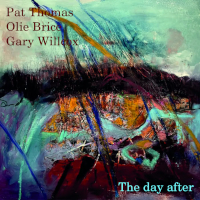 Pianist Pat Thomas joins forces with drummer Gary Willcox and bassist Olie Brice in a trio that balances spontaneous interaction with an instinct for form on The Day After. Their four communal inventions constitute the threesome’s first album, but such is their meld of immediacy and artifice that it’s unlikely to be their last. Long a stalwart of the UK scene, over the past decade Thomas has also been reaping his due Stateside, thanks especially to his tenure in the quartet Ahmed. Brice inhabits similar improvisational ecosystems, notably his quartet with Alexander Hawkins, Rachel Musson, and Will Glaser, but he also thrives in more structured settings, which is where Willcox, an alumnus of Stan Sulzman and Chris Biscoe, commonly resides.
Those affiliations illuminate the band’s approach. Even at their most abstract, there remains a palpable connection back to the jazz tradition. Thomas treats the piano as a percussion instrument, favoring insistent rhythmic patterns and ringing accents, which he constantly reshapes. Willcox proves equally direct. He leans towards a straightforward momentum, swinging either freely or in steady meter, alternately dovetailing or punctuating the pianist’s extemporizations. In such situations, Brice’s muscular pizzicato becomes the key voice, frequently furnishing the melodic lead. His embellishments and counterpoint give the trio’s surges both depth and intrigue.
Opening the disc, “A Thread Of Silk Can Cut Through Iron” stands as the outfit’s longest and most diverse portrait. A conversational start of rippling keys, assertive bass plucks, cymbal scrapes, and snare chatter establish a prolonged rubato passage. Eventually Thomas breaks ranks, adding well-turned propulsive figures that suggest he might be scrolling pages from the Monk songbook somewhere in his subconscious. Willcox latches into the repetitions fuelling increasingly dense and staccato exchanges. Brice then switches to bowed slashes that transforms the mood, presaging a reset that drives the piece to its conclusion.
Extended timbral interplay begins “A Strand Of Horse Hair,” as Brice’s vocalized arco moans vie with interior piano plonks and sudden snare attacks, before rhythmic primacy again declares itself. Likewise layers of unconventional textures – thumb rubs on wood, metal squeals, and bow bouncing strings – precede the rollicking bluster of the closing “Epigram.” Elsewhere Thomas settles into a rolling three-note motif on “The Caligrapher’s Blues,” evoking barrelhouse piano and prompting first a call and response with Willcox before Brice too supplies pithy rejoinders. Across the program such structural markers give the improvisations definition without diminishing their sense of discovery.
–John Sharpe
John Tilbury
At home: Domestic and archive recordings
Another Timbre at257x4
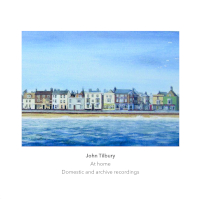 Where does one begin in diving into the music of pianist John Tilbury? As one of the preeminent performers of contemporary piano music, he has established himself as one of the key interpreters of the work of Morton Feldman, Cornelius Cardew (about whom he wrote a definitive biography), Howard Skempton, and Christian Wolff amongst many others. There’s his immersion into the late prose and radio plays of Samuel Beckett. Another inroad could focus in on his participation in the open-ended collective explorations of the Scratch Orchestra, founded in 1969 by Cardew, Skempton, and Michael Parsons. Though it existed for only a few years, Tilbury has remained close with and collaborated with many of the musicians from that time. Another tact would be to dive into the music he created as a member of AMM along with Eddie Prèvost and Keith Rowe or his longstanding duos with Rowe and Prèvost. Then there are improvised settings and special projects with musicians including John Butcher, Thomas Lehn, MIMEO, Bertrand Gauguet and Werner Dafeldecker.
Around 2018, Tilbury decided that he would end his performing career though he would perform a handful of times after that. It would be easy – and ill-considered – to view the six hours of music collected in At home: Domestic and archival recordings as an overview of Tilbury’s career. Instead, Another Timbre label head Simon Reynell, who has long supported and released Tilbury’s music, embarked on an ambitious project with the pianist. From 2018 through the spring of 2026, around the time of Tilbury’s 90th birthday, Reynell traveled to the musician’s home in Deal on the Kent coast a few times a year to record him playing piano and clavichord. As Reynell explains, “We recorded whatever John wanted to play at the time, and so assembled an unusual and varied collection of recordings ranging from [György Kurtág’s reworking of themes by 14th century French composer Guillaume Machaut] to new compositions sent by old friends from Scratch Orchestra days. Sometimes, if John was tired or in pain, we didn't record very much, and the visits became as much a social thing as a recording session ... In early 2026 – around the time of his 90th birthday – John decided that if we carried on much longer, he'd no longer be able to do justice to the music he was playing, and that we should stop.”
Upon listening to the resulting recordings, Tilbury suggested augmenting them with previously unreleased archival recordings, some going back to the 1970s. The resulting 4 CD boxed set along with two additional downloads is less an artistic survey and more the considered explorations of a musician revisiting and reflecting on decades of his creative endeavors. Some of the compositions go back to the 1950s, others were written for Tilbury over the course of the project. While most are solo readings, there are also collaborations with others, notably a duo with Keith Rowe from 2004 with a rare appearance of Tilbury on organ. The set also provides an invaluable opportunity to hear him playing his clavichord (a keyboard instrument which utilizes small metal blades to strike resonant paired metal strings).
What informs the music across the entire set is Tilbury’s focus and mastery on what he refers to as “the art of touch” – an acute attention to the dynamic quality along with attack and decay of piano, carrying through to his clavichord and organ playing. In an interview on the site Fifteen Questions, Tilbury reflects on that notion of touch, observing “touch is of the essence. It is the dialectic of, on the one hand, the extreme fingertip sensitivity and control, embodying the notion of intention – and on the other hand the recognition, through an awareness of the contingent, of the ultimate impossibility, indeed the undesirability of control. Intimately, at close quarters, as it were, the performer experiences the vulnerability of intention and the inevitability, and acceptance, of failure. And this ‘imperfection’ gives the music its unique quality. Again, we are reminded of Beckett's famous dictum: ‘No matter. Try again. Fail again. Fail better.’”
Christopher Hobbs, Michael Parsons, and Dave Smith, Tilbury’s collaborators from Scratch Orchestra days, provided a number of compositions for the project. Tilbury requested Hobbs’ Five Pieces for Clavichord in 2023 as he was continuing to immerse himself in the instrument’s sonorities. In composing, Hobbs had assumed that the clavichord was tuned in equal temperament and was pleasantly surprised upon hearing the results. Tilbury adroitly exploits the just intonation and steely timbre of the instrument for these studies of jangling angularity. Parsons has two contributions, “Oblique piece 25” for clavichord and “Salient” for piano, written for Tilbury’s 90th birthday, a pensive traversal of intersections of intertwined melodic kernels. An archival live recording of Smith’s “Al Contrario,” based on counterpoints of 19th century French composer Charles-Valentin Alkan’s darkly moody minor-key compositions, is one of the highlights of the recording. Over the course of 34 minutes, Tilbury probes the sedate, open trajectory with a contemplative balance of attack and sustain as crystalline upper-register notes and clusters ring out against the dark sonorous low-register motifs resounding in the reverberant hall.
No set of Tilbury’s performances would be complete without performances of pieces by Skempton, Cardew, Feldman, Wolff, and Beckett. Tilbury recorded Cardew’s thorny “Volo Solo” for the overview of the composer’s piano music from 1959-1970 he released on the Matchless label. For this set, an archival live version, recorded in 1970, provides a reading that pushes at the complexities of the piece, seizing on the underlying “undesirability of control.” The inclusion of Cardew’s “Bun No.2 for Orchestra” arranged for two pianos by Dave Smith from a 2002 performance by Tilbury and Tania Chen is of particular interest. Here, the composer combines his utilization of indeterminate graphic scores with traditional staff notation, employing pages from “Treatise” along with specified approaches to the formal relationships of harmonic intervals, setting up a structure that strives for an amalgamation of the two approaches. In their duo reading, Tilbury and Chen navigate the clustered intervals and arpeggios across stop-start pauses and flurries, imbuing the intricacies with poise and lucidity.
Feldman is represented by two works on the set. One is an unused take of “Piece for Four Pianos” recorded for the Morton Feldman Two Pianos release on Another Timbre performed by Tilbury, Philip Thomas, Mark Knoop, and Catherine Laws. The other is an arrangement of “Madame Press Died Last Week at Ninety” – originally written for ensemble – which has been rarely recorded. An homage to Feldman’s childhood piano teacher, Tilbury seizes on the slow, spare repeated notes the piece is built around, letting each phrase sound and decay with serenely evolving contemplation. Wolff’s music appears twice, including an archival recording of “For Pianist” from 1970 and “No Security Rope,” for clavichord which was composed in 2020. On the later, Wolff takes advantage of the flexible temperament of the instrument, plying skewed clusters that move in fits and starts across the 11-minute piece. Tilbury negotiates it with an assured command, interjecting phrases of prepared piano to expand the timbres. Beckett’s texts are utilized on two pieces; one, an archival recording by Tilbury for organ and voice and another by Taylor for clavichord and voice. In both, Beckett’s singular musings on aging provide a keen addition to the impetus of the set.
Tilbury is one of Howard Skempton’s foremost interpreters and five of the composer’s compact solo piano studies, each written since 2004, is an astute way to make that case. Tilbury’s attention to the sounding and decay of each of the notes and the spaces between reveals the sonorously haunting harmonic choices. Skempton’s “24 Preludes and Fugues,” one of the bonus downloads accompanying the boxed set, is another particular highlight. Over the course of 24 minutes, the cycle, written for piano but performed here on clavichord, begins in C major and ascends the chromatic scale with economical resolve, transforming and blurring tonal centers within each of the sections. Tilbury’s choice to perform the work on the clavichord complements the shifting tonal nuances of each of the component sections adding slight vacillations to Skempton’s harmonic abstractions. Don’t miss out on downloading this!
A younger generation of composers supply works as well. British composer Mark R. Taylor’s five “Nocturnes”, provide an effective extension of the pianist’s exploration of euphonious abstractions. In the pianists reading of Taylor’s pieces, themes are methodically doled out, letting notes pool and then dissolve with muted poise, drawing out the meditative harmonic inner-logic of the pieces. John Lely, who studied with Tilbury at Goldsmiths, University of London, contributes “Sycamore,” written specifically for this release. Over the course of 42 minutes, the chiming of paired notes sound out like pealing bells in an inky darkness. Here, in particular, Tilbury’s sensitive control of attack and decay across the austere structure is spellbinding. Contributions by former students Catherine Kontz and Erika Fox as well as Canadian composer Linda Catlin Smith round out the set.
Tilbury is a consummate collaborator and archival recordings with Sebastian Lexer, Klaus Filip, and Keith Rowe are incisive inclusions. Lexer’s electronic modulations were integral to Tilbury’s recording of John Cage’s “Electronic Music for Piano” on the Another Timbre release Lost Daylight and Beckett’s radio piece “Cascando” on Plays Samuel Beckett on Matchless. “For Samuel Beckett,” included here, is an improvisation performed live by Tilbury and Lexer, based on the music Tilbury had written for the Beckett piece. Over the course of the half hour performance, Lexer’s piano+ (a Max/MSP application he utilizes for real-time processing of his piano) provides reverberant scrims that color Tilbury’s spare piano voicings. Tilbury has stated that “in a sense my attitude towards the piano, towards the musical tone, towards the sound of the piano, is reflected, I hope, in the way I read Beckett’s text, And vice versa.” Even without the recitation of the text for “Cascando,” that sense of prescient pacing, and phrasing carries through the performance. The confluence of Tilbury’s ringing tones and their natural decay and Lexer’s subtle electronic shimmers and organ-like overtones provides a gripping listen.
Tilbury’s collaboration with Klaus Filip, “Dust and piano,” stands out in the collection in that the pianist sticks entirely to playing inside of the piano. Filip recorded what the liner notes describe as “dust sounds” which were sent to Tilbury and Reynell. The pianist’s 16-minute improvisation was recorded and the two were mixed together though it’s unclear as to whether Tilbury listened to the recording before recording his contribution. The electronic grit and the virtuosic inside-piano abrasions, scraped and plucked strings, diminutive percussive clangs, and sustained decay move in tandem and the mix allows them to accrue with a shrewd balance.
Keith Rowe is the musician Tilbury has collaborated with the most. Rowe recalls that the two performed a duo version of Cardew’s Treatise in 1965, before AMM was formed. While they have performed and recorded together as a duo multiple times since then, the untitled improvisation included in the set, from a 2004 performance at Holy Trinity Church in Leeds, is the only recorded instance of Tilbury playing organ in that setting. In the liner notes, Rowe recollects that he has often played this piece to visiting musicians, and no one has ever identified it as Tilbury. Starting with low frequency thrum, wafts of static textures and piercing tones emerge and then are subsumed. These two are masters at patient development and this is an exemplary example of the way they let things sit with imperturbable reflection. Over the course of 28 minutes, Rowe injects crackles, radio grabs, oscillating flutters, and textural shards in tandem with Tilbury’s slowly shuddering waves of organ, driving mercurial, crescendoing dynamic waves that ebb and flow with nuanced, textural refinement.
Few musicians in the later years of life are given the opportunity to embark on an expansive project like At home: Domestic and archive recordings. And even fewer benefit from the support and commitment of one that spans eight years. It is a tribute to Tilbury’s artistry that he has maintained such deep connections to composers whose work he has performed and who wrote work specifically for him as well as a pool of consummate musical collaborators to work with and galvanize him. The fact that close to half of the 34 pieces in this set were composed or created over the last decade – eight over the last two years – is evidence of that continued commitment. Simon Reynell’s deep dedication to documenting and championing musicians like this and putting out deeply considered sets like this one is also notable. This is one of those monumental sets that deserves attention and one that will continue to reveal new facets over repeated listens.
–Michael Rosenstein