Moment's Notice
Reviews of Recent Media
(continued)
Satoko Fujii
Bunker Ulmenwall Orchestra
Libra 218-083
 Satoko Fujii’s Bunker Ulmenwall Orchestra resurrects a 2014 concert from the German town of Bielefeld that that reaffirms the Japanese pianist and composer’s knack of shaping compelling performance. When Fujii heard the long-forgotten recording, she immediately sought to release it, and the resulting two-CD set vindicates that decision. The Orchestra contains a mix of seasoned and up-and-coming musicians, who Fujii deploys to striking effect on a program which centers on a rendition of her large-scale composition “Shiki,” along with charts by two orchestra members and further originals by Fujii and her partner, trumpeter Natsuki Tamura.
What sets apart her writing for large ensembles is the multitude of ways she integrates tightly scored passages with looser interludes, freely improvised small groupings, and encouragement for soloists to push at the bounds. Perhaps the only band that comes near is Barry Guy’s London Jazz Composers Orchestra, although Fujii’s music encompasses a wider palette, as happy to trash conventions (even her own) as to honor them. Given that Fujii leads numerous orchestras worldwide, and this is her 24th album in the format, her success in harnessing even unfamiliar collaborators should not surprise.
With “Shiki,” which occupies the entire first CD, Fujii achieves her aim of reaching for “something beyond,” something that suggests “the seasons of human life.” Fujii’s Orchestra New York recorded a slightly shorter version on the 2014 album of the same name. But because the participants themselves help shape delivery in Fujii’s universe, this Bunker Ulmenwall Orchestra outing not only stands apart but ranks equally highly. Counter intuitively despite the firepower on hand, it starts with a drone, initially distant but gradually increasing in volume until Lucy Liebe’s searching electric guitar enters. Thereafter predetermined and spontaneous parts crisscross and dialogue through a series of peaks and lulls, all fuelled by the twin percussion of Juri Beier and Karl Godejohann.
Fujii devises opportunities for everyone in the 17-strong orchestra to bask in the sun, whether unaccompanied, in small permutations, or against an orchestral backdrop. Although necessarily brief, there are several arresting solos. Among them the lyrical then wheezy reveille by trumpeter Robin Stüwe that emerges, amid brassy interjections, from an energetic drum duet. Then later an elliptical saxophone foray stands out, its undulations become increasingly serrated, before wailing atop a kinetic orchestral line. One of Fujii’s most triumphant soaring themes appears in various guises throughout, adding continuity to the piece’s architecture. A final diminuendo to silence echoes the mysterious beginning, and evokes the finite human span.
On the second CD Fujii shares the conductor’s baton. Bass saxophonist Andreas Kaling leads the crew on his “Yamantaka,” an exercise in orchestral power which intersperses artful pauses between heavy riffs and primal thud. It provides the frame for a pair of duets: the first between Matthias Klause’s plinking piano and the skittering electronics of Joel Köhn; and the second between Liebe’s slashing guitar and roiling drums. Its directness offers a refreshing contrast to more elaborate structures elsewhere.
Tamura’s “Jasper” also avoids intricacy, situating bucolic alto saxophone melodicism above the rise and fall of collective textures. Saxophonist Luise Volkmann’s “Antischwarm” hews closest to tradition, combining big band dash and kicking bass, illuminated by Kaling’s rampaging bass saxophone. Fujii returns for “Gen Himmel” which ends the album with a reflective melody both serene and consolatory, drifting over a litany of sighs, slurs and beeps, like evening mist forming over a lake.
–John Sharpe
Henry Grimes + Marzette Watts
The Call
Thingamajig 2511
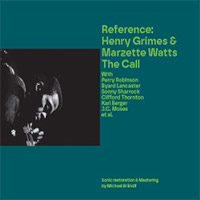 This one’s a vital blast from the past combining two sessions with the great bassist Henry Grimes. The first six tracks, from December 1965 and originally released as The Call under Grimes’ name, feature the bassist along with clarinetist Perry Robinson and drummer Tom Price. The remaining trio of tunes is from just under a year later, with a righteous octet: Grimes, Watts (on tenor, alto, and bass clarinet), Byard Lancaster (alto, flute, and bass clarinet), Clifford Thornton (trombone and cornet), guitarist Sonny Sharrock, vibraphonist Karl Berger, drummer J.C. Moses, and Juni Booth adding more bass for the lengthy final track.
“Fish Story” opens with a few seconds of furious arco before mad swinging and churning from all considered. Robinson is always a joy to hear, and is able to navigate the shifts into the mournful, lyrical portion of this track so well. Grimes’ “For Django” is affecting and threnodic. Robinson again extends some beautiful melodies at the track’s center before the trio is off to the races again, sounding so great in the middle of the turbulent times and so advanced. Unlike a lot of overly dense blowing sessions, these performances have considerable space and dynamic range. There’s a kind of stuttering urgency to Robinson’s “Walk On.” “Saturday Night/What Th’,” “The Call,” and the spritely, jagged “Son of Alfalfa” resemble some of the music that John Carter and Bobby Bradford were getting into out west.
Where the trio has a consistent melancholia running through it, Watts’ session is more boisterous, and a bit restless in places. The twang of early Sharrock and the ornate lines from Berger are perfect accompaniments to the horns, not least from Watts and Thornton on the brisk “Ia.” This is proper fire music here, righteous as it gets but also filled with gorgeous unisons (on “Geno,” for example). There are points where space opens up for duos or trios, including some really compellingly cosmic playing from Sharrock. But the full group often sounds delighted to pull the sound apart like taffy. Finally, the long “Backdrop to Urban Revolution” might not sound exactly like its subject, but there is a whooping, edgy quality to it that’s very compelling. Guttural and subterranean here, caterwauling there. Moses is so compelling as he guides shifts in tempo, feel, and dynamics. Particularly impressive is a long middle section where his pattering swing creates a structure for flute, bass clarinet, and vibes. Perhaps fittingly, the piece ends in a dark, ominous swirl, with slightly martial percussion flirting once more with the title.
Any fan of this era of playing should investigate promptly. It’s terrific music, six decades on.
–Jason Bivins
Hilary Jeffery
Green Prism
Discus 1970CD
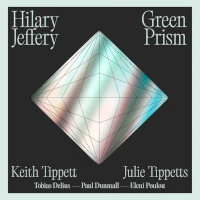 On Green Prism, Hilary Jeffery boldly recasts compositions penned by Keith Tippett over several decades. Jeffery had the prerequisite proximity to meet the challenge, having first met Tippett in the early 1990s at one of the pianist’s workshops at Dartington College of Arts, and then performing with Tippett’s Tapestry Orchestra at the 2002 Festival International de Musique Actuelle de Victoriaville. Relocating to Berlin, Jeffery lost contact with Tippett until 2017, when he attended a concert by the pianist and Louis Moholo-Moholo. By then, Jeffery was a member of the brass trio, Zinc & Copper; though their music was normally outside the usual parameters of jazz, Jeffery queried Tippett about writing for the ensemble. Soon after agreeing, Tippett began sending Jeffery initial sketches, which the trio would record, giving the composer necessary feedback for honing the material. Funded by the Berlin Senat and the German Musikfonds, and partnering with Jazzkeller 69 (an important presenter of free jazz in the GDR), Zinc & Copper presented Winter’s Welcome in February 2019.
Although he made a brief return to performing after his 2018 heart attack, Tippett’s health was already in decline, and he was unable to travel to Berlin for the premiere. When he passed nearly a year and a half later, Jeffery resolved to record Winter’s Welcome, playing all the parts himself. He began recording in 2021, but by 2024 he reimagined the project, expanding the ensemble and the repertoire, bringing in Julie Tippetts, Paul Dunmall, and synthesizer player Eleni Poulou, to build out tracks. He then enlisted Poulou and Tobias Delius for final touches in ‘25. Despite this method, the music has the feel of a live performance given by an ensemble whose commitment to the material is blossoming in real time.
While he took liberties in arranging some of the pieces included in Winter’s Welcome and others among the last Tippett composed, Jeffrey’s fastidiousness as a flame-keeper yields a program that goes to the essence of Tippett’s concert music, an English tonal gravity, deep, burnished, and moving. His brass tracks elicit especially powerful performances by Tippetts and Dunmall. While the saxophonist’s solos are brimming with his signature centrifugal energy, they nevertheless take a back seat whenever Tippetts sings. Green Prism ranks among the finest recordings of her singular career; her voice remains astoundingly lithe, her projections of strength and vulnerability masterfully nuanced, and her soaring altissimo no less thrilling than it was decades ago.
Though they may seem like out-of-the-box choices, the Berlin-based Poulou and Delius have long-standing associations with Jeffrey – Poulou through ETUDE, a Fluxus-focused ensemble, and the song-oriented band Organza Ray; while Delius and the trombonist have worked together intermittently for over twenty years. Though they are well placed and considered, their contributions are ultimately secondary on Jeffrey’s canvas, the primary elements being Keith Tippett and Julie Tippetts.
–Bill Shoemaker
Michael Marcus Quartet
Next Stop Down
ESP Disk ESP5112
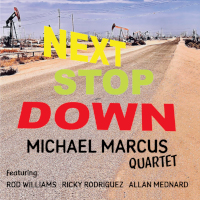 Michael Marcus is one of the too many cases of worthy artists who have captained sturdy recordings over decades, often with bona fide jazz legends – in his case, Jaki Byard, Denis Charles, and others – while remaining on the margins. The annotator of one of his earliest albums classified the music as “Free Jazz;” however, that label has to be stretched beyond the tearing point in regards to the totality of his work. It certainly cannot be applied to Next Stop Down, an engaging album of trio and quartet performances, whose compositional north star is Thelonious Monk.
Marcus’s status as an outcat is partially attributable to foregrounding on most of his recordings the stritch and the manzello, mutant saxophones introduced to the general jazz audience by Rahsaan Roland Kirk. He has also championed the conn-o-sax, an altered English horn. Surprisingly, none are employed on Next Stop Down; on most of the tracks, he plays taragato, which Peter Brötzmann used for markedly different purposes. In Marcus’ hands, the soprano-register Hungarian horn is surprisingly lithe and capable of capering lyricism and feisty swing. He also plays soprano and tenor saxophones with the authority he established years ago.
Monk’s music is like an exquisitely cut diamond. The transparency of the facet that is his impishness allows one to see through to the facet of his sentimentality; looking through the facet of his discontinuity, to use André Hodeir’s term, the facet of torchbearer can be seen. Marcus has a sense of this. Consciously or not, his writing not only has glints of this totality, but also how previous composers distilled aspects of Monk’s music to their own ends. Due in good measure to pianist Rod Williams, “Mr. Monk Time” has the lope and the pivots of early Andrew Hill, while “That Far is NOW,” one of the trio tracks with bassist Ricky Rodiguez and drummer Allan Mednard, is built on the repetition of a pungent phrase, a gambit that was Steve Lacy’s stock and trade.
Next Stop Down is a welcomed reminder of Michael Marcus’s artistry – and Rod William’s, too.
–Bill Shoemaker
Jason Moran + BlankFor.ms + Marcus Gilmore
Shards
Red Hook RH1009
 On Shards, pianist Jason Moran, electronic musician BlankFor.ms (Tyler Gilmore), and drummer Marcus Gilmore blur the distinction between acoustic performance and electronic transformation. Rather than treating electronics as a post-production enhancement, BlankFor.ms captures fragments of Moran’s piano playing and Gilmore’s drumming in real time – accelerating, reversing, granulating, and immediately feeding them back into their improvisations. The trio is constantly responding to echoes of its own recent past, so the music feels both spontaneous and self-aware, as if it is being composed and remembered simultaneously. Building on the foundation of 2023’s Refract, Shards sounds more confident and spacious, with acoustic and electronic elements coexisting as equals in an evolving musical conversation rather than as separate aspects competing for attention.
The album’s centerpiece is the five-part “Shard” suite, and each variation explores a different balance between melody, rhythm, and electronic intervention. “Shard I” opens with weighty grooves and rumbling piano figures but does not stay static for long; processed loops begin to multiply, and the piece gradually brightens into luminous lyricism. “Shard II” is more restrained, built from spacious piano phrases, shimmering cymbals, and subtle electronic drones that slowly reveal an understated melodic beauty. “Shard III” begins as a study in percussion and texture, with the trio emphasizing timbre, resonance, and pulse before the music opens into one of the album’s most understated melodic passages. “Shard IV” is the most volatile, transforming elegant piano phrases into explosive exchanges where blistering cadences, fractured rhythms, and surging electronics repeatedly collide and recede. “Shard V” offers an unexpectedly graceful resolution, pairing stately piano chords with softly looping electronics in a hopeful, elegiac meditation.
Throughout the suite, Moran remains the principal melodic voice, shifting effortlessly between rhapsodic lyricism and angular abstraction, while Gilmore functions as both rhythmic anchor and instigator, constantly redirecting the music’s momentum. BlankFor.ms avoids simply decorating the performances; instead, he becomes an active improviser whose processed returns often blur the boundaries between analog and digital. That blurring is crucial to the album’s success. A phrase may appear to be heading toward resolution, only to be refracted into a loop, stretched into a haze, or returned in a new rhythmic shape. The resulting music occupies an unusual space between composition and improvisation, where motifs continually dissolve, reappear, and evolve without losing their identity.
Three non-“Shard” pieces push the trio’s experiments in different directions. “Tape Loop A Echo” foregrounds dense electronic textures, forceful drumming, and fragmented piano figures on the verge of overload. “Barbershop” similarly develops an angular, groove-driven pulse that gradually dissolves beneath abrasive loops and controlled rhythmic chaos. In contrast, “And the Pieces Are Falling” provides one of the album’s quietest moments, with spacious piano lines, atmospheric electronics, and restrained percussion combining to create a mournful stillness. Together, these tracks function as alternate views of the same process, showing how the trio can move from density to restraint without abandoning its central concept.
What ultimately distinguishes Shards is the seamless integration of technology into the improvisational process. The electronics become integral participants, preserving fleeting gestures only to return them altered moments later. That gives the album its distinctive identity – every sound carries the trace of something that has just happened, even as it suggests something yet to come. Challenging but rewarding, Shards demonstrates how acoustic improvisation and real-time electronic processing can merge into something neither could achieve alone by transforming loops, echoes, and digital manipulation into an expressive language all its own.
–Troy Collins