Moment's Notice
Reviews of Recent Media
(continued)
Vanessa Rossetto
The Professional
ErstSolo ES011-2
 “... I’ve been recording for days, and then I bring all the recordings home, and I go through them and make notes and cut them all up and reassemble them in some way that they have some kind of, you know, narrative structure, make something out of all the things that are happening in the world.” In 2026, this off-the-cuff micro-manifesto, spoken by Vanessa Rossetto and concluding “This is a Recorder” from her 2014 album Whole Stories, remains true but incomplete. The Professional, her third and newest double solo album for Erstwhile, is the latest chapter in what has evolved into a continuing story at once hilarious, painfully direct and still elusive, even mysterious.
The facts are both necessary and superfluous. Around the time Rossetto traveled south to help her mother downsize and pack up to move into assisted living, a process documented on Pictures of the Warm South, Rossetto was invited to perform a series of concerts in Europe, a venture her mother insisted should happen and which came to fruition in the spring of 2025. The Professional documents the tour. Reciting and serializing these events is akin only to playing the right notes in the right order. Nuance is all but avoided, absolutely inexcusable as Rossetto’s work is loaded down with it, individual and community occurrence collaborating in interwoven layers. Her compositional method has been a unified corpus in development at least since Mineral Orange, her first album for Graham Lambkin’s KYE label a decade and a half ago. Intentionality emerged even more clearly with the use of her actual voice and the voices of her loved ones, particularly Toni, her mother, whose distinctive British accent opens the second piece on Whole Stories, the main voice on the harrowing You and I are Earth and to whom The Actress is dedicated.
The most difficult, and rewarding, element of Rossetto’s compositions involves the way one event connects to the next. Like the “themes” opening and prefiguring each of the three most recent albums’ trajectories, strict chronological time is supplanted by conjoined but non-linear moments in deep exploration and juxtaposition, every-day events shifting in size, weight and sequence as bits of them coalesce, loop and sustain. After the riotously funny “profesionali tema,” the “theatrical” number that opens The Professional, a wry look at a field recordist on the move abroad amidst her musical forbearers, we are plunged into a performative experience and just as quickly removed, leaving space for Rossetto to narrate the tour’s genesis amidst an amalgamation of event and commentary. “Stop recording me!” an obviously incensed voice orders as the accumulating palimpsest progresses, humorous amidst the swirling environmental shifts and juxtapositions. They form a score, a constantly evolving quilt of leitmotifs fashioned of environments in which the recordist’s presence is always felt. Vehicles beeping as they reverse bolster wrappers opened and discarded or the obviously buried microphone in conflict with tightly packed items that swing and pulse in time to the narrator’s footsteps. The stereo spectrum becomes a plaything, a landscape against which the context of confluence unfolds in mélange. “It’s not professional and it’s not ethical,” a voice intones with certainty amidst the busy thrum and swagger, environmental music often drifting in and out of focus. All notions of outside and inside shift without warning, but when present, they are as certain as that authorial voice. “Should I test something?” The droll moments of cause and effect in disarray are plentiful and always a shock. “That should work now,” the narrator asserts, followed by a plunge into silence and then into what sounds eerily like a sub-aquatically hallucinatory world. With “The Amateur,” The performance itself finally regains prominence. The net result is that the intersecting and blurred lines separating art from life, public performance from the performative actions of living, become less visible.
There is something dream-like, consequence-defying, in the way the album unfolds. The events themselves and their ghosts, their microcosmic implications, are augmented and inflated even as they threaten to disappear. In “belle époque,” Rossetto describes a concert’s assemblage and song-gathering concept to the audience and invites them to participate. Immersed in an ocean of voices, present and internet-harvested, set to external accompaniment in whose sweaty poly-oblivion, all notions of antecedent and consequent are laid waste. A particularly mellifluous rendition of “All Star” arrested these ears, unfurling lazily against what sounds remarkably like the non-sequitur of a rubber duck. Bells tinkle and recede against a backdrop of soft-focus and jump-cut edits, Ivesian densities describing the ebb and flow of simply walking down the street but all via what sounds “public,” as if it were all being broadcast. Completely unanticipated is the track’s slow, glorious, and achingly nostalgic fade to black.
It would be impolite, unprofessional, to give away the album’s many secrets. Webs and bridges of plunderphonics pervade, affording stream-of-consciousness familiarity at critical moments. Sonic signifiers precipitate those junctures, like a marble rolling across the soundstage, or a seatbelt warning capturing attention. Through it all, the voice of the narrator, the actress, the amateur become professional, emotes, elucidates, divulges. “I’d like to first apologize if I seem low-energy. I feel kinda sick, like I’m gonna pass out, but here we are.” Her emotive states contradict and meld with the singular soundscapes she has been refining for nearly twenty years, and in doing so, each moment takes on a quality larger than itself. A lot of the landscapes underpinning the events involve crescendoing loops, but that’s only contextual. Like ocean waves or an engine augmenting flight, each heaving exhortation contains multitudes as viewed through a single lens. All comes to its own fruition with “The Interview” and “The Professional,” generous and lavish souvenirs. The album’s concluding minutes are among its most effective, and the theme’s quips and allusions, courtesy of lyricist Michael Garin, who also swings the piano supporting Mardie Millet’s flashy delivery, get better with each listen. Rossetto’s music grows out of itself while settling into itself, its soundtrack deeper and its cast of sonic characters achieving more certainty as the autobiographical play continues. Like the Dylan song proclaims, “It’s life and life only,” but what an artistic vision of life it is!
–Marc Medwin
Valentin Silvestrov
Moments of Silvertones
Kyiv Dispatch #6
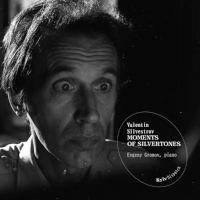 With each usage, or misusage, of the phrase “Avant Garde,” a box is built and another dismantled. The resultant inclusions and exclusions leave no room for permeability, particularly unfortunate where the music of Ukrainian composer Valentin Silvestrov is concerned. The common story is that he turned away from the Avant Garde he and several of his compatriots pioneered, but Moments of Silvertones, performed by pianist Evgeny Gromov on the Kyiv Dispatch label, demonstrates that there is much more unity to Silvestrov’s music than first meets the ear. To support this vantagepoint, this 2024 recording, released as a 2-LP set or download in anticipation of Silvestrov’s 90th birthday in 2027, features works spanning the years 1961-2006, neatly divided by 1975’s second piano sonata.
While Alexei Lubimov is usually the pianist credited with bringing international recognition to Silvestrov’s music, Gromov has long championed the composer, performing a memorable recital in 1998 for his 60th birthday. After Russia’s 2022 invasion of Ukraine, when Silvestrov fled with other refugees and took up residency in Berlin, Gromov, who remained in Kyiv, began a series of recitals at the vacant Khanenko Museum. The programs lasted over a year and expanded into a space for dialogue with the composer over skype meetings. Silvestrov’s involvement affords these traversals both authority and urgency.
The first LP represents Silvestrov’s early period, when his allegiance to other gamechangers like Boulez, Messiaen, and Dutilleux was most apparent. Unlike Penderecki, Silvestrov’s soundworld exhibited a degree of introversion, even at its atonally spikiest, as with Five Pieces (1961). It twitters like the insects informing Scriabin’s final piano sonata, and, like Boulez, exhibits a coloristic beauty too infrequently associated with anything lacking tonic and dominant. The final piece from Schoenberg’s opus 19, the air-from-other-planets tribute to Mahler composed in 1911, is an obvious precedent for the mystical sustains and long pauses as tones waft and alight, but the brief centers Silvestrov evokes demonstrate a post-Wagnerian approach to the ever-present tonal question. Even in 1961, implication imbues Silvestrov’s take on serial procedure, a fact Gromov emphasizes to gorgeous effect. His instrument and a full recording allows him to caress each sonority, demonstrating the composer’s divergence from the Webernian path. In the retrospect, this program allows the two seemingly diatonic harmonies at 4:42 to point the way toward a future less about disjuncture than distillation and refinement.
While certainly not Silvestrov’s initial foray into tonality – the first string quartet, much of it centered around G major, preceded it – the second piano sonata (1975) bridges many ideological gaps. The two chords at 0:19 of the one-movement piece are harmonically sequential, despite their context, and their repetition and transposition beginning at 0:40 triggers a small-scale version of the memory experience that would become so important to the composer in later years. In fact, the composer coming most to my mind is Medtner, so unified are form and structure, despite a universe of sonic diversity. Gromov’s pedaling and resultant melodic and harmonic contrasts are breathtaking in their subtlety. His is a tighter rendering than the Lubimov recording for Erato, from which I learned the piece, extremely important given the radical shifts in perspective and sound as the movement nears conclusion. Palms in direct contact with the bass strings, muting, harmonics in motion, and intersecting registral planes roar with a restrained power I’ve heard in no other performance, but the C-major section near the end teems with subdued life and sublimated energy. The Kyiv Dispatch production exceeds Erato’s in power and clarity, and even Simon Smith’s version, a full if slightly distant Delphian piano capture, now seems slightly anemic.
The two-chord sequence, appearing throughout the sonata and at its conclusion, is prophetic, not in and of itself but in the layered ways Silvestrov approaches ideas associated with memory. Reminiscence and its creative associations take on special import in Silvestrov’s recent music, so much so that his bagatelles begin with a new opus 1. This could not be expressed better, or more poetically, than by album producer Sasha Andrusyk in his liner notes. He calls Silvestrov’s compositions from the 2000s and beyond a “late language of memory, postlude, and distance.” Silvestrov crafts moments of reference even as they fade into something like impalpability. Yes, the tonal implications nascent in the second piano sonata are foregrounded here, but the language is diatonic mainly in a post-Wagnerian sense, that is of parenthetical center rather than of completely established framework. The first bagatelle of Opus 1 moves from C major to E major before the opening material repeats, doing so directly, abruptly returning to the original key. The piece ends similarly but after a sustain in A flat, conjuring shades of late Liszt. Moments demonstrates the same modulatory third-based relationships, and the motivic material is similarly aphoristic. Miraculously, Gromov plays these later miniatures so that they are of a piece with Triad and the second sonata, instants caught in the vicissitudes of time and nostalgia. Gromov’s genius is that he plays all of the music with an eye toward the seeming opposites of composition and improvisation, not all that differently from the composer’s pianism, which can be heard on his Bandcamp page. Gromov, who has recorded much music of the Ukraine Avant Garde, is the perfect pianist for the project, and I hope there will be more to follow. It would be unreasonable to hope for a complete piano works set, but there would be no one more qualified and better suited to approach it. The music and commentary coalesce to place Moments of Silvertones among the most satisfying Silvestrov piano albums to date.
–Marc Medwin
Harry Skoler
Echoes
Red Brick Hill RBH 2131
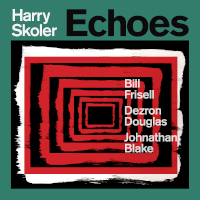 Memory is the organizing principle of Echoes. After surviving a catastrophic cardiac event in 2018 and confronting the emotional aftermath through therapy, clarinetist and Berklee professor Harry Skoler found himself reevaluating not only his career but his music. Encouraged to simultaneously embrace joy and trauma by his therapist, he abandoned the Benny Goodman quartet-inspired format that defined his earlier recordings in favor of a more personal approach. As recalled by Skoler in his entertaining liner notes, each of the album’s nine main compositions reflects a formative encounter with one of the musicians who helped shape his artistic identity – Bill Evans, James Williams, Rahsaan Roland Kirk, Marian McPartland, Teddy Wilson, Benny Goodman, Jimmy Giuffre, Lionel Hampton, and Miles Davis. More than just conventional tributes, these impressionistic recollections transform remembered conversations and lasting impressions into richly textured musical portraits.
Produced by fellow Berklee professor and tenor saxophonist Walter Smith III, Echoes continues the documentation of Skoler’s artistic reinvention, begun with the Mingus dedication Living in Sound (Sunnyside, 2022), and the fourteen-part suite Red Brick Hill (Sunnyside, 2024). Smith encouraged Skoler to work with a younger generation of musicians, resulting in a quartet featuring guitarist Bill Frisell and the venerable rhythm team of bassist Dezron Douglas and drummer Johnathan Blake, who both played on Red Brick Hill and together in Blake’s own Pentad quintet. Their chemistry gives Skoler’s carefully constructed writing remarkable flexibility, allowing the music to move naturally between composed elegance and open-ended improvisation. Skoler’s clarinet playing acknowledges tradition without being confined by it, balancing lyrical formalism with acerbic spontaneity. With a warm, conversational tone that frequently erupts into gruff cries, squeals, and moans, he draws as much from the expressive vocabulary of post-Coltrane saxophonists as from the swing tradition that first established his reputation.
The compositions evoke their subjects without resorting to mere imitation. “Study in Orange (for Bill),” inspired by Bill Evans, unfolds through transparent harmonies and gently elastic rhythms, with Skoler’s plangent clarinet floating effortlessly above Frisell’s luminous accompaniment. “Everything’s Cool, Everything’s Cool! (for Rahsaan)” recalls an awkward teenage encounter between Skoler and Rahsaan Roland Kirk through fractured melodies, restless rhythmic shifts, and moments of exhilarating abstraction, including Frisell’s use of backward loops and pedal-warped single notes. “Waiting Patiently (for Benny)” evokes Jimmy Giuffre more so than Benny Goodman, using a deceptively simple melody as the foundation for an expansive meditation in which Skoler’s increasingly oblique solo intertwines with Frisell’s understated lyricism.
Other numbers prove equally rewarding. Highlights include “Marian (for Marian),” which conveys Marian McPartland’s thoughtful elegance with drifting melodic fragments and subtle harmonic colors, while the nearly ten-minute “Thank You (for Teddy)” unfolds with extraordinary patience, allowing tempos, textures, and emotional shades to evolve organically without ever sacrificing the composition’s identity. The funky “Never Played in Syracuse! (for Miles)” avoids stylistic imitations of Miles Davis, instead offering an uplifting, harmonically rich setting that briefly allows Frisell to venture into a more electric, distorted sound world.
Threaded among these larger works are five concise interludes – “Evocation,” “Reminiscence,” “Counterpart,” “Allusion,” and “Overtone” – all written by Skoler and Smith. These brief pieces function as reflective pauses between portraits. Rather than interrupting the narrative, they reinforce the album’s conceptual theme, serving as transitional breaks within a larger autobiographical suite.
What ultimately makes an album where individual and musical histories are inseparable so compelling is emotional honesty. The musicians who inspired Skoler become landmarks within a broader story of survival, gratitude, and artistic renewal. The echoes that resonate throughout the recording are of personal experiences with celebrated artists that continue to shape the present, making Echoes one of the most thoughtfully realized statements of Skoler’s career.
–Troy Collins
Dave Soldier
Vipers At The Onyx
Bright Shiny Things BSTC-0233
 Dave Soldier’s Vipers at the Onyx is an orchestral portrait of a composer whose career has consistently ignored stylistic boundaries. Performed by the Prague Filmharmonic Orchestra under Adam Klemens, with Grammy nominated violinist Curtis Stewart as primary soloist, Vipers at the Onyx is the first album of symphonic works by Soldier, drawing on a wide array of jazz, Latin music, Korean traditions, and contemporary classical techniques. At its core is the world premiere recording of Stuff Smith’s Unfinished Concerto: Music Starts When Words Leave Off, a fascinating collaboration across time between Soldier and the pioneering jazz violinist Stuff Smith.
The concerto originates from a six-minute tape-recording Smith made in the early 1960s of a handful of themes intended for a future violin concerto that was never realized. Decades later, Soldier was given the tape and transcribed and expanded those fragments into a seventeen-minute orchestral work, adding his own motifs, harmonies, and arrangements, while remaining faithful to Smith’s innovative aesthetic. Soldier’s orchestration is vivid and colorful, full of warm brass sonorities, shimmering strings, and distinctive woodwind writing. The concerto is neither reconstruction nor imitation, but a living dialogue between two adventurous musical minds that emerges not simply as an intriguing historical curiosity but as a substantial and engaging new work. But what makes the concerto especially compelling is hearing Soldier’s jazz-inflected writing executed on a symphonic scale.
Stewart proves to be the ideal soloist for the piece, bringing dazzling virtuosity and personality to the evocative score, which sounds as though it begins mid-conversation. Equally at home in classical and jazz idioms, Stewart treats the violin not just as a pyrotechnic solo instrument but as a character traversing an unfolding narrative. A blisteringly fast two-part melody in the central section and a sublime unaccompanied cadenza offer striking showcases for both the work’s restless imagination and the soloist’s technical brilliance.
The surrounding pieces provide valuable context for Soldier’s eclectic musical ethos. “Jaleo,” dedicated to McCoy Tyner and Eddie Palmieri, expands a solo piano work into a bold orchestral statement, its thickly layered melodies and unusual instrumental combinations creating new timbres. Inspired by Korean percussion traditions and dedicated to master percussionist Kim Duk-Soo, “SamulNori” is the album’s most structurally demanding piece, building complex textures from interlocking rhythmic patterns before gradually modulating into lighter orchestral colors.
Six shorter works from Soldier’s Aventuras collection function as character studies. “New York Bars at Dawn” evokes a hazy late-night wander through quarter-tone clashes and lopsided waltz rhythms, while “Rahsaan” pays tribute to Rahsaan Roland Kirk with pungent dissonances surrounding a lyrical central ballad. The familiar melody of “El Amanecer” blends bird calls and nueva canción influences into music of quiet mystery, while “Kumiho” offers a more transparent and atmospheric sound world. “Albayzin” and “Lorette Velvette” reveal Soldier’s gift for portraying places and personalities through distinctive orchestral colors. The former represents the ancient Gitano, Jewish, and Muslim quarter across the Darro River from the Alhambra in Granada, while the latter is dedicated to the Mississippi/Memphis-based riot grrrl singer of the same name, who has played with Soldier for decades in their “Delta punk” band, The Kropotkins.
Throughout the album, Klemens and the Prague Filmharmonic Orchestra navigate Soldier’s constant shifts of mood and texture with aplomb. Yet it is Stuff Smith’s Unfinished Concerto that leaves the strongest impression as the album’s greatest achievement – a vibrant, imaginative work that transforms a forgotten fragment of jazz history into a compelling new addition to the contemporary violin concerto repertoire.
–Troy Collins
Tyshawn Sorey
Members... Don’t!
Pi Recordings PI112
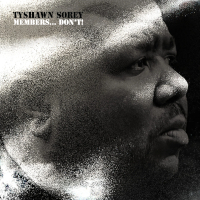 In 2024 Tyshawn Sorey was commissioned to write a composition celebrating Max Roach’s centennial. He chose Roach’s 1968 album Members, Don’t Git Weary – not as something to recreate, but as a work he could reimagine through his own compositional aesthetic while honoring and continuing Roach’s demands for liberation. The resulting piece is Members... Don’t!, a ninety-five-minute suite that retains each of the 1968 album’s compositions but reorders them to create a new narrative arc that is epic in sweep. It took Sorey’s band – trumpeter Adam O’Farrill, tenor saxophonist Mark Shim, pianist Lex Korten, bassist Tyrone Allen II, and guest vocalist Fay Victor – several performances of the demanding composition to work out the details before recording it. This sublime recording of their June 14, 2025 performance at The Jazz Gallery in New York shows that they got it just right.
To simply state that Sorey’s work is over three times longer than Roach’s doesn’t capture the difference in scale. One only needs to compare the first track on Roach’s and Sorey’s versions to understand how Sorey applied his practice of writing long and open forms that unfold over expanses of time. Stanley Cowell’s “Abstrusions” open both albums, but whereas Roach et al’s version is a tight three-and-a-half-minute spin over a “Sidewinder”-esque groove, Sorey’s group stretches it out to thirteen minutes. O’Farrill and Korten’s conversational opening to the piece befits a work of this stature. The pair interweave long lines, pointillism, trills, rolled chords, with cadenza-like flourishes, laying the foundation for Allen and Sorey’s entrance seven minutes in. Later, Shim enters the ring, taking a relatively cautious approach to his solo, as a boxer measuring his range. When Cowell’s composition does appear, it’s with only forty-five seconds left and disguised. Sorey transformed the horn stabs in the original into tenor and trumpet long tones and he moved the jaunty horn line to the piano in the middle of the texture. Where Cowell’s “Effi” was a slightly lilting 12/8 on Roach’s record, Sorey reframed it here as a scorching warp speed burn that transitions halfway through into a thick backbeat groove for Shim and O’Farrill to trade over. Here and throughout, Shim’s playing is assertive and his tenor is bold, edgy, and full of bite. O’Farrill has a warmer sound, and where Shim slashes through the band, O’Farrill floats above it.
When the pieces don’t segue, the band only gives a slight pause between them; the music comes at the listener in wave after wave. Invigorating solo after invigorating solo. Collective polyphonic sprees. Transitions between textures, tempi, and intensity. Sorey’s use of a large form makes the sheer amount of information his band shares absorbable. Even so, the moments of respite, such as Allen’s quiet solo deep into the twenty-six-minute arrangement of Cowell’s “Equipoise,” call on the listener to shift their focus in another direction and follow a new plot development. At the close of Allen’s solo, Korten slowly builds his own meticulously constructed solo that becomes a launching pad for a horn fanfare. Shim and O’Farrill’s entrance hits with the power of a big band shout chorus in full cry.
Originally, “Members, Don’t Git Weary,” which was sung by Andy Bey, was the penultimate track of Roach’s album. Sorey, however, moved it to the end, making it the work’s narrative climax. Fay Victor joins the group to deliver a message that is part sermon and part plea; part lamentation and part celebration. The song, played at a crawling tempo, is at once a blues, a spiritual, and a civil rights anthem. It is hard to imagine that I am not the only one who gets shivers as Victor repeats “I’m going down to the River Jordan” over Shim’s subtone obbligato lines and Korten’s gospel piano voicings. Halfway through the song Victor jettisons the words and leads Shim and O’Farrill into a wild three-way conversation. Soon comes a full-band wall of sound: uninhibited shouting horns and vocals atop a rhythm section that cannot push their instruments harder. Sorey leads the exuberant band out of the maelstrom with a triumphant 12/8 groove as Victor proclaims that she will “feast on milk and honey when our work is done.” The path may be difficult, but deliverance is assured.
At a moment when the civil rights gains of the 1960s and 1970s have been gutted at every level of government, it is as necessary as it ever has been for artists to be at the vanguard of social justice. Members... Don’t! meets the demands of the contemporary moment with a fierce, unwavering urgency. An artistic achievement of the highest order, it is a call to keep marching, keep organizing, and most importantly, to keep spirits high in the face of overwhelming adversity. The creative energy, intensity, and stamina with which Sorey’s band executed his expansive vision is sure to inspire their listeners to shed their weariness and carry on. I feel this album more deeply with every listen.
–Chris Robinson