Moment's Notice
Reviews of Recent Media
(continued)
Ran Blake + Dominique Eade
Roots & Byways
Sunnyside SCS 1813
 There is a substantial list of attributes that sets Ran Blake apart from every other innovative pianist of the past sixty-plus years, each of which falls under one of two headings: his choice of materials and his treatments of them. The former is based on Blake’s ability to hear connections between materials for which “disparate” is an inadequate descriptor. Who else would sequence Max Roach’s “Mendacity” and “Saving All My Love for You” – or “On Top of Old Smokey” and Michel Legrand’s “Watch What Happens”? Nobody, because what Blake does is unique. He doesn’t interpret materials as much as administer an MRI, revealing the connective tissues and vital organs as vividly, if not more so, than the skeletal structure. In the process, Blake makes the familiar sound radically new.
Blake’s collaborations with singers are central to his work. The current critical consensus is that his groundbreaking work with Jeanne Lee overshadows everything since, the respective qualities of notables like Christine Correa and Sara Serpa notwithstanding. Roots & Byways circumvents the edifice The Newest Sound Around has become, primarily because Dominique Eade takes a different tact. She is not as rooted as Correa – or Lee, for that matter – in Billie Holiday, and she is not as committed to understatement as Serpa. Like both Correa and Serpa, Eade can shape a song syllable by syllable and render a highly personal interpretation. It is Eade’s palpably deep joy in singing that sets her apart, one that is not only bursting at the seams on showstoppers like the Whitney Houston megahit, but one that even seeps into noirish songs like Mingus’ “Portrait.” It is the key to her relatability and appeal, and to that of the album, as well.
–Bill Shoemaker
Marion Brown
Live in Europe, 1968 & 1972
NoBusiness NBCD 187
 In August of 1967, Marion Brown moved to Paris, which became his home base for the next two years. After freelancing across Europe those first months and recording Porto Novo in December with Maarten Van Regeteren Altena and Han Bennink, Brown put together a quartet in January of 1968 with Gunter Hampel on vibes, Barre Phillips on bass, and Steve McCall on drums. That March the quartet made its debut recordings at Maison de la Radio in Paris. The opener, Brown’s “Current Events” has a jumpy, twitchy theme that immediately gives way to a Brown solo that is charged with melodic invention. The time is more implied than played, and when he unleashes a rash of urgently expressed shrieks and bursts of harshly articulated notes, Hampel’s vibes ring over a supercharged rhythm section. The vibist dials the intensity down during his solo as Phillips accompanies with his bow. Phillips quiets things further before Brown comes back and the foursome turn up the heat. The theme of Hampel’s “Epiphanie” built around short, repeating phrases that could easily become hypnotic if the group dwelled on them at length. Brown repeats a healthy quote of “Rhapsody in Blue” while still in the middle of the head. Hampel takes the first solo, using the pedal to create a dreamscape of ringing tones. As before, Brown is the more strident partner to the relatively understated Hampel. The final of the three pieces heard here, Brown’s “61 to Erie Basin,” begins as a medium swing that goes out of time for Hampel and back in for Brown. Midway through the group seems to question the way forward for a few moments, but to their credit, they had only been together for a few months.
After his stay in Paris, Brown went back to the United States, where he worked with Wadada Leo Smith and taught at Bowdoin College in Maine. In the summer of 1972 Brown performed across Europe. That August he and McCall appeared at the Festival de Châteauvallon in Ollioules, France, where they played “Djinji’s Corner” and “Afternoon of a Georgia Faun.” Brown afficionados will recognize these titles as the two pieces that comprised Brown’s 1970 ECM album Afternoon of a Georgia Faun. The live version of “Djinji’s Corner” is quite different from that appearing on the LP. The composition calls for each musician to move to different stations and play a different instrument and theme at each. As a duo, Brown and McCall could not recreate the same diversity of colors and density of textures as the seven musicians heard on the LP; yet, over the twenty-two minutes, the pair move through a series of loose set pieces: subtone alto above barely audible shakers; pitched idiophone phrases that McCall moves aside with cymbals and drums; an arrested alto solo accompanied by kick drum and cymbals; percussion call and response, etc. The meditative sound world from “Djinji’s Corner” continues in “Faun,” which retains the narrative arc heard on the LP. Brown and McCall begin with quiet and delicate shakers and pitched percussion that sounds very much like the raindrops that Brown describes on the LP’s liner notes. The duo builds to the high point slowly, with stillness and space. Brown plays low wooden or bamboo flute tones while McCall expands from shakers and bells to drums and cymbals. Brown moves between alto and bells as McCall opens up on his kit. The apex comes, not with a flash or a bang, but with a restrained alto-drums duet that maintains the attention to nuance, subtlety, and form the piece requires. Although each composition’s form isn’t as clear in the duo context as they were on the LP, there’s a palpable air of experimentality that shrouds the performance in mystery.
In its entirety, the disc captures Brown at two points in the development of his compositional and instrumental voice, demonstrating how he used them in different contexts. The 1968 recordings show Brown at the beginning of his run of albums that featured the core of Hampel and McCall: Le Temps Fu, Gesprächsfetzen, and In Sommerhausen, while the duo set shows him at the transition between Afternoon of a Georgia Faun and Geechee Recollections and Sweet Earth Flying. Live in Europe, 1968 & 1972 might not be an ideal entre into Brown’s oeuvre, as he plays relatively little alto on the 1972 recordings, but for serious Brown fans, it is an illuminating and essential release.
–Chris Robinson
Columbia Icefield
A Silence Opens
Out Of Your Head OOYH 045
 How do artists honor colleagues who have died without inadvertently reducing their contributions to sentimental nostalgia? A Silence Opens, the final statement from trumpeter Nate Wooley’s Columbia Icefield, was initially planned as a tribute to Wooley’s late mentor and friend Ron Miles, but when bandmate and pedal steel guitarist Susan Alcorn unexpectedly passed away during its completion, the album took on an additional layer of mourning. As an act of creative continuation rather than a simple recreation of either musician’s style, Wooley and company channel the humanistic characteristics that defined their artistry into a poignant meditation on loss, memory, and artistic legacy.
Three Miles compositions form the album’s emotional core. “Howard Beach” expertly demonstrates Columbia Icefield’s approach, preserving the melodic essence of Miles’ writing while transforming it through the ensemble’s distinctive language. Wooley’s solemn trumpet lines drift between reflection and uncertainty, while Ava Mendoza’s electric guitar shifts from delicate accompaniment to abrasive, rock-inflected surges. Ryan Sawyer’s drumming provides rhythm with emotive momentum, guiding the music through moments of intimacy and outburst. What begins as a tribute gradually transforms into something more exploratory, embodying the spirit of Miles rather than simply replicating his music.
“Darken My Door” is among the record’s most affecting performances. The piece unfolds patiently from shakers, humming voices, and sparse instrumental gestures. Alcorn’s pedal steel becomes the emotional center, her improvisations gracefully moving through surprising contours. Mendoza follows with menacing textures that darken the atmosphere before Wooley steers the music toward a fragile sense of hope, expressing the dual nature of mourning – the desire to preserve memory while learning to live past it.
The hard rocking “You Taste” is the album’s most expansive interpretation. Mendoza launches the performance with a striking blend of distortion and lyricism before the quartet gradually builds passages of rollicking intensity. Wooley’s trumpet balances abrasion and tenderness, while Sawyer sensitively responds to every tonal shift. The climactic mid-point features one of Alcorn’s final recorded solos, a breathtaking, near metallic performance that reimagines the possibilities of pedal steel in a raw, heavily amplified improvisational setting. The episodic piece conveys grief not as a single event but as an emotional process.
The album’s spiritual centerpiece, “We Say Goodbye Twice/Wildwood Flower,” best encapsulates its larger purpose. Combining Wooley’s original composition with a traditional American folk song, it examines how music passes from generation to generation, with Alcorn’s haunting pedal steel, Mendoza’s bristling fretwork, and Wooley’s lyrical trumpet blurring the boundary between farewell and continuation.
The album’s secondary narrative is expressed through five variations on Victor Jara’s “El Derecho de Vivir en Paz,” a Chilean protest song that was known by Alcorn’s bandmates to be especially meaningful to her. Interwoven throughout the program, these brief but emotionally resonant interludes provide structural continuity to the proceedings. Wooley’s opening whistled version is stark and solitary, while later readings introduce Mendoza’s bracing acapella vocal, a choir of friends and collaborators (Mary Halvorson, Ingrid Laubrock, Wendy Eisenberg, gabby fluke-mogul, Laura Ortman, and Patrick Holmes), and multi-tracked trumpet harmonies. The final reprise returns to the simplicity of the opening rendition but now evokes a sense of acceptance rather than despair. By threading these variations throughout the album, Wooley unifies these tributes into a singular meditation on the collective act of commemoration.
As both a memorial and a final chapter for Columbia Icefield, A Silence Opens neither sentimentalizes death nor seeks to provide comfort through imitation. Instead, it recognizes that the people we lose remain present in the ways they affect those who survive them. The presence of Ron Miles and Susan Alcorn can be heard everywhere on this recording – not only in retrospective tribute, but as ongoing influences. Confronting grief with heartfelt imagination, Columbia Icefield has created a moving requiem not only for two remarkable artists, but for the band itself.
–Troy Collins
Charles Downs Quartet
inner
ESP Disk ESP5044
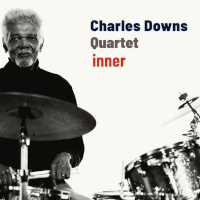 Formerly known as Rashid Bakr, Charles Downs has sterling credentials, joining Cecil Taylor’s Unit in the early 1980s, anchoring the undervalued Other Dimensions in Music in the ‘90s, and working with a long list of other luminaries, headed by Jemeel Moondoc. That he had to wait until he turned 81 to lead a recording is a measure of the-more-things-change-the-more-they-stay-the-same. Downs is a drummer – and one allergic to grandstanding, to boot – which, even at this late date, puts him towards the end of the queue for a session. inner is therefore a welcomed case of better way late than never.
Downs has assembled a strong ensemble. Hery Paz is quickly becoming a tenor saxophonist of note, one that gives a spine to a free improvisation with arcing lines and who has plenty of amperage to light up the moment. With appreciably big ears from delving in sundry musical zones, Jamie Saft has a fluency in multiple piano vocabularies and a keen sense of how to shape and support the unfolding moment. Though not the innovator that he is on guitar, Joe Morris is nevertheless a complete bassist, a propulsive ensemble player, and a compelling soloist. Each of them brings plenty to the table.
All four improvisations have a sure-footed flow of ideas, timely pivots, and confident finishes. Their respective abilities to move between the fore, mid, and back, grounds are impressive throughout. The music frequently simmers; however, it fully retains the smart banter and sidebars the quartet establishes at the outset of each piece. “Synergy” has been – seemingly forever – such a grossly overused word that it was effectively cancelled from the critical lexicon, but it does apply to this quartet.
Excellent ensembles constantly come and quickly go. Charles Downs’ Quartet has arrived with inner. Albums as good as this should not be lost in the current deluge of somewhat interesting releases.
–Bill Shoemaker
Kevin Drumm + Taku Unami
Zero Talk
Erstwhile 111-3
 Like silence, like love, snow, or anything elemental, drone comes in myriad manifestations. If Kevin Drumm and Taku Unami work in numerous areas beyond the proverbial drone, it also informs enough of their respective oeuvres to identify them strongly with that largely misunderstood trope. All three pieces on Zero Talk, their first collaboration, tap into one variety of drone or another, but much more resides beneath, around and through the glassy and concrete surfaces of these three hour-long meditations. It should be noted that the pieces were assembled without direct communication.
To invert that well-worn Gertrude Stein chestnut: A drone is not a drone is not a drone. The unfortunately beleaguered concept is always being pigeonholed, its Procrustean treatment one of the problems dogging discussions of Eliane Radigue’s astonishing work. Drone and melody are often so closely related as to be inseparable, and this is where the individuality of approach slams into focus. Where Radigue’s melodies often come from harmonic and overtone manipulation, Drumm and Unami find other ways to create melodies that emerge from the complex and superficially static interplay of fundamental and upper partials. d2u exemplifies the process with ravishing completeness. The piece’s loosely palindromic structure involves more static but extremely complex sustain as it commences and concludes, while in the middle, all manner of pulse, tempo, and tone rend, converge, and collide. The most fascinating drones foster a sense of static motion, an art to achieve but so satisfying when the illusion samples and holds each moment in a kind of internal counterpoint. Melodies do not so much mirror and enhance their accompanying harmonies as grow out of them. Ascent and descent ripple throughout the registers even as that fundamental pitch complex remains, ending basically as it began. Glass and crystal shimmer transport immediately, via astonishing clarity, into a world where all else in the listening environment becomes distorted as beat and pulse rend and warp temporal perception. The only sense of time as repetition involves a low-register pulse, gentle and sometimes nearly inaudible but felt, as are the flutes just before the double fugue in the finale of Beethoven’s last-completed symphony. Like a drug, sound demands attention and control in equal measure.
How intriguingly similar is the piece named u2d, not quite a mirror most obviously because of what might be construction sounds entering at the ten-minute mark. This would be unsurprising given Unami’s preoccupations with building and demolition, but each occurrence alters all in its wake. Nearly halfway through, the second piece, 0, drops suddenly and precipitously into near-silence, leaving only the sound of a room, the activity in it a minuscule and even parenthetical reality check until the hallucinatory returns centerstage mere seconds later. Like Stockhausen’s croupier in Hymnen, we are granted only a moment’s respite from the lush, luminous and often claustrophobic soundscapes the pair has assembled.
Each musician has had notable releases on the label. Drumm’s 2000 collaboration with Martin Tétreault’s atomistic Particles and Smears was one of Erstwhile’s earliest, and the distance to 2024’s Shere Hellish Miasma II involves distillation and nuance as much as a substantial volume increase. Beyond his remastering work for the label, Unami’s Wovenland collaboration with Toshiya Tsunoda, which spawned a trilogy of albums, expanded the field recording vocabulary, pioneering a language of sound and proportion in tandem. His ear for minute sonic detail is astonishing, and only his uniquely uncompromising nature would produce the street-smart but intensely ambiguous listening experience of 2023’s Bot Box Boxes. Zero Talk’s second disc veers closest to Wovenland’s universe of polyrhythm, stretch and sonic distortion, but all three illustrate that languages do not need to develop together to achieve parallel aims. Much of the music’s intrigue comes from placement, as much of it emanates from centerstage. With headphones or in a superb listening environment the already potent brew of tone and affixing/disassembling takes on a third dimension, one layer enhancing or dispersing the other. More than anything else, the set elucidates differences in the way Erstwhile releases now approach narrative. There was, at the beginning, something arbitrary, even fragmentary, about the way events would proceed, an aesthetic associated with certain strains of improvisation. As the millennium’s second decade unfolded, the narrative became more concentrated, even if, as in this case, the collaborative process involved no direct communication. Obviously, some conversations are too deep for speech.
–Marc Medwin