Moment's Notice
Reviews of Recent Media
Julius Hemphill
Dogon A.D.
New World 80850-2
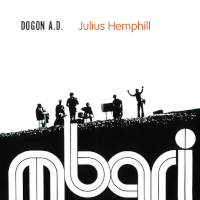
This New World CD is by my count the fourth or fifth edition in half a century of a record that should never go out of print. Julius Hemphill released it on LP soon after its 1972 recording on his Mbari label. (Its name is writ large on the original cover; his own name did not appear. New World adds it to the facsimile cover.) He distributed it himself, and not many copies circulated. The album came out to a larger world with the 1977 version in Arista/Freedom’s new music series, with a new and striking cubistic photo-montage cover by Dennis Pohl, and liner notes by Robert Palmer which told us a bit about the West African Dogon people, and about Fort Worth–reared St. Louis–seasoned Hemphill. Curiously Palmer never IDs the backbones of Hemphill’s backbeat, cellist Abdul Wadud and ex-Paul Butterfield, ex-Art Ensemble of Chicago drummer Philip Wilson. (He did mention Julius’ right hand, trumpeter Baikida Carroll.) Advance word of a sort had come the previous year, with the release of Hemphill’s Arista/Freedom Coon Bid’ness, mostly recorded in 1975. It included “The Hard Blues” left over from the 1972 session, a tune which added Hamiet Bluiett’s bari to the core tet. A 2011 (pricey) limited edition CD miniaturizing the Pohl/Palmer package was produced by International Phonograph’s late Jonathan Horwich, who remastered the program from the original tapes (which he then donated to the Hemphill estate), sensibly tacking on “The Hard Blues” as a bonus track. So does the New World version, which also sports new notes by Hemphill colleague/scholar/archivist Marty Ehrlich. The sound has been newly refurbished by Paul Zinman, cleaning up the raggedy/degraded tape ending of “Rites.” (I haven’t seen it, but there’s also a new Superior Viaduct LP edition of the original program/artwork, with notes by John Corbett.)
Wadud’s cello voice is prominent on Coon Bid’ness’ choogling “Skin 1” and “Skin 2,” but even with that album to whet a new Hemphill fan’s appetite, Abdul’s entrance at the top of Dogon’s 15-minute opening/title track was a stunner. First time I heard it, 49 years ago, I fell in love with the album before Julius had sounded a note: Wadud’s grinding one-bar bowed-dyads ostinato turned cello into a big Delta blues guitar. Wadud wasn’t the first jazz cello player by a long shot, though earlier ones mostly treated it like a baby bass. Other improvising cellists cropped up in the 1970s – Diedre Murray, David Eyges, Tristan Honsinger, Tom Cora, Ernst Reijseger ... – with many more soon to come, but nobody brought earthy sensibility and downhome funk to intonation and frictive bowing like Wadud. “Dogon”’s grinder riff nestled in the cracks in Philip Wilson’s sparse 11/16 drums and cymbal tattoo (a 4+4+3 he found tricky to master and held onto, tight, for most of it). And then come the horns, alto and trumpet melded in unison, and occasional blue minor harmony, phrasing like a single entity – the yoked horns of World Saxophone Quartet coming. (WSQ was already active when Arista/Freedom’s Dogon came out.) That melody is a series of bluesy aphoristic phrases that build on what’s already unfolded, then atomizes into a series of exclamatory single notes. The overall structure mirrors that odd-meter bar: the main melody’s sections are 19, 11 and 13 bars long.) In practice the melody seems capable of infinite development, while leaving space for cello and drums to speak through. (The cello part’s built-in variations may outline the harmony, arco or pizz.) And then comes Hemphill’s alto solo over vamping. Ornette’s North Texas holler is somewhere in the distance behind it, but Julius’s tone is dryer and harsher, his blues-infused intonation more sour and pitiless, his wildly scouring line informed by the written material: it’s all of a piece. He boils over and keeps boiling. (Baikida eases into his spot – won’t compete with that.) The blues gets dehydrated and reconstituted.
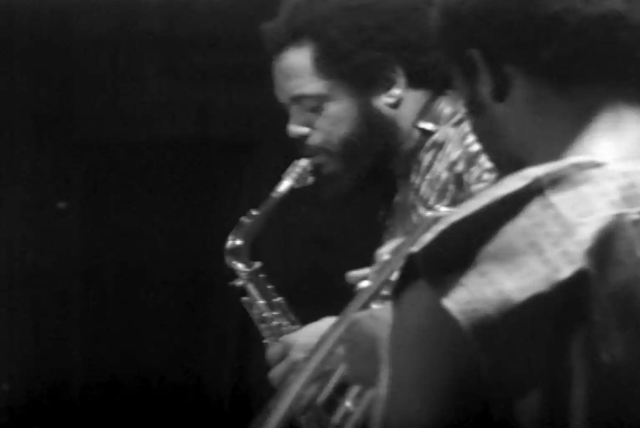
Julius Hemphill + Baikida Carroll, still from 1971 video, Courtesy New World Records
“Dogon A.D.” is all slow build; swifter “Rites” plunges right into the twisty melody; we’re in the thick of action from the opening seconds, fast but with no fixed tempo, its recurring hook (and opening) a couldn’t-be-simpler drop of a whole step. Thick is right: three-part harmony with cello as third horn, or sometimes as droning tambura. (If Ornette’s in there, it’s the roiling Crisis.) Baikida is especially effective darting behind Julius, blowing bugler’s commentary, reinforcing but never upstaging the boss’ alto. “Rites” is all coiled energy; when it flags, return to the head for a quick exit. For still more contrast, there’s the slowly unwinding “The Painter” for Hemphill’s bucolic sung-multiphonics flute (refreshingly un-Rahsaan-like), its melody both wide-ranging and sing-song catchy. Timing and articulation can be tricky – it’s not a line a part-time flutist writes for an easy layup. Wadud strums or picks rhythm; Wilson rustles; Carroll is as ever the loyal supporter, nimbly selfless, has chops to burn but keeps them in check. It’s the composer’s show, even without Hemphill’s name on the original cover.
And then “The Hard Blues” with its stompy riffy head, looking directly ahead to (and featuring half of) WSQ, but also – with its achingly-slow-to-quick tempos and dense-to-lean textures, suite-like variety and scored interludes – to Henry Threadgill’s 1980s Sextett. Whatever else he did, Julius Hemphill (like other members of St. Louis’s BAG co-op) brought convincing funk to new acoustic jazz, and reaffirmed the blues as eternal wellspring. Timeless tunes, an original group sound, liberatory cello – their appeal does not wear thin. Ehrlich’s notes describe in detail a private video of an earlier performance of the “Dogon A.D.” suite including a first unrecorded movement. The quartet was Hemphill, Carroll, Wilson and pre-Wadud pianist John Hicks, on vibes, playing what I’ve always thought of as the idiosyncratic ‘cello part.’ I imagine this performance as something from an alternate universe, one where Hemphill never performed at Oberlin College in 1970, and never met and jammed with the cellist known to classical audiences as Ronald DeVaughn, and that earthy blue arco scrape never got to shake us to the core.
Ideally Dogon A.D. and Coon Bid’ness should be reissued together, a definitive picture of Hemphill’s (and Wadud’s) music in early bloom. Rights to both are currently held by Germany’s DA Music. But both together are just too long to fit on a single CD. (With thanks to Marty Ehrlich for fielding various questions.)
–Kevin Whitehead