Moment's Notice
Reviews of Recent Media
(continued)
حمد [Ahmed]
Play Monk
Otoroku ROKU047
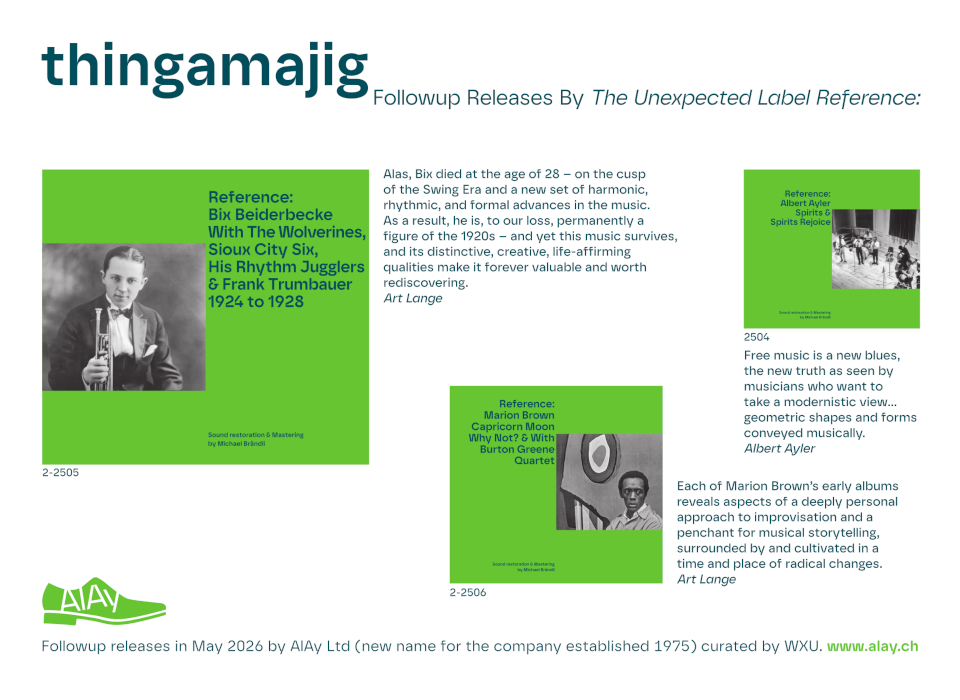
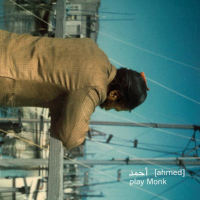 Over the course of the last decade, the group أحمد [Ahmed] has carved out a distinctive approach to the jazz canon through their tireless exploration of the music of Ahmed Abdul-Malik. Mining Abdul-Malik’s compositions and his incorporation of non-Western microtonality into the jazz vocabulary, pianist Pat Thomas, alto saxophone player Seymour Wright, bassist Joel Grip, and drummer Antonin Gerbal have done more than reinterpretation. They have used the music as a foundation for both immersion and subversion of the way that the standard jazz quartet functions within post-bop structures. For last year’s Sama'a (Audition), they went into the studio for an expansive refraction of Abdul-Malik’s Jazz Sahara. During that same session, the four took a slight detour to record Play Monk, a dive into deconstructions of six pieces by Thelonious Monk, all but one of which he recorded in the late 1950s when Abdul-Malik was part of his group. أحمد [Ahmed] has incorporated Monk tunes into their live sets but this is the first time they have focused on his tunes on a recording.
While Thomas, Wright, Grip, and Gerbal have not altered their strategies in the switch of source material, there is one significant shift in the way one listens to this music. A quick search returns no other versions of Abdul-Malik’s pieces other than those recorded by the composer or أحمد [Ahmed] whereas Monk’s “Epistrophy” or “’Round Midnight” have hundreds. Even a less well-known piece like “Oska T” has dozens. Because the pieces covered are so well known, their teasing apart and restructuring of the underlying thematic kernels are more readily evident. Over two CDs, the quartet digs in, with improvisations that range between 20 and 30 minutes with the exception of a seven-minute extrapolation of “Epistrophy.” These extended explorations allow the group to excavate the forms with a focused patience, zeroing in on and elucidating microscopic details, extricating them into the fundamental elements of penetrating improvisations.
The first phrases of the opening “Bye-ya / Epistrophy” provide a glimpse of what is to come. Bass and piano circle around the theme and Gerbal’s lithe drumming circles up to drive momentum. Wright’s stabbing alto picks apart the melody and the four launch off on a circuitous inquiry, dismantling Monk’s tune into its constituent fragments and then reassembling them with constructivist abstraction. Each of the four seize on elements of the underlying piece, playing them off of each other with unwavering resolve, an approach the group continues to advance in their sweeping live sets. There is an insistent intensity as Wright’s notes pick and prod at Thomas’ skewed clusters, Grip’s free walking lines, and Gerbal’s churning free rhythms. Shards of “Epistrophy” are introduced into the mix by Grip and Thomas, slowly accruing with multifaceted erudition.
The group continues to subvert expectations with “Friday the Thirteenth” as Thomas insistently repeats the first phrase of the tune against Grip’s growling arco inversions. Wright’s keypad pops and Gerbal’s open percussion build momentum and Wright unleashes spattered honks that open into a collective four-part splintering of the theme, picking it apart and recasting it with angular exactitude, building density and intensity over the course of the sweeping 26-minute improvisation. “’Round Midnight” gets a relatively straightforward introduction with Wright intoning the theme over sinuous bass and cymbal splashes. Thomas’ spare chords enter as the quartet dynamically transposes the constituent parts of the piece with imperturbable resolution resolving with the riveting cycling hushed snare abrasions that brings the piece to a close.
A seven-minute scorching, stuttering run through “Epistrophy” serves as an interlude to an abstracted, cascading reading of “Evidence” which takes Monk’s stop-start theme and explodes it with relentless, spiraled piano phrases and the hurtling momentum of bass and drums driving Wright’s coruscating alto which prods and jabs with spiky dexterity. The 30-minute improvisation is an engulfing exemplification of unflagging invention. Monk’s “Oska T.,” structured around an obsessively cyclical riff, is a fitting conclusion to the release. The quartet slows things down to a free shuffle with bass and alto arcing over the mutable pulse of piano and drums. The four players adroitly weave their lines in and out of the collective undercurrent with indefatigable ingenuity. While others have dedicated themselves to the reinterpretation of the music of Thelonious Monk, أحمد [Ahmed]’s Play Monk is distinctive in its mastery, fully absorbing his music into the collective rigor and artistry of this singular ensemble.
–Michael Rosenstein
Sylvie Courvoisier Trio
Éclats - Live In Europe
Intakt CD452
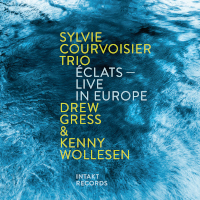 Éclats - Live In Europe, the fourth recording by Sylvie Courvoisier’s trio with bassist Drew Gress and drummer Kenny Wollesen, documents the outfit at a point where structure and spontaneity have become nearly indistinguishable. The album artfully stitches together excerpts from three dates in early 2025, while maintaining a consistent sonic ambience and the continuity of a single performance. It presents nine Courvoisier compositions, all but one drawn from the group’s previous three outings, including some of the pianist’s most memorable tunes in what could pass as a greatest hits compendium.
Even in normal circumstances, Courvoisier’s writing teems with catchy hooks, abrupt switchbacks and sudden suspensions. After six years of touring this repertoire following 2020’s Free Hoops, the trio has internalized the material to the point where the charts function more as points of departure than fixed forms. As a consequence the renditions here bear scant resemblance to the original versions, thematic framing aside. Nor are they alternate codifications. Having been lucky enough to witness the threesome several times in recent years, I can attest that they treat the pieces as organic entities, freshly minted on each occasion, kaleidoscopic in reach.
The title cut, one of the pianist’s flagship numbers, which has appeared in multiple guises over the years, furnishes a case in point. Dedicated to Ornette Coleman, it echoes the saxophonist’s vivacity, but views it through a distinctly exploratory lens. After the sprightly head, a lyrical bass and drum interlude settles into a walking groove. Courvoisier exploits this as a backdrop for a jaw-dropping display incorporating metal rubbed across strings, poltergeist taps, jazzy consonance, bluesy motifs, Cecil Taylor-like energy and articulation, and hyperspeed runs which suggest Conlon Nancarrow at his most ambitious. Her ability to meld real-time piano preparations and disparate styles into a cohesive whole brooks no rivals. In one exceptional passage she makes the strings veritably moan, eliciting sympathetic bass slurs from Gress. All of it unfolds in just over six minutes, on almost the shortest track.
At times such adventures generate formidable momentum. Gress exerts a mastery of melody and motion, combining them into an elastic flow, while Wollesen takes care of business without neglecting pitch and timbre. Yet although they tether the trio to the tradition, they remain alert to opportunities to subvert it. Foot-tapping or head nodding are likely to lead to dislocation. Form dissolves in an instant, only to miraculously reassemble Terminator-like and carry on as if nothing has happened. Bass and drums shine through gaps in the luxuriant surrounding foliage, whether cleared purposely or occurring by serendipity is a moot point. False endings and teasing feints, in which incipient solos suddenly vanish, render futile any attempt to distinguish scored interventions from collective improvisation.
Gems stud the program. “Just Twisted” takes on the contours of a drum concerto, Wollesen stretching out alone and later atop a rippling piano figure, amid the emphatic flourishes, slashing boogie-woogie and darting clusters. On the kinetic “Imprint Double” Courvoisier essays a dazzling series of glissandos before slotting back into a stomping beat. Gress introduces “South Side Rules” with a singing arco serenade. “Lulu’s Dance” receives a spare pointillist reading, taking its cue from the clipped high notes interpolated into the rolling theme, and providing a platform for the clacks and clangs of the drummer’s homemade “Wollesonics.”
Few working bands move so comfortably between swing, abstraction and chamber-like detail while sounding this wholly engaged with the moment. Among a slew of strong releases, this stands as one of Courvoisier’s finest.
–John Sharpe
Caleb Wheeler Curtis
Ritual
Chill Tone CT007
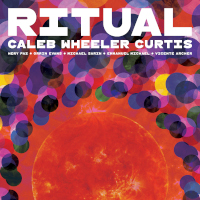 Multi-instrumentalist Caleb Wheeler Curtis has developed a reputation for restless curiosity, from the expansive sprawl of The True Story of Bears and the Invention of the Battery (Imani, 2024) to his work with collaborative ensembles like Ember and Walking Distance. On Ritual, he refines that breadth into a concentrated yet no less ambitious project which focuses on the process of communal music-making. Drawing on his command of stritch (the straight alto associated with Rahsaan Roland Kirk), soprano, sopranino, and trumpet, Curtis assembles a fluctuating ensemble – multi-instrumentalist Hery Paz, guitarist Emmanuel Michael, pianist Orrin Evans, bassist Vicente Archer, and drummer Michael Sarin – to explore wide-ranging sonic terrain that encompasses both tradition and forward-thinking experimentation.
The album conceptually emphasizes the “ritual” experience of artistic practice, invoking principles like daily discipline, shared language, and collective creation. Curtis’ compositions are structurally concise yet layered, with memorable motifs that are transformed through subtle shifts in rhythm, timbre, and ensemble configuration. The opening “Fantasmas” sets an incantatory tone that evokes the spiritual. From there, Curtis embarks on a journey shaped by tension and release – whether in the anxious impetus of “Bleakout,” written during a Madrid blackout, or the serene, nostalgic lyricism of “Florence,” inspired by his childhood summers.
A defining feature of Ritual is its varied personnel. The ensemble expands and contracts across tracks, creating a sense of continual change while maintaining a consistent inner logic. The full sextet brings urgency to “Black Box Extraction,” while more intimate configurations reveal different facets of Curtis’ vision. His duet with Evans on “You Can’t Just Keep the Music” is a brief but emotionally rich exchange that highlights their deep rapport and mutual sensitivity. Elsewhere, Paz’s flute colors pieces like “Pond” and “Tenastic,” where the combination of flute, guitar, and piano produces textures that run from lush to flinty.
Curtis’ compositional acumen lies in his ability to balance structure with freedom. His influences can be traced back to innovators like Ornette Coleman and Arthur Blythe, as well as Thelonious Monk, whose music Curtis has previously reinterpreted. That lineage surfaces not as imitation but as a continuum – a willingness to let forms fracture and reassemble between grounded harmonic frameworks and more abstract, expressionistic passages. Tracks like “The End of Power,” with its hushed interplay of soprano, brushed drums, and subtle guitar textures, or the title piece, where paired sopranino and trumpet create a mystical atmosphere, demonstrate this delicate balance.
Despite its complexity, Ritual never feels overworked. This recording exemplifies the ritualized process of collaborative creation by a community of artists. It rewards attentive listening and an open-minded sensibility with a sense of discovery. The music’s emotional resonance is cumulative as repeated spins reveal a finely wrought architecture, where each nuanced detail contributes to a larger expressive whole. In an era often defined by limited attention spans and instant gratification, Curtis and company offer something patient and enduring.
–Troy Collins
Morton Feldman
For Bunita Marcus
True Blanking 005
Morton Feldman
Palais de Mari
True Blanking 006
 At its half-way point as of this writing, Morton Feldman’s centennial year has seen some extraordinary contributions affording golden opportunities to enjoy his music afresh, and nowhere better than with this pair of releases. There is no need to rehearse John Tilbury’s Feldman credentials in these pages, as several ubiquitous labels house his venerable discography, to which these last piano pieces, documented here in concert performances, make invaluable additions. Rather, we are presented with another chance to celebrate the composer/performer symbiosis that sets Tilbury’s interpretations apart from so many that view Feldman’s sui generis soundworld through a narrower lens.
Even beyond the far-fabled reduced dynamics and the spontaneity of approach in Feldman’s music, about which Tilbury always waxes eloquent, the mysticism underlying Feldman’s final works involves balance. The difficulties involved in creating balance in music that threatens disruption on every level is formidable. Palais de Mari (1986) and For Bunita Marcus (1985), the two pieces under discussion, evolve as much along various lines of departure and return as do the traditional musical forms learned by every theory student but on varied temporal scales and using entirely different rhetorical devices. A comparative miniature, Palais de Mari lasts only 26 minutes. Its initial motivic ideas prefigure their various reiterations, first at 4:02 and at various points throughout the piece. These revisitations are balanced by architecturally different single notes and chords, first separate and later in tandem, pulling together the various rhythmic elements that foster unification. All formal and structural material is heard before the ten-minute mark, and the rest might be described as the simultaneous development and fragmented recapitulation so integral to Feldman’s later works. Yet, Feldman’s pitch centers can be ephemeral, just as his motives stun and stagger as they morph. Listen at 17:35 to observe the way he enters one of them only to have it dissolve by 17:48 and to establish another, albeit tentatively, at 18:29. Much more motivically diverse and nearly an hour longer in this performance, For Bunita Marcus augments the idea of centers in exploration, as with the gorgeously flowing stretch beginning at 57:33. My Western-trained sensibilities insist on hearing it in A-major, but this is overgeneralization to the point of folly, not to mention that Tilbury has pedaled the immediately preceding “outsider” pitch, blurring any sense of harmonic boundaries as that beautifully recorded single note creates an entirely different context.
That one note speaks volumes where Tilbury’s Feldman is concerned. Sonority, balance and production converge to elevate these performances in ways that are complemented by notions of “memory, time and place,” the entirely appropriate title to Frank Denyer’s notes for Palais de Mari. Unlike, just as one example, Steffen Schleiermacher’s rather distantly captured interpretations for MDG, Tilbury is recorded at close range. His pioneering London Hall series of Feldman’s “complete” piano works inhabits a similar soundstage. The MDG approach is an aesthetic choice, and it should be viewed as such, but to these ears, nuance and depth are lost. Denyer quotes Feldman positing that “music is not so much an art form as a memory form,” and if this is the case, Tilbury’s is an interpretation of accumulation. There is the aforementioned context-shifting pitch, but, as with his work in AMM, the pianist thrives on the balance of individual utterance and the roots-and-branches narratives attendant to the convergence of tone and luscious sonority. Each of the repeated pitches beginning 6:13 into For Bunita Marcus bristles with sublimated energy, the same but worlds apart, resonating with what has come before while trailing slowly off toward a silence never reached. The suddenly arpeggiated rhythmic disjuncture at 11:49 is pedaled with extreme delicacy so that the last note is sustained, leading directly into the next three-note phrase.
The closest points of comparison are the identical pairing from Sabine Liebner, recorded for Oehms Classics and Philip Thomas’ superb traversals for Another Timbre. I would not be without any of these versions, but the depth and richness of these Tilbury renderings make them irresistible. As with Alfred Brendel’s last Beethoven sonatas series, each note is a center leading to subsequent centers of accumulated tone and timbre, concentric narratives opening new paths of discovery with each audition. Single pitches swell and decay, dyads vibrate sympathetically, and the excellent recording ensures that all balances are faithfully presented. Then, beyond all verbiage and analysis, there is the music, as stunningly beautiful and mysterious as anything in Feldman’s corpus. Don’t let a few in-house noises and audience intrusions distract from these documents of a pianist at the height of his considerable powers performing music to match.
–Marc Medwin