Moment's Notice
Reviews of Recent Media
(continued)
Fieldwork
Thereupon
Pi PI109
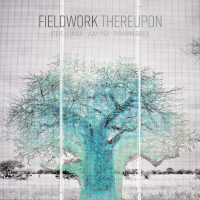 Fieldwork, the innovative trio of pianist Vijay Iyer, alto saxophonist Steve Lehman, and drummer Tyshawn Sorey, returns after a 17-year recording hiatus with Thereupon. Formed by Iyer at the turn of the millennium, the group debuted with Your Life Flashes (2002), followed by Simultaneous Progress (2005) and Door (2008), each Pi Recordings release extending the possibilities of small-group jazz. Over the years, personnel shifts solidified into a definitive lineup: Lehman replaced Aaron Stewart in 2005; and Sorey replaced Elliot Humberto Kavee in 2007. Since then, all three artists have pursued distinguished careers as performers, composers, and educators, collecting MacArthur Grants and Guggenheim Fellowships, multiple Grammy nominations, and a Pulitzer Prize along the way.
Iyer and Lehman split compositional duties, writing pieces that balance structured composition with open improvisation, leaving ample space for spontaneous interplay. The group’s sound remains democratic, with all arrangements shaped collectively by the trio, allowing roles to shift fluidly among the participants as they engage in empathic exchanges informed by deep listening. Iyer plays both acoustic piano and occasional Rhodes, while Lehman and Sorey remain acoustic, emphasizing the ensemble’s unamplified immediacy. Together, Iyer’s kaleidoscopic harmonies, Lehman’s incisive lines, and Sorey’s elastic drumming create a volatile yet precise sound that is relentless in its forward motion.
Thereupon is comprised of nine mostly energetic excursions with expansive finales. The record opens with Iyer’s briefly manic “Propaganda,” a fervent statement of intent, followed by Lehman’s frantic “Embracing Difference,” whose circular rhythmic patterns and odd meters inspire blistering exchanges. Iyer’s jaunty “Evening Rite” slows the pace to reveal intricately composed unison lines, while his “Fire City” combusts in freewheeling abandon. Lehman’s “Domain” surges with cinematic grandeur, his upper-register cries sparking ricocheting retorts. On “Fantóme,” Iyer’s ringing Rhodes lends warmth to Lehman’s syncopated explorations, and “Astral” offers a calm interlude before accelerating into angular intensity, while the title track epitomizes Fieldwork’s collective aesthetic with shifting meters and tightly wound rhythms. Closing with Iyer’s “The Night Before,” the trio drifts into eerie spaciousness, blending scintillating Rhodes, breathy alto, and shimmering cymbals in a hypnotic finale that contrasts with the program’s prevailing intensity.
Fieldwork demonstrates a singular musical language that continues to evolve beyond its M-Base origins, reaffirming it as one of the most inventive groups in contemporary jazz. Odd meters, fragmented motifs, and shifting grooves reveal nuanced detail, the virtuosic trio’s sound tightly coiled in perpetual movement. As with past albums, the combination of composition and improvisation is seamless, leaving even astute listeners unsure where one ends and the other begins. Each musician listens intently and responds instinctively, their deep chemistry honed over two decades of collaboration revealing a whole greater than the sum of its parts. Meticulously crafted yet vibrantly spontaneous, Thereupon reveals new dimensions with every spin.
–Troy Collins
Jürg Frey
Composer, alone
Elsewhere 030-3
 There is no containing Jürg Frey’s music. Far from the platitude or even backhanded compliment that might be presumed, this is only to suggest an astonishing subtlety of rhetoric, from seeming minutiae to the vast formal gesture so often integral to his work. It is an oeuvre of relationships made more apparent with each immersion. Among so much else, Frey composes nesting series; his alone pieces are now taking their places among them. Pianist Reinier van Houdt has already recorded the second Pianist, alone installment on lieues d'ombres, the triple disc to which Composer, alone is the sequel, and his version of Pianist, alone (1) now takes its place alongside entries from Circular Music and the Klavierstück arrangements. Containing works composed between 1990 and 2024, the album is a non-chronological survey in which the titular diptych is the most recent item. Frey and van Houdt view the set as a dialogue encapsulating Frey’s compositional development, elaborated, elliptically but with obvious sincerity, in an illuminating interview at elsewheremusic.net.
Among so many other metaphorical issues explored in that three-way conversation, Elsewhere owner Yuko Zama leads Frey and van Houdt to discuss what they call the “alone.” Their answers harken back to William Robin’s notes to R. Andrew Lee’s performances of the Pianist, alone diptych. Robin writes: “The piano here is not the bearer of tradition but of timbre, of pure sound.” While exactly what constitutes tradition can be debated, Robin’s observations about Frey’s relationship to it are borne out by the music. Tradition may not be obliterated but rather deconstructed, subsumed into the new forms Frey brings into being, forms that still somehow hinge on familiar tropes. The open fourths and fifths form a static and, dare I say, medieval backdrop against which later seemingly traditional elements emerge rhetorically unmoored, like the D-major scale that begins at 60:01 of van Houdt’s version; it lasts five minutes before the open sonorities return. Traditionally, a scale indicates a center, each note fraught with meaning in that context, and a scale indicates stability, but here, it’s a parenthetical, a sign in the void of near-silence so often palpable in the 72-minute odyssey. Like the repetitions anticipating and succeeding it, the scale “leads” nowhere, though each note is a galaxy. It is fascinating to compare van Houdt’s version to Lee’s, released in 2016 on a pioneering set from Irritable Hedgehog which also contains the premier recording of Pianist, alone’s second installment. If Lee’s corporealization of the music is more overtly textured and lengthens the silences at strategic moments, van Houdt may be described as more of a moment-to-moment colorist. Each repetition is a statement, and this is largely due to a certain flexibility of timbre and tempo. This should cause no surprise. All performance practices morph and deepen. Were it not for the dialectical forces of Malcolm Troup, Peter Hill, and Anatol Ugorski, Messiaen’s piano music might still be the exclusive domain of Yvonne Loriod. So, now a large portion of Frey’s work is receiving a similarly evolutionary treatment, a more than welcome development.
When attempting to come to terms with what sets van Houdt’s two triple discs apart from earlier versions, I came across a stunning quotation from correspondence I had with Frey in 2014: “... And then, most difficult to describe: when I write a piece, when I write notes/pitches on the blank sheet, I work on the surface of the piece. But at the same time, I go also inside of the piece (inside of the sheet), I'm looking for the center of the piece, I'm creating the core, the nucleus of the piece, an activity which then influences the surface.” Frey might as well have been describing the processes guiding van Houdt’s pianism. There is a centeredness in van Houdt’s playing, a depth, but each note is a searchlight in soft focus. He inhabits the score which then inhabits him, a synergy transferred to the instrument. The first Composer, alone piece moves from octaves, repeated notes and something sounding like elongated grace notes to chords that continue, basically uninterrupted, from 2:40 until they cluster and fragment. Some of the open sounds of Pianist, alone return to create a wonderful unity in Frey’s oeuvre, loosely referential fragments that recur as in Stockhausen or Messiaen. A single-pitch repetition, beginning at 9:03, leads to an octave at 9:22, and the most glorious aspect of these initial minutes is van Houdt’s touch! Each repetition is individual, a micro-statement stunningly recorded and articulated with palpable concentration but in a relaxed focus, elemental and certain as water or light. Sabine Liebner’s Cage and Scelsi recordings might be the closest points of comparison. Van Houdt inhabits Frey’s conjoining worlds so completely that he finds the line – Zama’s interview calls it melody – throughout every passage of flux and stasis. Connection and its polar opposite exist in tandem, and while Frey’s music is always beautiful, these performances re-center it, adding depth and nuance in ways that foster a new experience. It might even be fair to suggest that van Houdt layers his performances with the sonic diversity of Frey’s chamber music, his electroacoustic pieces and the extremely subtle color combinations occurring when those disparate forces are combined. A case in point is Instruments, Field Recordings, Counterpoints, a canonic duo with Radu Malfatti in which one layer involves the expectant hush of field recordings. Van Houdt summons similar layers of varied articulation even in the blocks comprising much of Frey’s brief memorial to Cornelius Carddew.
Listening again demonstrates that the word beauty is incomplete complete. Beyond temporal and timbral juxtaposition, beyond the silence too often used as a convenient pigeonhole, beyond repetition, varied or otherwise, and beyond the ambiguity of scale, Frey composes radiance. In the Zama interview, he speaks of his compositions’ “alone”ness as light, meaning not heavy, but his words transcend that sentiment. Frey does compose light, one in which community-building in its stereotypical form plays little part. Rather than investing time and energy, a certain relinquishing is necessary to inhabit his music, whether the briefest miniature or vast edifices for varied ensembles or environments. To allow unfolding rather than to impose a narrative brings rewards far beyond the telling, and the piano music represents the whole. Van Houdt captures Frey’s work as the ephemeral totality it is. In all of it, Protean and never predictable, fragmentary or dense, often somehow familiar but never facile, the pianist ensures that sound is afforded the chance to be what it is, to be shaped gently and with quiet certainty into what it is. Laid bare and luminous, the center is glimpsed, the core exposed, reflecting and illuminating all surfaces and interstices beyond.
–Marc Medwin
Fred Frith + Mariá Portugal
Matter
Intakt CD44
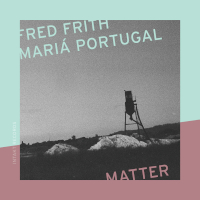 Stripped of visual clues, the dynamics of musical dialogue can become elusive, and nowhere is that more apparent than in a guitar-and-drums duet that resists the usual hierarchies. When the guitar belongs to veteran iconoclast Fred Frith and the percussion and voice to Berlin-based Brazilian improviser Mariá Portugal, then all bets are off. Their 2023 unerhört Festival performance in Zurich – presented here in four freely evolving pieces – begs the question of agency itself. Who initiates? Who replies? And how much does it matter when the music’s internal logic keeps reconfiguring the roles?
Certainly even guessing the instrumentation of “Things Considered” might be challenging. It begins with grainy, unplaceable roar, then what resembles water pouring into a container, a flash of cheesy organ and a run of amplified plucks and abrasions. Undoubtedly Frith’s array of FX pedals contributes to the unconventional exchanges, but more important still are the animating imaginations of the two protagonists. Frith has long approached the guitar as a toolbox rather than a fixed identity, a stance heard to striking effect on Laying Demons To Rest (Rogue Art, 2023) with Portuguese trumpeter Susana Santos Silva. Portugal, for her part, draws on a sensibility rooted in her Brazilian heritage yet refracted through Berlin’s experimental circles, creating a hybrid dialect that is as sharp as it is unpredictable.
Indeed it may be the drummer’s affinity for rhythm, manifest in self-contained fragments, which induces Frith to engage with more conventional vocabulary alongside the kaleidoscopic textural shifts. While “See Through The Blind” starts with a didgeridoo-like drone, it doesn’t stay like that for long, instead morphing into propulsive indie rock strums and insistent beat, a steam train judder and a passage evoking the pedal steel twang of Ry Cooder, as Portugal threads a wordless vocal melody through the racket – lyrical, and disarming in its simplicity.
Such episodes unfold not as outliers, but as integral elements, a thought reaffirmed by the closing section of “O Tempo E Sua Secura,” where bombastic beats usher in stately near anthemic guitar to close the album on a satisfying high. The duo’s rapport reaches its most declarative moment here: not a resolution exactly, but confirmation that their method – continual reinvention, patient listening, and a refusal to settle – shapes a storytelling arc out of volatility.
–John Sharpe
Francesca Gemmo + Magda Mayas
Tides in the Mirror
ezz-thetics 119
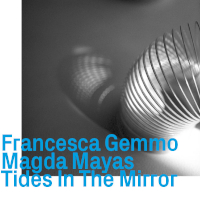 Two-piano albums actually work far less often than they should. Equivalent to putting two orchestras together, as only a few have managed with anything approaching success, the overlap and clutter of timbral diversity may range from the momentary excitement of novelty to the discomfort of irritation. Improvisation only increases uncertainty and the possibility of folly. Leave it to the combined experience, awareness and wisdom of Francesca Gemmo and Magda Mayas to flout this discouraging norm with such engaging and satisfying results.
Foremost, their approaches to the instrument differ fundamentally. Annotator Art Lange foregrounds the disparity, as well he should, though Mayas doesn’t simply conjure Cowell but also, and more often, John Butcher’s airy multiphonics and astonishing sonic range. To say that the piano is “prepared” is to suggest that all counterpoint and silence are the same or even similar, or that harmony might even pose as unifier. Harmony, that Protean vagueness behind everything, is indeed at the root of the disc’s success, and it can vanguard itself in stunning ways. “Gravity and Glow” places front and center the possibility of moment-to-moment implication. Mayas begins, a-metric and spacious, with gestures residing somewhere between Webern and Crumb, and Gemmo listens. The listening is palpable, anticipatory and even edgy, especially as Mayas centers on a mode, repeating and congealing its elements. Gemmo’s first pitch (0:54) insinuates and asserts with quiet dignity. All occurring after this astonishing entry advances and reenforces the connection. Mayas listens and supports as Gemmo digs down into the blues, chiming ascent and occasionally melodic encouragement. Gemmo’s intuition leads to expansion, the soundstage increasingly populated by pitch and ghost in contrapuntal dialogue. Melody changes hands, and mode shifts only to resume and finally end as inconclusively as is the vignette’s opening pitch.
The part speaks for the whole, but the whole is, of course, larger than its constituent parts and any verbiage attendant to them. The chamber-music rapidity of “The Sound of Falling Sideways” bristles with the energetic exchange entirely countered by the preceding and much briefer “Returning.” There, Gemmo initiates with Gargantuan sustains later fragmented, Mayas grabbing and loosing components on the multivalent texture until, at 2:48, she hurls something like a thunderbolt, a zesty shattering, and then another. Dissolving in open sonorities, the music never recovers. That double lightning bolt reflects, or is reflected by, the moonlit shards “Strum Song” offers to balance the bowed-and-struck droning luminosity of “Heratic Links.” The constant flux of moments in context renders the album’s title the more potent, more seismic. “In one small pane/Of My Window/In Bude/The ocean fits,” the lyrics of a King Crimson vignette have it. Blending the simultaneous forces only improvisers and composers can harness, Gemmo and Mayas harness the powers of tide and mirror to similarly gripping effect.
–Marc Medwin
Jean-Luc Guionnet
L'épaisseur De L'air – Live
Potlatch P125
 A release of a new solo alto saxophone recording by Jean-Luc Guionnet is cause for celebration. Guionnet is an inveterate musical explorer as reed player and organist, working as a collaborator, composer, and musical organizer in settings ranging from acoustic free improvisation to electro-acoustic collaboration to field recordings to site-specific installations, a number of which have been documented on the French Potlatch label. But he has previously only released two solo outings, the first as part of a solo reed collection on Remote Resonator and the second, L'Epaisseur De L'Air, a focused studio study of the confluence of breath, reed, and the conical bore of the saxophone. L'épaisseur De L'air – Live picks up on those releases, documenting two live sets recorded at Les Instants Chavirés in Montreuil, France in January 2023 and July 2024. Translated as ‘the thickness of the air,’ Guionnet sees this ongoing project as a way to delve into his approach to the saxophone as an instrument for spatialization of sound.
The two pieces, the first an expansive 36-minute improvisation and the second a more compact 16-minute study, explore shifting overtones that resonate in the live space. Guionnet places the sounds against each other with methodic deliberation. Notes are intoned, hang in the space, and then are allowed to naturally decay. The resolved pacing built around that approach toward attack and decay defines the arc of the pieces. It is as if the reed player is performing a duo with the space itself. The playing begins to get more strident and the velocity of phrasing increases, but even then, the spacious arc of the improvisation is pensively maintained, never devolving into bristling bluster. Though an astounding technician, he never leans on technique, but rather takes a structural view of how the music evolves, calling up the full tonal and timbral range of the alto saxophone and orchestrating that into a contemplative accretion of sonic investigation. Guionnet has no signs of slowing down his broad-ranging musical endeavors. This solo outing is a particularly welcome addition and a wonderful return for the invaluable Potlatch label which has been quiet for the past few years.
–Michael Rosenstein