Moment's Notice
Reviews of Recent Media
(continued)
Barry Guy + London Jazz Composers’ Orchestra
Harmos Krakow
Maya MCD2501
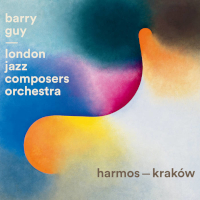 In her meditative Gilead tetralogy, Marilynne Robinson has Jack Boughton musing momentarily over what would happen if the miraculous became normal. In his memory, Jack’s father observes that miracles are a kind of commentary on all else. As Barry Guy’s Harmos tune spins its wistfully familiar thread, as it morphs, divides and recapitulates in this new concert performance by the London Jazz Composers’ Orchestra, I wonder about these matters of context, just how repetitions can differ so fundamentally, so miraculously, without really differing at all. Here, on multiple levels, we audition repetition on a vast plane, the 50th anniversary of this landmark and much beloved ensemble captured in a 2020 performance of perhaps its most appreciated work. Yet, so much has changed, not least so many of the performers and the spirit they bring to the colliding and coexisting components of a Barry Guy composition.
The miracle is in the seed. If, as Bert Noglik astutely observes in his notes to Ode’s reissue, that LJCO debut is a manifesto, Harmos (1988) is a summation. It codifies all supposed incongruities into a unity, in language, of form, structure and intent. It has done well on disc, where this is its third iteration, not to mention on DVD, also to great acclaim. As with so many pieces that eschew all categories while sitting adjacent to many, the decades bring what I’ll call stabilization. Even the most difficult of innovative pieces, like Boulez’s Le Marteau Sans maître, has demonstrated that familiarity with the idiom now affords performers the chance to perceive and perform layers initially obscured by exuberance. Harmos now treads this path. Dig how the wedge-like ensemble passages emerge from the dueting trombones of Alan Tomlinson and Konrad Bauer, and, as annotator John Sharpe states so beautifully, from “jittery crashes and thorny improv.” Atoms merge to form lines, and the lines intersect, something akin to harmony bolstering Agustí Fernández’s wriggling ascent. Immediately, dizzyingly, gorgeously layered as in a Charles Ives symphony, the theme, that gorgeously rolling edifice spun out toward the infinity its possibilities simultaneously incapsulate and refute, pervades everything surrounding it.
How to describe it as it rests, now newly tranquil amidst the soloistic interjections, the conjoined vocabularies elucidating transgenerational improvisation? In 1988, it disrupted and depicted in equal measure, a quaint vibrato sometimes infusing its core as to inject whimsy. In 2003, in trio formation with Marilyn Crispell and Paul Lytton, its disruption conjured something classico-romantic, especially after the blistering “free” collectivity preceding it. In 2020, it adopts a character somewhere between chorale and post-Takemitsu meditation. This version of the LJCO brings to it the serenity of “Small Town Agonist,” a pivotal moment from Carla Bley’s Escalator Over the Hill, itself an infamously large amalgam of amalgams. The drone beginning at 6:06 is breathtaking as it grounds and supports saxophonist Jürg Wickihalder’s wise rendering of the melody, leading ultimately to the work’s first series of shattering climaxes, prefigurations of the final moments, outcroppings increasing in intensity until the fanfares momentarily breaking the mood at 11:20.
If the above descriptions seem to connote a lack of innovation and invention in this performance, nothing could be further from the facts. The form’s malleability leaves wide openings for all manner of creative investigation, from atomistic schism to bits of raw blues, like the understated saxophone at 14:42 as it negotiates its way around the chorale, itself soon to be exultantly dispelled. Yet, through all the rapid-fire changes, some astonishing in their parenthetical rupture, like the shallow dive into sonic revelry at 16:26 or the sudden plunge into the warm waters of cabaret at 28:22, that sense of layered subtlety remains, rendering the extraordinary blissfully ordinary as each section meets the next. It affords the opportunity to hear the various chamber ensembles embedded in the piece, like the incendiary duets dotting the craggy second half. The timing is perfect. As lines between individuality and collectivity blur and disappear, the “coming together” of Harmos’ title, and the true measure of Guy’s conception, become abundantly clear. While every soloist performs way beyond expectation, it is especially gratifying to hear the brilliant, muted trumpet work of Martin Eberle. The glee he whoops and growls back at Phil Wachsmann is infectious, and the blast they’re having is palpable. The increasing conflations render it impossible to describe the way a simple trio, emerging around the 30-minute mark, lays the groundwork for the indefatigable give and take delineating the concluding series of climaxes. Of course, Guy, Bruno Chevillon and Lucas Niggli anchor the piece through all its mutations and returns, as plentiful as they are diverse.
Ives might not be a bad point of comparison. Guy’s composition might actually best be likened to the New Englander’s 4th symphony. Within any restrictions form might impose, irrepressibility of syntax in all manifestations reigns supreme. As with Ives, Guy’s compositions and playing form a unity of purpose that bridges micro and macrocosm. Comparing the two Intakt CDs demonstrate just how tight a ship Guy runs. The 1989 recording has a timing nearly identical to this one, but the radical actions and felicities of improvisation obviously determine both form and structure. The overarching impression this new rendering leaves is one of beauty, of that gorgeous thematic material at the music’s heart being played with such maturity, such grace and power. Each return brings an ache to the throat, a sting to the bridge of the nose, the revisitation of an old friend. Nothing has changed, or is it everything? Time’s passing and orchestral regeneration ensure a continued convergence of performing traditions. Commitment and power nevertheless persist in that long-nurtured balance. This multifarious continuity might be the greatest of all miracles.
–Marc Medwin
Jon Irabagon PlainsPeak
Someone to Someone
Irabbagast 032
 Saxophonist Jon Irabagon is commonly considered one of today’s most versatile and mercurial artists, with a reputation as both consummate craftsman and wily provocateur. Born in Chicago, Irabagon refined his craft at the Manhattan School of Music and Juilliard before making his mark on the New York scene. After years of eclectic collaborations and ambitious projects, he returns to Chicago and his Midwestern roots with PlainsPeak, a new quartet that reconnects him with trumpeter Russ Johnson, bassist Clark Sommers, and drummer Dana Hall. A renowned multi-reedist, Irabagon forgoes other members of the saxophone family on this date to concentrate on alto, which he played with Johnson on Outright! (Innova, 2008), his debut as a bandleader. Eschewing electronics and high-minded conceptual gambits, as heard on the recent AI-inspired Server Farm (Irabbagast, 2024), Someone to Someone presents Irabagon’s music at its most unadorned. The group’s name, PlainsPeak, refers both to Chicago as the “peak” of the Great Plains and to “plain speak,” a sly nod to Irabagon’s penchant for wordplay and the quartet’s stripped-down approach. Modeled on the chord-less two-horn quartet pioneered by Ornette Coleman, the ensemble shifts fluidly between inside and outside approaches.
The opening title track, described by Irabagon as a love song to family, begins rubato and hymn-like with Sommers’ bowed bass before building to freer exchanges. Horns and drums converge, separate, and reunite, personifying a range of familial relationships. “Buggin’ the Bug,” inspired by cicadas, reimagines a blues march into a sly, restless shuffle, while “Malört Is My Shepherd” – named after Chicago’s infamously bitter liqueur – portrays its subject with ceremonial themes that erupt into some of the most cacophonous blowing of the set. Other highlights include “At What Price Garlic,” a labyrinthine epic likened to deep-dish pizza for its multi-tiered structure, which features the quartet maintaining driving tension as bass and drums interlock and Irabagon and Johnson careen through shifting time signatures. “Tiny Miracles (at a Funeral for a Friend)” balances grief with tenderness, acknowledging both personal loss and Chicago Cubs fandom through lyrical call-and-response. The album closes with “The Pulseman,” an energetic tribute to Hall and Chicago’s percussion masters. Forceful yet precise, Hall sets the stage for soaring horn lines that end abruptly, as if the music could continue forever. A hidden track extends the journey, giving each member ample space to stretch out.
Someone to Someone serves as both a love letter to and portrait of Chicago. Each piece presents the uniqueness of the Windy City: as distinctive as Malört; as layered as deep-dish pizza; and as moving as the city’s long-awaited World Series win. The quartet embraces these contrasts, pitching lyricism against volatility and groove against fragmentation, yet always maintains the creative focus of Irabagon’s writing, which is witty but never superficial, favoring ebullience over austerity. Over the years, Irabagon has proven to be a restless seeker, adept in multiple idioms. Here, he demonstrates that returning home can be just as creatively viable as exploring new territory. Bolstered by the empathetic enthusiasm of his hometown bandmates, Irabagon embraces the familiar without falling into conventional routines on Someone to Someone, crafting a program that is playfully adventurous, yet respectful of the past.
–Troy Collins
Masabumi Kikcuchi
Hanamichi: The Final Studio Recording Vol. II
Red Hook RH1008
 Masabumi Kikcuchi had many gifts, among them being his ability to make the standards most pianists take cookie cutters to sound fresh, if not altogether new, and to generate fleeting materials in open improvisations that seem familiar, but only faintly so. Kikcuchi drew listeners in with both approaches to what they would discover to be a sound world of delicate surfaces and gently but persistently tugging undercurrents. This feat is repeated throughout Hanamichi: The Final Studio Recording Vo. II, making it one of the more deeply engaging recordings of the year.
Usually, second volumes of last or otherwise consequential or storied sessions are thinner than the first, either in terms of running time or quality of performance. That is not the case with the second volume of Hanamichi. Kikcuchi’s finely calibrated touch and sly, occasionally misdirecting, approach to developing materials is spot-on throughout a program of four standards and three improvisations. It clocks in at almost three-quarters of an hour, plenty of time for full immersion. Far from a collection of leftovers, Hanamichi is a substantial addition to Kikcuchi’s discography.
As Ben Ratliff relates in his liner notes, Kikcuchi was coming to terms with being “an old musician,” who had learned to “’lay back.’” He would die two years after this session. The music suggests that he had successfully negotiated the issue. Throughout the album, there are moments suggesting the grace that sometimes accompanies the acceptance of the inevitable. This is more apparent with the standards, perhaps because he had spent decades interpreting them. While these moments also fleck the improvisations, there is abundant evidence his incisiveness was not flagging.
Whether heard alone or in tandem with the first volume released by Red Hook in 2021, Hanamuchi Volume II is so much more than an archival release that fills in a blank.
–Bill Shoemaker
Kirk Knuffke
Window
Royal Potato Family 020286246046
 Kirk Knuffke has long distinguished himself within contemporary jazz circles, not only for his choice of cornet rather than the more common trumpet, but for his tonal individuality, stylistic versatility, and intuitive musicality. Knuffke is equally comfortable navigating the delicate interplay of chamber-like configurations as he is cutting loose in freer, more adventurous settings. Collaborating with a wide range of artists, Knuffke’s ability to thrive among any set of players allows him to blend into ensembles of all types and sizes while maintaining a unique voice. As a bandleader, Knuffke seems to work with a different combination of musicians on nearly every recording. Each project reveals a new facet of his artistry, whether in duos, small combos, or large ensembles. This constant rotation of partners demonstrates his adaptability and openness to different musical contexts.
Window showcases Knuffke in a stripped-down trio setting with bassist Stomu Takeishi and veteran drummer Bill Goodwin. Across thirteen tracks, the trio explores a range of moods and textures, blending ballads, blues, funk, and Eastern-inspired meditations. Titles like “Choose” offer slinky grooves from Takeishi’s loping bass and Goodwin’s crisp drumming, while the bluesy “Mr. Bill” evokes Southern Gothic atmospheres with whinnying cornet cries and swaying rhythms. “For Your Needing” pairs playful, parade-like brass motifs with dub-style bass and cowbell, and “Ballad” provides meditative, abstract lyricism. “Carey” highlights the trio’s humor and intricate interplay, with Knuffke’s slurred cornet pirouetting over the dynamic rhythm section. Providing introspective respite, a trio of improvised “Gong” interludes explores unsettled textures. Goodwin’s percussive inventions, Takeishi’s exploratory bass, and Knuffke’s expressive horn create tension and release, ranging from mysterious rumblings to muted primitivism.
Knuffke also sings on several tracks, revealing a new dimension in his work. On the title track, based on a Carl Sandburg poem, his cool baritone floats above the trio’s interchanges, while “Runs Red” pairs hushed vocal storytelling with Middle Eastern-tinged rhythms. “A Little More So” finds Knuffke musing over cryptic questions in sync with the band’s groove. Goodwin contributes a spoken-word reading of William Blake’s “A Divine Image” on “Poem,” blending seamlessly with Knuffke’s chants on “Runs Red.” These vocal experiments enhance the album’s emotional depth and provide an additional point of interest for those familiar with Knuffke’s instrumental work.
Window is a highly personal statement from one of today’s most resourceful artists. Knuffke’s timbral warmth, compositional imagination, and fearless improvisations are on full display, while the contributions of Takeishi and Goodwin elevate the music into a cohesive, dynamic whole. Throughout the date, the trio moves seamlessly from lyrical passages to volatile excursions and funk-tinged grooves to contemplative abstraction. With the addition of his own vocals, Knuffke expands the trio’s palette, offering listeners a surprising new aspect of his artistry underscoring why he remains a uniquely compelling and deeply expressive voice in modern jazz.
–Troy Collins
Denman Maroney
Umwelt
Neuma 243
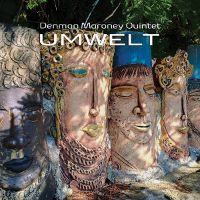 To put it simply, far too simply, Denman Maroney is a composer of repetition in expansion. Some of his compositions involve improvisation, some do not, and some incorporate hyperpiano, itself an expansion of what the piano might be presupposed to accomplish. He also employs what he calls temporal harmony, which I understand to be a nesting of rhythmic cycles and resultant harmonic juxtapositions, elucidated in astonishing detail, with tables, on his website. Umwelt, his third album since relocating to LeGard, France in 2020, presents all of these variables to one degree or another, but what may look on paper like an academic exercise springs to life in the hands of his quintet. This iteration, including saxophonists Guillaume Orti and Robin Fincker, bassist Scott Walton, and drummer Samuel Silvant, is essentially the same as on The Air-Conditioned Nightmare, so they’re used to digging deep and riffing on Maroney’s jagged lines and layered repetitions.
In describing these compositions, which Maroney does in some detail, he says of “Lilt” only that it “just wandered in.” I’s rhythmic counterpoint, each strand of which might even be labeled as minimalist were it not for the other continually decentering it, cycles in staggered entry and re-entry, and, as if that weren’t enough, starts and stops abound. All that is happening in the piano, but when the others join in, the starts and stops, never hectic, take on a gentle humor as melodies chromaticize their way along the crooked path. Improvisation finally reveals the title’s appropriateness.
Time and tonality waft whimsically in and out of focus on this album as I’ve only heard from other innovators like Henry Threadgill and Tyshawn Sorey. The titles can reflect Maroney’s humorous problematizations. “Andale Simplexity,” where the tail-chasing melody rasps and slithers along courtesy of Maroney’s hyperpiano, its only appearance on Umwelt. The real dialogue begins when Maroney and Fincker bandy phrases about, rebooting collective improvisation until all drop out except the two saxophones, who offer motives in open fifths, adding a Medieval flavor to the strong draught. It’s all good fun, as one perfectly timed descending glissando from Walton makes plain with just the right kind of punch. The titular piece stacks harmonic complexes in those rolling patterns, so infectious as they come to be more familiar, conjoining and dispersing only to regroup after the proportional explorations loosely linking these sounds to creative music’s attendant histories. Maroney’s pianism on this track is beyond exquisite, highlighting and augmenting each melodic fragment with chordal subtlety.
Stacks, ostinato, and cycles add up to so much more than might be assumed. The music grooves with the pure joy inherent in it. Maroney’s is such a positive vision, such a quirky but quietly exuberant take on historical combination, on expansion in miniature, or is it the other way around? Intricacy breeds a kind of evolution, a continuous realization that can be felt even if the cycles slip by with the ease obvious in every performance. Each player pushes at the boundaries Maroney seems more than ready to have blurred and erased. Even as some cycles continue, the rhythm section emotes in the language we too narrowly associate with freedom, when Maroney’s vision is larger and, ironically, simpler. The album ends with such a gesture, abrupt, innocently experienced, definitive and beautiful, just like his compositions.
–Marc Medwin