The Book Cooks
Excerpt from
Composing While Black: Afrodiasporic New Music Today
Harald Kisiedu and George E. Lewis, Editors
(Wolke Verlag, Hofheim)
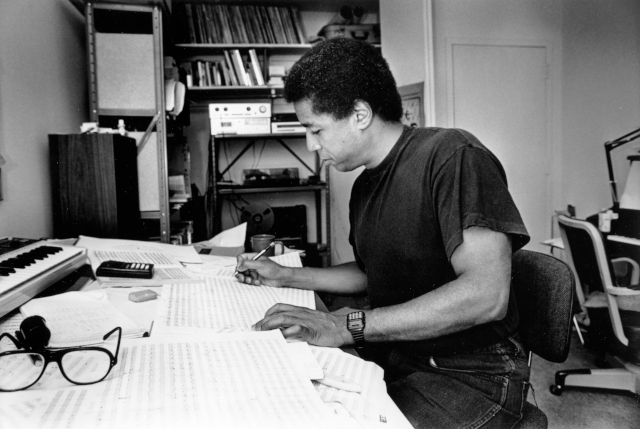
Alvin Singleton, courtesy of Schott Music Corporation © 2023
Alvin Singleton in Darmstadt Again: A Conversation
Harald Kisiedu
The following conversation between Alvin Singleton, George E. Lewis, and myself took place on July 19, 2021, on the occasion of the 2021 Darmstadt Summer Course opening concert, which featured Singleton’s composition Again, which was premiered in 1979 and has been performed widely internationally over the past several years.[1] As will become apparent from Singleton’s comments, the Darmstadt Summer Course not only had special significance for his artistic development, but moreover was a site where he gained hitherto unprecedented recognition. In 1972, his work Argoru II for cello was the first ever to be performed by a Black composer at Darmstadt. Two years later, his Be Natural for three string instruments received the internationally renowned Kranichsteiner Musikpreis.
In this conversation, Singleton talks about his early listening experiences and music studies during his formative years in Brooklyn, New York; his graduate work in composition at Yale University with Mel Powell and Yehudi Wyner; and his activities as the founder of Yale’s Black Music Students Union. Singleton also discusses his fourteen-year sojourn in Italy and Austria, his rich experiences at the Darmstadt Summer Courses, where he collaborated with Siegfried Palm and others, and the significance of improvisation and cultural intermixture in his life and work.
[The first part of the interview centered around Singleton’s years at Yale University, his studies with Mel Powell, and living in Europe.]
HK: And you had a chance to visit Germany and you visited Darmstadt. So, you visited the Internationale Ferienkurse für Neue Musik.
AS: Yes.
HK: I believe for the first time in 1972. Is that right?
AS: Yeah, that's correct. That's where I met Helmut Lachenmann. He was the composer there in residence when I first went, and I liked him very much. We had a lot to talk about and you know, I kept up with him as much as I could after that.
HK: How do you remember your first visit? What do you remember about the interaction with fellow composers? You just mentioned Helmut Lachenmann, but maybe other composers and students as well.
AS: Well, it was amazing to me that you had composers from everywhere. I remember there was a composer from South Africa, Latin American composers. It was very exciting because in the composition studios, we'd hear music of these people and also, you know, at other times we'd socialize. And this was this is a great experience, I thought. And at the same time, we'd look ahead about which speakers would be coming. I remember Ligeti came, and Stockhausen. And it was just very exciting. I had been there, I think three times. It was just very exciting for me because at this point, although I had studied and all that, it was new music. I mean classical music still was very new to me. And to hear pieces from other cultural points of view really was enlightening. If you grow up in a situation where you hear only new music by Americans, there are certain elements of that music that were so familiar, which to me is cultural. I mean, I'll give you an example. I had a performance at Carnegie Recital Hall and I remember during that time there was a woman from our church. She was in her 80s. She lived in Brooklyn. And she came to my concert with my parents. And she said to me afterwards that she did not understand the music, but she said there was something about it that was very familiar. And I took that to mean it's a cultural aspect. And that's what I got in Europe. When I hear pieces by Germans or even English, French, they were all very different structurally. And also, the idea of the colors, the orchestration, just the idea of how it was put together. And one of the things I did notice was the orchestrational element. I found pieces that were far out in terms of language and rhythmic aspect, but they were so well orchestrated. And I questioned, do we orchestrate like that in the United States? We do somewhat, but it's more kind of a big band orchestration.
GL: Mm-hmm, that’s interesting. I mean despite all the attempts of classical music in the US to really distance itself from that heritage. The composition Argoru II which was mentioned, and I think ...
HK: Yes, so, Argoru II was a composition that was performed in 1972 and was actually the first composition ever to be performed by a Black composer at Darmstadt, and it was performed by Siegfried Palm. I wanted to ask you do have any recollections of Siegfried Palm’s performance and the reception of your piece back then at Darmstadt?
AS: Siegfried Palm performed the piece, but the person who premiered it and was written for was Ronald Crutcher, who at that time was a student of Siegfried Palm’s. And that piece was written when Ron and I both were at Yale, and it was written over a period of time when I’d visit him in his dorm room, and we'd go through little things that he could do on the cello. And little by little, I put it all together. And then we met again at Darmstadt, and I guess he showed the piece to Palm and Palm played it. But Palm at that time was very famous.[2]
HK: He was known for playing pieces that were deemed by many people as unplayable, such as some pieces by Bernd Alois Zimmermann.
GL: I was interested because in 1974 you won the Kranichsteiner Music Prize. And that was for Be Natural, which was a very different kind of piece from Argoru II. I mean I was looking at the score the other day and a lot of it is quite graphic. I heard Be Natural. I programed it at The Kitchen years later, but I hadn't looked at the score. I mean, you won the Kranichsteiner Music Prize, but then I'm not sure whether they continued to play your music at Darmstadt.
AS: Now, actually the Be Natural piece is written as a result of an assignment for the workshop, for that particular workshop where people had to make up things that had to do with graphics. That piece, you know, came to me over time and I was trying to make it make sense, and it worked very well. And in fact, to this day, it's a piece that can be played regardless of experience. Kids can play this piece. It's a droning of a B natural sound. And in there, there are figures that are drawn. If you had a picture of something that related to string writing, you would interpret that. I had so many performances of this piece. My publisher only recently did a new score for it, which you've seen, right?
GL: Yeah.
AS: I remember the New England Conservatory has a festival for their preschool students, youngsters, and my piece Be Natural was on the program and kids were lining up to play it. They wanted the chance to interpret some of these graphics. And then when professional people play it, it's very different because the mentality of the professionals is different. The experience of the professionals is different, but it all works because of that B natural. And going back to Siegfried Palm, I recall he tried to explain Be Natural to the group of composers who were there, and he was talking about what that B natural meant in English. Then he said in German it makes no sense as H natural.
HK: Yeah. [chuckles]
GL: You returned to the US in 1985 and became composer in residence with the Atlanta Symphony Orchestra. What impact did you stay in Europe have in terms of interest in you and your work in the US?
AS: Oh, boy [laughs]. You know, the thing is that I was happy to be back home and one of the problems always, as the composer Roger Sessions once said, they give you these awards to send you away so they can forget about you. So, when I came back, I felt really good because I came back as a “hero” in the sense that I had something to show for it. And I came back with a job with the Atlanta Symphony Orchestra. They had programed my music. You know, I had a job to recommend performances of other composers and to look at scores. Of course, one thing you learn about is that these scores that I had to look at had accumulated over years because these American composers, probably European composers as well, have difficulty getting performances. So now they’re having composers in residence. They come in and they clean out the closets to find pieces. Of course, at that length of time you don't really find many pieces, but I did. But I was just happy to be home.
HK: You know, I was thinking about, and I guess it's somewhat related, George, to the work that we've been trying to do. I was wondering about the global impact of the Black Lives Matter movement and the silence surrounding Black composers and the extent of the exclusionary practices which have been increasingly challenged since the summer of 2020. And, Alvin, I wanted to ask you, to what extent do you think there's a growing interest and also an awareness with regard to the work of living Black composers?
AS: Well, I think there's more of an awareness, now. They're complaining about it, they're mentioning it. As far as me personally, I'm concerned peripherally about it because, you know, once you go through almost a lifetime of trying to get performances, of trying to be “noticed,” you get tired. And so, you try to pass it on to younger composers because the same problems exist all the time. People always ask, how do you get performed? And I don't want to tell them, send your music somewhere, because that doesn't seem to help. I always tell young people at college level or people who are writing music, don't write pieces for people who will never perform your music. You can't write a piece for i.e., the New York Philharmonic. They don't know who you are. They don't know how you write. Write music for your friends because your friends will play it and play it and play it. And some day it'll be known. My piece Argoru II for cello solo is still being played. In fact, it's been recorded and cellists are discovering it still and they are playing it. Now, my viola piece, Argoru IV, has been discovered. Now this piece was premiered at Darmstadt, but it's only been discovered, I guess, the last three or four years. I get my first New York American performance.
HK: This was really amazing. Thank you so much. It was a great experience talking to you. I enjoyed that thoroughly. Thank you for taking the time talking to us.
GL: Thank you. I learned a great deal about stuff I didn't know. The double bass thing, all kinds of things. Wow! Thanks very much for speaking with us today.
AS: Oh, thank you for your interest and your friendship.
GL: Mm-hmm. You inspired us all.
[1] This is an edited version of the podcast “Darmstadt on Air #20: Singleton in Darmstadt Again” (Internationales Musikinstitut Darmstadt), https://internationales-musikinstitut.de/en/ferienkurse/onair/podcast20/.
[2] For an autobiographical account of the premiere of Argoru II, see Ronald A. Crutcher, “I Had No Idea You Were Black: Navigating Race on the Road to Leadership” (Bellevue, WA: Clyde Hill Publishing, 2021), 93-94.
© 2023 by the editors and the authors with the permission of Wolke Verlag, Hofheim.