Page One
a column by
Bill Shoemaker
Jin Hi Kim: Living Tones
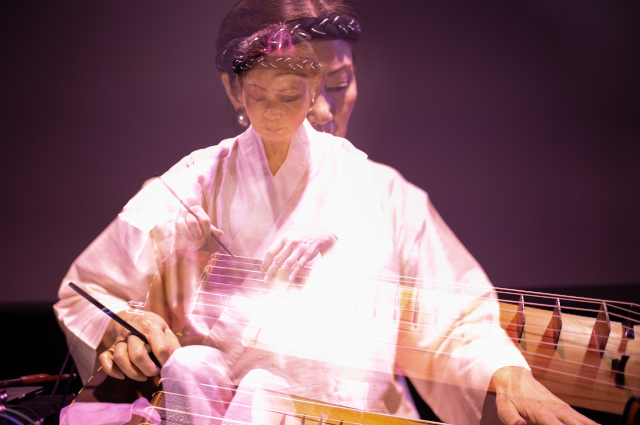
Jim Hi Kim © 2026 Livia Sa
Curating a retrospective of 40 years of recorded music is a daunting task, particularly when it is your own. Accurately representing the arc of the work and the life that created it requires frankness and acceptance. It is a process punctuated with winces and sighs and the occasional grin. Composer and improviser Jin Hi Kim experienced it all when compiling The Jin Hi Kim Collection, recently issued by Neuma. If the use of “odyssey” requires a great voyage, discovering new lands, and encountering titans, then Kim’s journey easily qualifies. Not only did she leave Korea at 23 for the US in 1980, Kim traversed an arguably greater gulf by leaving her elite training in traditional Korean music to study electronic music and composition with Lou Harrison, Terry Riley, and others. In the intervening decades, she worked with leading exponents of contemporary composition and improvisation like Kronos Quartet and Derek Bailey, and transformed the komungo, the traditional five-foot-long lute dating from the 4th Century CE, exponentially extending its sonic range through computer interfaces and signal processing.
Rediscovery accompanied the selection process for the 9-CD Collection. She was especially surprised when reviewing early works transliterating Korean music through Western instruments, or employing graphic notation. “It was created by a young mind,” Kim recently recalled with a laugh. “Sometimes it was hard to hear that’s what I did. But it was also good evidence for an archival collection. It was a wonderful feeling to look at everything I did – well, almost everything – but one thing that I was really proud about it is that there is not just one kind of music. Each piece has its Korean roots but, like I’ve said, I came to America to make new music, so I look at my 40 years of work and, yeah, I achieved that. So, it was a very satisfying process.
“When I listen to some of the improvisations, I realized how young and unafraid I was. Komungo has a limited sound compared to other instruments. When you work with virtuoso improvisers, they have vocabularies that are so rich. They are creating so many different colors and textures, but komungo has limits. It doesn’t allow you to express so much of the story. It has a meditative energy, of nothingness, of slowness. I was so brave to use this instrument with such incredible masters and to communicate with them and create music with them. I did it somehow with my inner energy. I was able to present this inner energy.”
The Collection almost equally divides Kim’s work in composition and improvisation, with five discs devoted to works for orchestra and chamber music ensembles, and four documenting improvisations with, among others, an impressive diversity of percussionists, including Gerry Hemingway, Susie Ibarra, and Tony Oxley, and string players like Bill Frisell, Min Xiao-Fen, and Hans Reichel. If anything can be read into it, the slight tilt reflects her ardent pursuit to articulate the concept of Living Tones Compositions, and how central it is to her work.
“The most important thing about the Living Tones Compositions is to convey the Korean element and philosophy through Western contemporary music,” she explained. “When I came to the United States after training in traditional Korean music, European classical music was more respected in Korea than the traditional music. They didn’t know much about American avant-garde music then, in the 1970s. I was a young musician who trained with the very best teachers and saw that I was not respected because I was not doing Western music.
“That created within me a great desire to fix that problem. You can’t fix anything, but I was young, I had a passion and a mission. I was living in the United States; I was composing for Western musicians; so how could I make this Korean idea, this Korean state of mind in making music, how could I put this together with Western music with equal respect? That was my thing. All my Living Tones Compositions come from the idea of putting together the Korean context and philosophy and Western instruments and musical context, to see how Western musicians took to the Korean attitude – not necessarily techniques, scales, anything like that – but this attitude, this state of mind. That’s what I’m doing with Living Tones music.
“Korean traditional music was once influenced by Chinese music,” Kim prefaced to explain the context and philosophy of Korean music, which she also detailed extensively in her book, Duality of Ancient Korean Roots and Western New Music. “Korean music can be divided into folk music and court music. Court music was quite different from music of ordinary people. The court was deeply influenced by ancient Chinese philosophy – yin and yang; the five elements, and ancient ancestors worship. The music wasn’t entertainment; it was ritual – that was part of both court and folk music. For ordinary people, they associated music with the shaman. For court music, there were virtuoso musicians who created an austere music, based on a philosophy of cosmic sound and abstract thinking; but for ordinary people, the shaman always took care of pain, community pain. Music was performed for celebrations of harvests and other things, but more for problems like drought, someone who is sick, some kind of problem. The shaman is always dealing with the problem of pain in their lives. They always had to sing something very sad. Her song has nothing to do with joyous things – always grief and pain. Ordinary people related to that.
“Both court and folk music had an emphasis on energy – they never thought of music as just sound. It had healing energy. In the folk community, they tried to imitate the shaman, the way she sang, shaking the notes, trying to reach out to another spirit, trying to connect heaven and earth. If you listen to a shaman’s song, there’s a very strong vibrato. The instrumentalists who don’t sing listen to this type of music; it’s very touching, very soulful, and it reflects the problems in their lives. Korean instrumentalists are all shaking, shaking their hands, shaking their instruments, shaking their notes. I play komungo, where the strings can move a lot, up and down, so you can really shake the notes and express the music in the same way as the shaman. I translate that process, that context, that spirit, into Living Tones. Each tone has its own light, and because it has its own light, its time is elastic. It is not like abstract Western time, where you count the time of each note perfectly, and you don’t have the space for microtones. There’s no time to do that in Western music. Time becomes much more open and that’s why in Korean music they don’t talk about abstract time but time in a cycle. Within that cycle, you have a lot of freedom of how to use that space with deep vibratos or any other articulation to create that intense feeling.”
The qualities Kim ascribes to Korean music are manifest in the komungo. It has a palpably plangent sound, with a bass register lower and more resonant than the guembri’s and the sting of ancient harps in its highest notes. It has a timbral luster comparable to the dark, iridescent glazes of pit-fired ceramics or the blocks of deep color that hover over the black basecoats of a Mark Rothko painting. Its dredge-like twang and the skeletal figures central to the music stop the racing, associative Western mind dead in its tracks. Even before Kim augmented the instrument with signal processing, Western improvisers had a strong attraction to the komungo. Conversely, improvisation has, over the decades, impacted Kim’s outlook.
However, Kim has a nuanced view on how improvisation has influenced her. “Influence is the result over a long period,” she elaborated, “because I played with a person one time or two times. That long period is a really deep space. It’s not that a particular musician gave me something. It is that the experience of playing with someone becomes part of my life experience. Now I look at something differently than when I was young. I understand how the universe works because of scientists and I understand how improvisation works because of improvisers. When you travel all around the world – I’ve performed in over 60 countries and have lived in some of these countries for a long time, six months or even a year – then you have an incredibly different life perspective. All of those things interest me. So, I have been influenced by many things over the decades, so that when I play with someone, it is not just that moment I am responding to; it’s everything about the other musicians: their instruments; their traditions; their culture. That gives me a very clear idea what to do.
“When I was young, I was so desperate to communicate successfully with each improviser I played with. I was trying to understand their personality; I was trying to understand their vocabulary. There have been very few times that I played on the spot without any information about the people I was playing with. I had heard them before I had the opportunity to play with them, playing with other musicians or solo. In my own way, I understood who they are. If I don’t understand them and their musical elements, I have no way to contribute anything on komungo. I have to understand their personality, their energy, how they process the music. Not all people process the same way; some people are poetic; some people are very emotional; some people are very funny. Everybody has those things happening. Understanding that was very important to me. It helped me to communicate, to hear what they were giving me, so I could give back. I listened a lot to what they were doing at a particular moment.”
Given that improvisers spanning James Newton and Elliott Sharp, and Rüdiger Carl and Oliver Lake, are heard throughout the box set, it is noteworthy that Kim singles one out to illustrate her approach to improvisation. “When I work with William Parker, he has a very deep energy in his soul,” she said of the bassist. “When I played with him, he influenced me with his deep energy. It’s really big. That influenced me to be really big. That bigness, that abundance, that tireless energy; that lets us play a really long time. He has the qualities to do something that a Korean shaman could do, playing the same idea over and over and over for a long time – trance like – but the energy becomes more powerful. William Parker has that type of energy. The bass is like the komungo; it has a deep energy and incredible power. I’m really influenced by that.”
Retrospectives like the Collection are generally considered to be merely summations, but in Kim’s case, it is more a marker of distance travelled and journeys ahead. “It reflects my continuous evolution as an artist. Throughout my musical journey, I have always searched for new ways to express myself creatively while remaining deeply rooted in my Korean musical identity.
“In essence, every work in this collection is the result of my enduring desire to elevate often-neglected Korean aesthetics, shaped alongside the freedom I found in America – a place that allowed me to pursue my artistic passions and ideas without limitation.
“Today, my perspective extends beyond national boundaries to the increasingly interconnected global community. I have aspired to use music as a spiritual and transformative force to confront social challenges. I believe this has become the new direction of my artistic journey.”
Kim’s new direction has steered her towards to uplifting marginalized subalterns and breaking through the fourth wall of the concert hall separating musicians from listeners. “Right now, because the world has changed so much, and America is now so blue, and so many people are mentally ill – I know because I recently gave a music meditation workshop at the Yale mental health center – I want to do something about community pain. I always go back to what the shaman does. I think I have sort of achieved my goal of blending Korean and Western ways of thinking with Living Tones, so right now I want to make music that the community participates in. Not necessarily well-trained musicians, but anybody who is interested. I already started on this in 2023 with a piece called ‘Ritual for Earth.’ I would like to do these things for now. I’m not anxious about my career or my next commission. I’m thinking about community pain, environmental issues like wildfires and floods, the world we are living in. So, if I have the opportunity, working with communities is what I want to do.”