Steven Bernstein: The Busiest Man in Show Biz
by Troy Collins
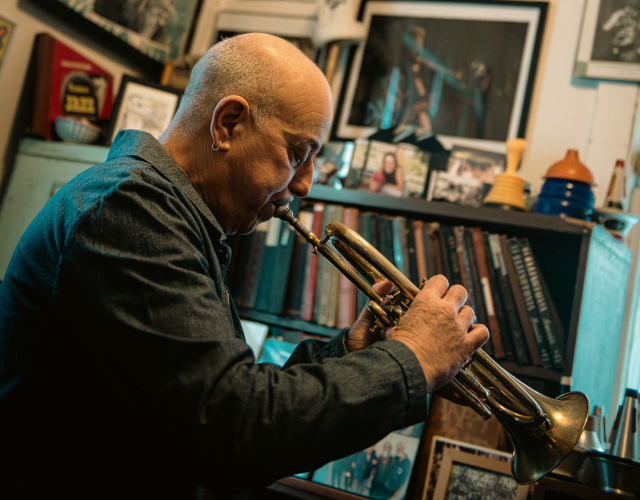
Steven Bernstein © 2026 Andrew Blackstein
A key presence on the New York scene over the past 30 years, trumpeter, composer, arranger, and bandleader Steven Bernstein has immersed himself in such a wide array of music with his bands Sexmob, Millennial Territory Orchestra, Diaspora Soul, Universal Melody Brass Band, Spanish Fly, Blue Campfire, and the Butler-Bernstein Hot 9 that his output defies easy categorization. A former member of The Lounge Lizards and Levon Helm’s Midnight Ramble Band, Bernstein has also composed works for film, theater, and dance in addition to doing arrangements for a diverse list of artists, including Lou Reed, Lee “Scratch” Perry, Allen Toussaint, Marianne Faithfull, Linda Ronstadt, Rufus Wainwright, Darlene Love, Mario Pavone, Bill Frisell, and John Lurie. His lengthy list of sideman credits includes appearances on recent recordings by Laurie Anderson (Heart of a Dog), Roswell Rudd (Trombone for Lovers), Mostly Other People Do the Killing (Loafer’s Hollow), Antony and the Johnsons (Turning), and Nels Cline (Lovers). He also continues to perform with Ray Anderson’s Pocket Brass Band, Omaha Diner, and the Kamikaze Ground Crew.
Born in Berkeley, California, Bernstein moved to New York in 1978. By 1990 he had joined The Lounge Lizards, appearing on the group’s 1991 release Live in Berlin (Intuition). Shortly before that, in 1988 he formed the trio Spanish Fly with slide guitarist Dave Tronzo and tuba virtuoso Marcus Rojas. By 1995, producer Hal Willner, a fan of Spanish Fly, enlisted Bernstein as arranger for the soundtrack to Robert Altman’s film Kansas City, which led to collaborations on numerous other Willner projects, including tributes to Bill Withers, Doc Pomus, and Leonard Cohen, among many others.
In 1996, Bernstein formed Sexmob with saxophonist Briggan Krauss, bassist Tony Scherr, and drummer Kenny Wollesen. It remains his primary vehicle for exploring the slide trumpet, a rare instrument that he picked up in a Woodstock guitar shop back in 1977. Over two decades of recording, the group has put their singular stamp on an eclectic list of tunes by the likes of Leadbelly, John Barry, Hoagy Carmichael, Paul McCartney, Duke Ellington, Prince, Kurt Cobain, the Rolling Stones, James Brown, Count Basie, Professor Longhair, and Nino Rota. The group’s latest album, in its 20th anniversary year, is Cultural Capital, the first Sexmob recording to feature all original compositions.
From 1999 to 2008, Bernstein contributed four recordings to John Zorn’s Radical Jewish Culture series on his Tzadik label – 1999’s Diaspora Soul (featuring members of The Lounge Lizards and Sexmob), 2002’s Diaspora Blues (featuring Sam Rivers), 2004’s Diaspora Hollywood (inspired by classic film composers and West Coast cool jazz), and 2008’s Diaspora Suite (a homecoming recorded with Bay Area musicians). Each project combined traditional cantorial songs and elements of jazz, blues, and rock.
Bernstein’s Millennial Territory Orchestra debuted with 2006’s MTO, Vol. 1, which featured large ensemble interpretations of songs by Stevie Wonder, Prince, and the Grateful Dead, as well as Benny Moten and Charlie Johnson and His Paradise Band. They followed with 2008’s We Are MTO, which included renditions of tunes by Fats Waller, Don Redman, Count Basie, and the Beatles. Their 2011 recording, MTO Plays Sly, was a tribute to the music of Sly & The Family Stone and featured the late P-Funk keyboardist Bernie Worrell along with guest vocalists.
In 2012, Bernstein joined up with New Orleans piano master Henry Butler in the retro-flavored Butler, Bernstein and the Hot 9. Their critically acclaimed 2014 Impulse! debut, Viper’s Drag, featured spirited renditions of Fats Waller’s title track along with tunes by Jelly Roll Morton and originals by Butler. The restlessly creative Bernstein continues to juggle several working bands. During a recent residency at The Stone in NYC, he performed with Sexmob, Millennial Territory Orchestra, Spanish Fly, Blue Campfire, and Universal Melody Brass Band.
Bernstein’s latest album is ResoNation Trio/Ultra Resonance (Royal Potato Family). In the liner notes, Bernstein mentions being enchanted by Burning Spear’s Garvey’s Ghost (Island, 1976) back in 1981, only realizing years later that it was a dub version of Marcus Garvey, Burning Spear’s Island release from the previous year. Since then, Bernstein has wanted to record an acoustic jazz trio album and have the results remade as a dub album. The first half of the release, ResoNation Trio, features Bernstein on trumpets, Scott Colley on contrabass, and Nasheet Waits on drums. To challenge himself, Bernstein eschews his main axe (slide trumpet) for this session and instead plays regular valve trumpet, G trumpet, and flugelhorn. The second half is called Ultra Resonance and features the first session tapes remixed and rearranged in dub fashion by longtime producer Scotty Hard, who also adds various keyboards, samples, and percussion to the mix. The former date is as spartan as the latter is dense, yet the two recordings (different though they are in concept and execution), are inextricably linked. I interviewed Bernstein in the summer of 2026, shortly after the release of ResoNation Trio/Ultra Resonance.
* * *
Troy Collins: You’ve been touring with Laurie Anderson the past few years, as documented by the recently released Let X = X (Nonesuch), which features Sexmob as Anderson’s backing band. What has it been like interpreting and rearranging her tunes for Sexmob, especially since Sexmob (in)famously doesn’t typically use pre-arranged tunes and/or setlists? And perhaps more importantly, how did this particular collaboration come about and what is working with Anderson herself like?
Steven Bernstein: Playing with Laurie has been a life-changing experience. She is completely about creation, being in the moment, acting on every inspiration, trying every idea and having fun. Her work ethic is legendary. Her ability to transform an audience is mastery. So being around her and that energy is just a powerful and positive situation. Even though a “show” is basically set once Laurie has decided on it (we are touring a completely different concert, different songs, different stories, different visuals, and a different “theme”) we/she are constantly making changes. Every show day we are at the theatre by 2:00 pm (she gets there at 11:00 am to start working with the lighting director) and we run every piece, whether a new idea comes from Laurie, me, another member of the band, a random sound that makes Laurie say “What’s that? Let’s try that in ‘___’.” Every idea is entertained and often added to the show.
The story of how this all started is beautiful. I’ve been around Laurie and known her at a distance for a long time, but the first time we really worked closely was doing Hal Willner’s Leonard Cohen show in Brighton in 2004. I arranged two songs for her, “The Guest” and “If It Be Your Will.” At Hal’s memorial she wanted to do Lou Reed’s “Gassed and Stoked.” I brought an arrangement that sounded just like the record and we played it through. She turned to me and said, “that sounds great, but I had another idea, I have this new loop” and she starts activating the loop with her violin bowing. It was a very “Laurie-style” loop: rhythmic, sonic, and not in 4/4 time. Tony and Kenny just drop in and start playing. It was grooving and effortless from the first sound. Laurie ended up testing positive for Covid and was unable to play the memorial, but a week later she calls and says how much fun she had playing with us. She said, “I’ve never had that feeling playing music” and that Warners is re-releasing her records and she was thinking of revisiting her older material (which she had never done), and asked would Sexmob play with her? You know my answer.
TC: Since you mentioned him, I’d be remiss to not ask about your years working with Hal Willner. The man’s various artist projects were significant touchstones in my development as a listener. I know he was a big fan of Spanish Fly – is that how you first met? And how did you become his go-to arranger for so many of his projects?
SB: I heard Hal’s Nino Rota record the summer of 1981 while visiting back home in Berkeley. Peter Engelhart, the legendary metal percussion maker played it for me (his daughters are some of my oldest and best friends). It changed my DNA! After that it became a thing. Who is Hal Willner? Where is Hal Willner? I did Night Music with Karen Mantler in 1989. I also played with Carla Bley, Bootsy, and Allen Toussaint on that show. Hal came up to me and said that he was a fan of Spanish Fly, that he’d been coming to our gigs at the Knitting Factory (lurking in the back I’m sure). He gave me his number and said that he would love to help us in any way he could. That led to him producing the first Spanish Fly record (on Knitting Factory records). It is a great Hal Willner production. Hal and I had very similar musical loves and ideas about music, he believed in me and kept offering me amazing opportunities. That led to a 25-year relationship. He could ask me to arrange for Elton John, Bill Frisell, Nick Cave, Lou Reed, Courtney Love, Robert Altman, Marshall Allan, U2 – it was always magic and natural. When I met him, it was pre-internet, and I would keep a pad of paper next to me during our phone conversations. His references could be Ernie Kovacs, Rahsaan, Allan Ginsberg, Martin Denny, Dorothy Parker, Anne Waldman, The Three Stooges, Gregory Corso, Fellini ... I did my best to keep up and learned a lot.
TC: Talking about Willner reminds me that you’ve done arrangements for more people than I can list, and the stylistic variety of artists is staggering. I’m curious if there’s ever been any job you feel you couldn’t or wouldn’t do?
To clarify, the beautiful thing about music is that someone else can take a song that seems unsalvageable and make something new from it that the original author may not have ever suspected was possible. Having just listened to a recent interview with Bill Frisell, I was reminded of his rendition of Madonna’s “Live To Tell,” which transforms what I would consider to be a lightweight pop song into a rhapsodic epic.
You are obviously capable of the same magic, but I wonder, have there ever been offers that you’ve refused based on the material or direction that someone wanted to go with it? Have you ever encountered a song that you felt was simply unredeemable?
SB: Well, there’s a funny story from about 8 years ago, at the beginning of Trump’s 1st term. It was a slow time (as often is the case for freelance workers) and I got an email from someone about arranging/producing some songs. The guy is a Sexmob fan, knows my work with Hal, and he has written some protest songs, tells me he thinks he can get Bono to sing on them, etc. He is not a professional musician, but this is his passion. He also has a vision of a performance piece situation, where the song is played while the listener goes down the “golden elevator” and walks somewhere else. We agree to a fee and he sends me the demo. He is playing rudimentary chords on the piano, and sings one verse, one chorus – it’s about 25 seconds. I call him and ask if there is more, he says no that’s the song. I explain that songs usually have a second or third verse, maybe a bridge, but he says no this is the song. I explain to him that it’s about 25 seconds, and if he wants it to work the way he is envisioning, (going down the elevator and walking) it needs to be at least 3 minutes long. He says, “Well do that Sexmob thing.” I talk to my wife and tell her that I don’t know if I can do this and she says “I thought you said you can make music out of anything.” So, I did and it ended up very cool!
TC: Well then, the obvious follow-up question to that is – did Bono sing on it?
SB: NO. A total pipe dream!
TC: Since we’ve been talking about arranging, I assume nothing is off limits in your own bands regarding your original tunes. Are there any pieces specifically written for say Sexmob, Millennial Territory Orchestra, or Spanish Fly that don’t translate as well from one band to the other, or do you compose your pieces so that any of your bands can perform them?
SB: Each piece is written not only for the band, but specifically for the players in each band. So, there hasn’t been much crossover. There is a piece I wrote as a commission during the pandemic that I played with Sexmob and MTO, but it really worked better as an MTO piece. But the very last phrase (the kicker) of the MTO end of night theme came from a Spanish Fly composition!
TC: Let’s move on to your new album. Your latest release for Royal Potato Family, ResoNation Trio/Ultra Resonance present two very different facets of your artistry – the former title finds you playing on valve trumpet and flugelhorn (instead of the ubiquitous slide trumpet) accompanied by bassist Scott Colley and drummer Nasheet Waits, while the later features Scotty Hard remixing the trio. How did this project come about and when did you first meet and work with Scotty Hard? It seems to me your working relationship with Hard goes all the way back to the very first Sexmob album, 1998’s Din of Inequity.
SB: This project came about because of a grant from the Shifting Foundation. The idea of creating original music with the orchestration of valve trumpet, acoustic bass, and drum set has been a dream of mine for a very long time. This particular vibrational intersection is not widely used, so the unknown possibilities are vast. On a musical/improvisational/technical level it has a very specific set of challenges, and it has taken me this long to feel ready to undertake this long-held desire. Scott Colley and Nasheet were always the musicians I wanted to do this with; I have known them both a long time, and they are veteran masters of spontaneous composition. Another long-held dream has been to create a dub version of an improvisatory instrumental record. I heard Garvey’s Ghost in 1981, and it changed my DNA. Once I started making my own records, I was just waiting for the right opportunity ... and this was it. The trio record is purely conversational and in the moment; back porch music with unlimited harmonic and structural possibilities. The time spent on this record was the decades of playing and writing that preceded it. Ultra Resonance is a mirror image, in that Scott creates his pieces layer by layer, adding and subtracting sounds and rhythms – it takes weeks to build a track.
When I first started playing in The Lounge Lizards with Michael Blake on tenor, Scotty started coming to hang; he was a friend of Michael’s from Vancouver. The first session we did with him was for a Justin Warfield record on Quincy Jones’ label Qwest. It was produced by Prince Paul (I am a huge fan of De La Soul). Scotty wrote the horn chart and engineered. Scotty went on to record and produce the first four Sexmob records. I was already doing fast cuts and dropouts live, but Scotty’s mixes/arrangements shaped the sound of the band.
TC: Having just listened to Sexotica (Thirsty Ear, 2006), your collaborative effort with the production duo known as GoodandEvil (Danny Blume and Chris Castagno), I’m curious how that experience was compared to your similar efforts with Scotty Hard? How does GoodandEvil’s working method differ from Hard’s and what are your thoughts on the different outcomes?
SB: Regarding the two albums/processes – they were fundamentally different as working methods and outcomes. We went into Sexotica (which got a Grammy nomination) with the idea of creating a project that was half acoustic and half electronic. Sexmob went on and recorded all the compositions (two of them being loose jams with input from Danny Blume). Then we did a full day of overdubs with Kenny: wood percussion, metal percussion, bird whistles, and gongs. Then GoodandEvil did their magic. Some pieces skewed more acoustic, some more electronic. The idea was an even balance overall.
With Ultra Resonance Scott was given all the tracks (20 songs). The first track he made, “Titano,” was a piece that’s not on the trio record, but I felt it would be a good piece for Scotty to put his magic on. I figured he would do a “remix” of it, but he rewrote the bass line and created a brand-new piece (natch). After that it was just letting Scott experiment and follow his muse. We had mapped out a series of “zones” we wanted the pieces to be in, but everything Scotty created was totally unexpected. Part of this was the idea of intentional experimentation – on both of our parts. For me it was the idea of the acoustic record, for Scotty it was some new boxes/plug-ins that he had recently received, and the idea of not going back to his tried-and-true techniques. Also, with Sexotica I was not involved in their process, but with Scotty I would hang in the studio once the “track” was created, and was involved in arranging process (Scott claims I had 3 good ideas, I’d say more like 7.6).
As far as my thoughts on the outcomes – two singular recordings that I believe are unlike anything else in the modern recording world. I’m proud of that.
TC: Switching gears slightly (towards acoustic sounds), you’re a fan of vintage horns. I’m assuming that there are certain models you never take on tour and some that you take on the road more frequently? What are the criteria for those distinctions? And what about the slide trumpet? I’m not familiar with anyone else playing one, so where and when did you ever find one?
SB: Vintage trumpets aren’t an issue on the road. I just use the horn best suited for the music. The horn I used touring with Levon Helm was a handmade Chicago Benge from 1947. That was a horn that could project over a five-piece horn section and two electric guitars. It had amazing response and Levon could feel my beat matching his. That’s not what I need with Laurie Anderson!
Regarding the slide trumpet – I found my first horn in a guitar store in Woodstock in 1977 when I was attending Creative Music Studio. When I started Sexmob 30 years ago my old friend (and master repairman) Dick Akright in Oakland (who I met in 6th grade) built the horn I use. It’s one a kind! I’ve collected almost every brand of slide trumpet over the years, though they are not as playable as my horn.
The first horn was $25, at the time (mid-70s) and many trumpet players had one because they were cheap and easily available.
TC: Speaking of Levon Helm, what was it like working with Helm and how did that relationship come about?
SB: This is a long story. I knew Levon had been having “rent party” gigs at the barn. Tony Scherr had done some, and Erik Lawrence did as well. Levon was in danger of losing the barn, as this was a last-ditch attempt to raise some money and also make some music. Erik had invited me to play a few times, and there was a Saturday where I was available (I often did a wedding on Saturday, as I was raising a family, and those gigs paid the bills). Anyway, they mention a few songs Levon might want to do (no Band songs) and said come up early because we might rehearse. We got up there and Levon didn’t come out, so I sat with a boombox and learned a few more songs that Levon “might want to do.” It was a nice chill hang up there, and when it became clear that there was not going to be any rehearsing, I told Erik Lawrence “Don’t play what I play. You just play what you hear, and I’ll play what I hear.” That way we were both free to react to the music. We were playing with Olabelle, and Levon just walked up and got behind the drums. It was the most natural improvisation/spontaneous composition. Levon didn’t know my name, had never seen me before, just smiled at me and told me what he needed with his drum fills. It was magic, and in true Levon form, he put a song from that night on one of his CD’s. Pure improvisation – we had never met!
As far as working with him – it was some of the most magic, swinging, joyous, pure music I have ever had the opportunity to create. He taught me so much about playing in time, playing melody, playing directly from the heart to the people. He was as great and real and no bullshit and smart as you would think from his legendary status. And we had FUN. And he went from almost losing everything to winning three Grammys in eight years!
TC: Speaking of legendary performers, how did you meet pianist Henry Butler, and what was your working relationship with him like?
SB: Another long and beautiful story. In the summer of 1984, I was working with the Flying Karamazov Brothers. We spent two months doing a show at the Goodman Theater in Chicago, and then went on to do a second show at the Olympic Arts Festival in LA. When that was over, they invited me up to the Eugene Country Fair, a legendary hippie festival that was associated with Ken Kesey and the Grateful Dead family. When they asked if I’d like to join them on the Old Time New Age Chataqua tour, a traveling group of “New Vaudevillians” – musicians and environmental activists that toured small communities in the rural Northwest, camping out and putting on shows – that seemed like a better option than returning to my non-air-conditioned fifth story walk up apartment on 109th street in July.
Our first stop was our one actual “gig,” at the Vancouver Folk Festival, and we headed up there directly from the Eugene Country Fair, where we had been enjoying the kind of quality research one would associate with the Grateful Dead Community. As we entered the festival, I heard a sound I was not expecting at a folk festival – a piano player, playing and singing music that seemed like it was completely futuristic, and at the same time playing music that seemed to come from early pre-jazz America. I had never heard anything like this, and at first, I thought my ears and brain were still vibrating from my Country Fair adventures, but it was actually being played, and it was (a pre-Impulse records) Henry Butler. He completely changed my DNA and I became a fan, buying his records when they came out.
When the Kansas City soundtrack record came out on Verve records, it was a time of flowing money in the record business, CDs were selling, and I believe the Bertleman Family had bought the Verve company. In 1995 they organized a cross-country tour with the Joe Henderson Trio, Charlie Haden Quartet West, and the Kansas City All-Stars, which included many Verve artists. I was the musical director of a band that included David “Fathead” Newman, Don Byron, Nicholas Payton, Christian McBride, James Carter, Mark Whitfield, etc.
I had contracted the band but was unable to find a piano player (Gerri Allen and Cyrus Chesnut had done the movie). I contacted seemingly every pianist in NYC who would fit the bill, and none were available, and I was starting to panic. I called Hal Willner to ask his advice and without missing a beat he said “did you call Henry Butler?” And that’s how it all started.
Henry and I were kindred spirits and when the tour was over he told me we would work together again. In 2011 I was doing an “MTO Plays the Early Blues” concert at a summer series in NYC. The promoter, Jay Weisman, asked if I’d like to have Henry Butler play, and I said of course, but where is he? It turned out he had an apartment in Brooklyn, post Katrina. When the concert was over Henry called me and said we should do a show with MTO playing all of his music – that was the birth of Butler Bernstein and the Hot 9 (there were 10 people in the band). As far as my working relationship, he totally trusted my bandleading instincts and arranging, and I was always awed and inspired by the music flowing out of him.
TC: You bring up a salient point. Around the time of the Kansas City soundtrack, there seemed to be a very healthy major label interest in jazz that benefitted musicians of all stripes, even those somewhat on the fringe (James Carter, Don Byron, David Murray, etc.), which to me, evoked the pre-Young Lions era, when major labels signed post-loft jazz artists like Anthony Braxton, Arthur Blythe, and Henry Threadgill.
Much has changed since then. I’m curious what your thoughts are on that phenomenon? How have you adapted to the changing fortunes of the recording business? And what do you foresee for the future?
SB: Well, the beautiful thing is that I have been DIY since the beginning. I think the budget of the first Spanish Fly record (which was on Knitting Factory Records) was 3K, and Hal Willner produced it! I personally have never really had a record contract where I was signed and had a budget. I’ve had a few independent contracts, and records funded by public and private grants. That is the way everything is now, so it’s just the way I’ve always been able to create new things. And that’s what it’s about, creating new things.
TC: In reference to creating new things, I’m curious about your thoughts on live performance versus studio recording. Studio recordings of Sexmob often feature a fair amount of electronic manipulation and remixing, much like Ultra Resonance. What are your thoughts on the difference between purely acoustic performances versus such heavily processed and studio manipulated recordings? Do you vary your approach towards playing depending on the situation?
SB: My feeling is that once Electric Ladyland and The White Album came out, there was no turning back. Even my albums that aren’t “heavily electronically processed” (aka produced by Scotty Hard) feature mixes that are very specific, often times emphasizing certain frequencies, the same way a painter will use certain colors to draw the eye. I believe a record should be a mind-altering listening experience. ResoNation Trio is also a studio record, although one that creates a vision of an imagined acoustic experience. As far as playing, I just do the best I can when the recording light is on!
TC: Let’s go back to those early, heady days. According to your bio, you grew up in the Berkeley area and were friends with Peter Apfelbaum, with whom you regularly attended jazz gigs. There was mention of an “eye-opening gig” by the Art Ensemble of Chicago at San Francisco’s Great American Music Hall. What was it about that particular show that resonated with you?
SB: It was just seeing them live after listening to the records for two years. The magic and visceral-ness of it. There is magic that happens when you are in the room, seeing the musicians and feeling the vibrations, sharing the communion of music. We also met them that night. We were pretty heady. We went to their dressing room and banged out “Nfamoudou-Boudougou” on the door. They were certainly shocked to open the door and see two scruffy teenagers.
They welcomed Peter and me into the dressing room, and that started a relationship that continues to this day (Peter is still in touch with Roscoe). When I moved to NYC I went to see the AEC at the Public Theatre, either late 1979 or early 1980. Now when we went to shows in the Bay Area everyone was dressed hippie funky, so that’s how I showed up, probably in overalls and a t-shirt. I go backstage after the show and am totally self-conscious to be surrounded by well-dressed urban New Yorkers in Kente Cloth and immaculate jewelry. Lester opens up the dressing room door, peeks out at all the “beautiful people” and says “BERNSTEIN get in here!” closes the door, points to the table and says “you can roll a joint, right?” (I could).
TC: Now that’s funny. I certainly remember my one and only time seeing the Art Ensemble of Chicago. It was in Philadelphia, at The Clef Club. Jarman wasn’t touring with them at this point, but it was still magical, ceremonial even.
One group I regretfully never saw was The Lounge Lizards. You were a member of The Lounge Lizards in the 1990s. How did that association come about? And while bandleader John Lurie has had an unusual (to say the least) life and career path since then, I was wondering, do you still have any contact with him?
SB: I have yet another tall tale to tell. It was summer of 1989 and I was touring with Chautauqua again, the same group of people I was touring with when I first heard Henry Butler in 1984. Back then we had answering machines that you called into and used a beeper to retrieve your messages (This is pre cell phones). I was in a small town somewhere, probably Idaho or Montana, and I went to a payphone and checked my messages, and I heard a message from John’s assistant saying to call John up because he was interested in having me join The Lounge Lizards. Needless to say I was beyond excited, because The Lounge Lizards was the “Premiere Band” on the downtown scene.
I call John up and the first thing he says to me is “Do you have a suit?” The next thing he says to me is “you’re not gonna get a lot of solos.” Luckily, the tour was heading to a place of general civilization (Port Townsend) and I was able to put together a tape so John had an idea of what my playing was like, and that September I started rehearsing with the band.
I still talk with John. The most recent project we did together was working on music for his film, that was two summers ago. We did music for Painting with John, and there was an excellent and entertaining episode in season three (I believe) that featured the making of the soundtrack, which really showed the process that we use.
Early on with The Lounge Lizards I started to arrange and transcribe for John, first working on Fishing with John, which led to arranging and conducting soundtracks such as Get Shorty and Excess Baggage. Get Shorty was the summer of 1995, and John and I would spend 12 hours a day together as I transcribed his ideas and put them into notated forms.
TC: I’m glad to hear you’re still in contact with John. Speaking of the 1990s, you recorded four albums in the late 1990s to early 2000s for John Zorn’s Radical Jewish Culture series on his Tzadik label: Diaspora Soul (1999); Diaspora Blues (2002); Diaspora Hollywood (2004); and Diaspora Suite (2008). As a fan of those albums, I’m curious if you ever return to any of those tunes or arrangements?
SB: I’m glad you brought up those records. I love the Diaspora series too. Yes, it lives on. I wrote big band arrangements of some of this music for Arturo O’Farril and the Afro Latin Jazz Orchestra for two different concerts. I arranged a version of “Ani Mamin,” which I recorded with saxophones and valve trumpet on Diaspora Soul, reimagined as a tribute to Eddie Palmer and Conjunto Libre, arranged now for four trombones and slide trumpet. I learned that Barry Rogers, the architect of the New York salsa trombone sound, was raised in Brooklyn and his father and uncle sang with Moshe Kousevvitskey’s choir. Full circle New York history for you. I also recorded a version of “Cha” with Arturo and the Afro Latin Jazz Orchestra. We recorded it during the pandemic, so it's all over-dubbed. “Cha” was inspired by John Zorn’s composing for Masada, and I created an arrangement inspired by Machito. I recently revisited the Diaspora Blues music alongside Arturo O’Farrill, Anat Cohen, and a small version of the Afro Latin Jazz Ensemble. This October at the Stone I'll be premiering a duo version of the Diaspora music with Arturo O’Farrill, so the music lives on, and keeps evolving.
TC: What other musical projects or performances do you have coming up in the near future?
SB: Here are a few upcoming shows:
September 23-29: Laurie Anderson and Sexmob, West Coast Tour and Chicago
October 1: Helm Family Ramble in Brooklyn
October 2: ResoNation Trio at Tempo, Kingston NY
October 28: ResoNation Trio at The Stone
October 29: Ultra Resonance at The Stone
October 30: Diaspora Special Edition with Arturo O’Farrill at The Stone
October 31: Sexmob Kurt Weill Halloween at The Stone
Sexmob Live at Carambolage, Bolzano (the last night of our March 2026 European tour) will be released at the end of the year. It’s our first documentation of the “new sound” of the band with Kenny’s electro drums in the mix.
And more upcoming projects that I’m not quite ready to announce.
© 2026 Troy Collins