Moment's Notice
Reviews of Recent Media
(continued)
The Messthetics and James Brandon Lewis
Deface the Currency
Impulse! 00602488348652
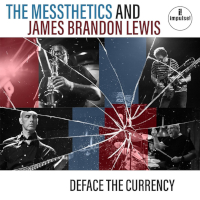 Boasting an album title inspired by the revolutionary actions of the Greek philosopher Diogenes, Deface the Currency finds tenor saxophonist James Brandon Lewis and The Messthetics strengthening a genre-defying, yet seemingly inevitable collaboration. Anchored by the former Fugazi rhythm section of bassist Joe Lally and drummer Brendan Canty, alongside virtuosic guitarist Anthony Pirog, the quartet builds on their self-titled 2024 Impulse! debut with the cohesion of a road-tested band. Recorded just after playing around 150 shows together, the album captures a group no longer discovering its chemistry but confirming it.
The ensemble’s hybrid of post-punk and avant jazz remains intact, yet here it sounds additionally assured, volatile, and expansive. If the debut album suggested a cautious meeting point between styles, this sophomore effort thrives on their collision – balancing tightly structured compositions with unfettered improvisation, veering between groove and abstraction with remarkable ease. The result is both more diverse and more unified, with sharper dynamic contrasts and a darker tonal palette.
The opening title track sets the tone with an aggressive surge of dissonance and kinetic interplay. Lewis’ tenor and Pirog’s guitar spiral together in a pointed harmonic duel, shifting from angular vamp to explosive release, while Lally and Canty generate a dense, elastic foundation. That push and pull between chaos and control defines the proceedings. “Gestations” follows, pivoting into noir-tinged funk, its slippery bassline grounding a gradual ascent toward a blistering climax that suggests Sonny Sharrock’s legendary ferocity.
Elsewhere, the quartet reveals a somewhat more nuanced sensibility. The introspective “30 Years of Knowing” offers a comparatively restrained, midtempo excursion, laced with lyrical unison lines that evoke the post-bop tradition. “Rules of the Game” emphasizes interaction, moving from angular dialogue to full-throttle propulsion, while “Universal Security” begins as a rolling waltz before deconstructing into a maelstrom of freely improvised noise – one of the album’s most dramatic transformations. Even “Clutch,” which opens with Pirog’s atmospheric guitar figures, gradually escalates into a ferocious outburst. These constant shifts in mood and structure never feel forced; rather, they reflect a group with a cooperative instinct honed onstage, listening and reacting in real time.
The album closes with “Serpent Tongue (Slight Return),” a reinterpretation of a track from their debut that doubles as a mission statement. Echoing Jimi Hendrix in both title and spirit, it channels blues-rock swagger through a free jazz lens, culminating in a frenzied, rhapsodic finale. Here, as throughout the date, Lewis pushes his muscular tone to raw, throaty extremes while Pirog matches him with equally unfettered guitar work, the powerhouse rhythm section driving with barely contained force.
Deface the Currency doesn’t surpass the novelty of the quartet’s first effort, although it does compensate with greater depth, range, and conviction. The quartet sounds like a fully realized band now – incorporating explosive improvisations into intricate compositions without ever losing momentum. At its best, the album captures the thrill of four musicians testing the limits of a shared language, forging a sound that is as visceral as it is unpredictable.
–Troy Collins
Adam O’Farrill
ELEPHANT
Out Of Your Head OOYH 042
 Trumpeter and composer Adam O’Farrill has imposing ancestry – son of Arturo O’Farrill and grandson of Chico O’Farrill – but ELEPHANT, his fifth album as a leader, makes clear that his artistic identity is his own. Leading a young, intuitive quartet with pianist Yvonne Rogers, bassist Walter Stinson, and drummer Russell Holzman, O’Farrill incorporates an array of influences – post-bop, indie rock, electronica, and contemporary classical – into a singularly original language. Defined by expressive playing, intricate structures, and collaborative interplay, this genre-blurring statement is his most fully realized work to date.
From the start, O’Farrill’s new project establishes a distinct rhythmic and textural identity. “Curves and Convolutions” opens with interlocking patterns – Rogers’ rapid arpeggios set against Stinson and Holzman’s off-kilter accents – creating a mechanical yet fluid rhythm. O’Farrill enters with sharp, vocalized tones before the ensemble shifts through odd-metered passages and cantilevered vamps, demonstrating a collective improvisational approach where intensity builds collaboratively rather than through individual solos.
O’Farrill’s compositional voice is defined by stylistic contrast. “Thank You Song” channels driving indie rock without sacrificing subtlety, while “Eleanor’s Dance” evokes a retro-electronica pulse – its groove based on a funky backbeat subtly destabilized by cross-rhythms. His haunting rendition of Ryuichi Sakamoto’s “Bibo No Aozora” blends ambient minimalism and lyrical trumpet phrases into a delicate hybrid. Across these pieces, subtle electronic effects – delay, echo, reverb – expand the sonic palette without overwhelming the acoustic foundation.
Tracks like “Herkimer Diamond” and “The Return” further reveal O’Farrill’s command of form and atmosphere. The former juxtaposes hip-hop-inflected beats with tricky counterpoint, moving from introspective calm to impassioned release, with Rogers’ ingenious lines and Stinson’s bass emerging as key voices. The latter unfolds cinematically, transitioning from rubato passages to swing and slow funk, threading together episodes of contrasting texture and mood. Inspired by the final season of Twin Peaks, it highlights O’Farrill’s nuanced control of tone, phrasing, and pacing, as well as the quartet’s ability to navigate evolving structures with sensitive dynamics.
The album’s centerpiece is “Sea Triptych,” an expansive three-part suite where the changeable nature of water becomes both metaphor and methodology. “Along the Malecon” surges with rhythmic urgency, its irregular meter and echo-laden trumpet lines evoking movement and distance. “The Three of Us, Floating” unfolds through minimalist repetition and atmospheric effects that suggest meditative suspension. The concluding “Iris Murdoch” reintroduces motion with an interlocked groove, as trumpet and piano soar in unison over Stinson’s driving bass.
Throughout the session, O’Farrill balances virtuosity with simplicity, ensuring that even the most sophisticated passages retain a sense of emotional resonance. His trumpet – capable of growls, whispers, and soaring lines – serves not as the dominant voice but as one part of the collective conversation, inspiring adroit responses from his bandmates. The quartet’s interaction is rich and democratic, avoiding showmanship in favor of collective expression.
ELEPHANT is a highwater mark in O’Farrill’s burgeoning career. With its blend of rhythmic invention, textural detail, and imaginative integration of disparate influences, the album captures a young, masterful ensemble honoring the jazz tradition while pushing beyond it, sounding both of its moment and the future.
–Troy Collins
The Outskirts
Orbital
Aerophonic ARO49
 It’s hard to address Dave Rempis’s status as a creative saxophonist; he’s less under-rated, I suspect, than simply overlooked. Give any of his recordings a close listen and his position as a major figure in contemporary free jazz should be an immediate given. For those who have missed out on his gifts, Orbital might be the recording that makes Rempis’ stature undisputable.
The Outskirts is a trio consisting of Rempis on alto and tenor saxophones, Ingebrigt Håker Flaten on bass, and Frank Rosaly on drums. This two-CD set presents performances from March 2025: disc one has the trio at Teatro Tomesio in Padova, Italy; disc two adds pianist Marta Warelis to the group for a performance at Rataplan in Antwerp. Disc one presents three pieces composed by Rempis; disc two has two long collective improvisations. Together, the two CDs run over two hours and 24 minutes without a let-up in the creative energy.
The first track of Disc One, “Four Feet of Slush/Glass Part 2,” could suffice to make a satisfying release: a driving rhythm section of hyperactive bass and drums takes flight after an opening invocation, creating an intense and shifting pulsation for a tenor jeremiad of heroic dimensions, shifting positions with the aplomb of a Rollins or an Ayler, actually shifting among those positions, building a vast emotional edifice that covers numerous viewpoints, shifting timbres from gentle to overblown, matching hints to cascading runs in ever changing relationships. A Håker Flaten bass solo follows that is both memorably articulate and exploratory, contrasting internal tempos and registers, sometimes revery, sometimes imaginative flight. Rosaly’s framing leads to his own fleet solo, shifting drums and rapid-fire brush and stick work with the delicacy of tap dancing.
Rosaly’s lightness of touch may inspire Rempis’ switch to alto on his return, but it’s a transformative move, the alto alternately sweet and tart, the duet with Rosaly a kind of shadow dance until Håker Flaten returns with an advanced arco in the upper register, a subtle touch that seemingly inspires Rempis’ exploration of sweetly lyrical, almost muffled figurations amidst Rosaly’s delicate accents, a world away from the opening outburst but nonetheless a complementary one, a series of sounds and shapes that are fused into a singular yet collective emotional map, finally reaching a boppish bounce with a definite theme, an uncoiling Middle-Eastern dance number that might inspire Cannonball Adderley to an Arabian Nights interlude.
“Cascades” begins in the sweetest of ballad modes with Håker Flaten’s sustained tones and Rosaly’s brushes gently lifting the tenor, supremely lyrical, the whole eventually transforming into a swaggering tenor atop a Latinate beat (kin to Rollins’ muscular adventure in bossa nova) before a turn to alto balladry.
“Strafe/Glass Part 1” has Rempis continuing on alto at a medium tempo that plants his exploratory virtuosity very near mainstream territory, a joyous bouncing adventure that similarly brings out the roots mastery of Håker Flaten and Rosaly, the latter contributing a genuinely melodic solo. With the transition to the near dirge of “Glass Part 1,” the trio adopts a radically different approach, Rempis bending isolated notes on his alto to their maximum expressive potential, then turning to a joyous lyricism before an ultimate expressive flurry.
Disc Two begins with a 41-minute odyssey entitled “Spherical Harmonies” with Rempis playing rapid circular upper-register alto patterns in lockstep with Warelis’ cascading complementary lines, Rosaly’s rapid-fire drumming rising in volume. Rempis begins to thin his lines, adding more forceful punctuating honks and Warelis’ patterns become more percussive until the group finds a kind of dense serenity some eight minutes in when Rempis’ sudden lyrical shift surrenders to a balladic shift and a quiet episode of Håker Flaten and Rosaly emerges, still energized but at significantly lower volume. The re-entry of Rempis and Warelis bears a taut, dark-toned tenor melody amid complementary piano flurries while a subtle yet turbulent tension curve in the drums gradually opens up to Rempis’ expressionist rise in volume, his high-pitched sustains alternating with punctuating honks and squeals across the tenor’s range, eventually exploding into constant shifts between a wailing melody and supportive blasts. I can really only keep this account going so long, vague though it may be, and cease around the 20-minute mark as a rapid, pointillist duet emerges between Rempis and Warelis, continuing and developing contrasts in density for the next three minutes until it gradually thins and fades into air, The Outskirts trio and Rosaly’s clicks supporting the harmonic gauze of Rempis’s tenor and Håker Flaten’s bowed bass. Soon the bowed bass part becomes more complex and Warelis re-enters, the subtlest, quietist, and fleetest upper-register piano imaginable growing increasingly rapid and dense with rapid lower-register punctuations. The pairing of Warelis and Rosaly can recall the expansive improvisations of Cecil Taylor and Andrew Cyrille. Rempis ushers in the next stage with some genuinely tuneful alto playing, until eventually the full quartet is multiplying tempos and playing in a zone that few improvisers ever reach. The final moments drift toward sustained chords and modal resonances suspended amidst dense drumming as the entire quartet drifts toward the conclusion, Rempis leading a gradual and focussed shift to silence.
Another piece, “Angular Momentum,” then rises from the ashes on the air of Rempis’ sweetly melodic, barely articulated alto, until a switch to tenor in the same mood gradually ushers in the rest of the quartet in the kind of close-knit conversation in which everyone speaks, however spaciously, at the same time, like a troupe of empathetic commentators. He eventually cedes the floor to Warelis’ dense meditation, but soon returns with an elegantly tightknit tenor line that is at once fleet and sympathetic, all the components of the music reflecting and enjoying a singular interactive space, developing a stunning collective lyricism that presses to the intensity of the late oracular stages of John Coltrane’s journey, until then becoming gauze. It’s a performance that might astonish.
–Stuart Broomer
Ajítẹnà Marco Scarassatti
èmí
scatterArchive
 Brazilian Ajítẹnà Marco Scarassatti is a sound artist, composer, improviser, and instrument builder exploring the micro worlds of sound. He explains it as follows: “My main interest in music have been always what is not strictly music, in other words, what is on the other side, obliging me to cross borders. The relationship with the physical space, the visual form and the concept, my main interest have been using unwanted sounds in order to produce desired sounds.” Previous recordings have incorporated traditional Brazilian instruments, field recordings and site-specific sound installations. For èmí, Scarassatti sticks to E♭ alto saxophone, exploring the elemental sonic properties of the instrument in four pieces incorporating improvisation, overlays, and processing.
Èmí is a Yoruba word for the invisible life force that gives humans breath. Each of the pieces here delve into the interaction of breath and instrument, “foregrounding the perception of breath: air passing through the body of the saxophone, the percussive attack on the keys, the instability of the sound, the search for multiphonics. The saxophone as a resonant body, traversed by breath.” One thinks of reed explores like John Butcher, Seymour Wright, Christine Abdelnour, or Sergio Merce who have each developed ongoing deconstructions/reconstructions of their instruments. The 18-minute-long “èmí 1” begins with the abstracted telegraph of percussive pops of keypads, first as subtle shadow clatters and then slowly layered with the hiss of breath and overdubbed sputtering patterns. Three minutes in, stretched and refracted tonal sighs are introduced while still maintaining the transparent striations of the piece. Scarassatti gradually builds velocity and density, orchestrating countervailing threads into lushly welling sheets of rich timbral detail and rhythmic complexities.
“èmí 2” is more compact study in overlapping tones which are sounded and allowed to decay against each other. While Scarassatti works with trajectory and pacing, the tones stand on their own, never developing into phrased motifs. In the final third of the piece, the reedy layers evoke the quavering sound of an accordion. “èmí 3” is constructed from wheezing huffs, skirls of shimmering microtones, low pummels of keypads, and bass register groans that ebb and flow along the reed player’s breath patterns. The heavily processed “èmí 4” is the most abstracted, with reed tones that are scumbled, granularized and pitch shifted, sounding like transmissions from a distant galaxy. Scarassatti comments that the project is “a reunion with my original instrument, an old acquaintance, a companion species with whom I once again enter into association, in search of new paths.” The results present a keenly personal exploration of the intersection of breath, reed, keypads, and conical bore.
–Michael Rosenstein