Simon Hanes: Transgressive Obsession
by Troy Collins
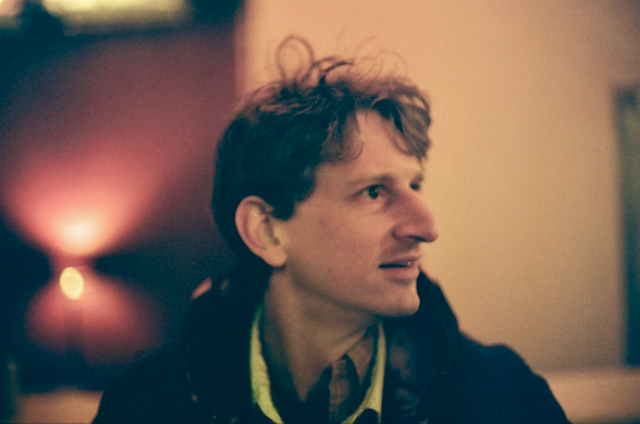
Simon Hanes © 2026 Jacob Garchik
Simon Hanes is a California born, Brooklyn-based composer, performer, and arranger. Hanes’ work unifies his primary influences into a singularly unique style, drawing inspiration from post-war Italian film scores, contemporary classical music, and non-idiomatic improvisation. Hanes composes for, conducts, and performs extensively with his Italian soundtrack-pop ensemble Tredici Bacci, which has collaborated with such musicians as Elysian Fields, Ryan Power, Ruth Garbus, JG Thirlwell, Charlie Looker, Ed Askew, Vincenzo Vasi, and Gary Wilson. His other projects include the experimental surf band Tsons of Tsunami, the extreme noise-thrash trio Trigger (which is an ongoing part of John Zorn’s Bagatelles project); GNR8RZ, a noise/improv quartet with Anthony Coleman, Grant Calvin Weston, and Aliya Ultan; the Brooklyn-based quartet Shimmer with Anina Ivry-Block, Nina Ryser, and Paco Cathcart, and Luxardo, a washed-up Italian lounge singer alter ego, whose performances intentionally devolve into chaos.
As an arranger, orchestrator, and music director, Hanes has worked with Eartheater, Keyon Harrold, and with frequent collaborator JG Thirlwell on his Foetus Ensemble project. He has provided string arrangements for Quilt, Lina Tullgren, Ryan Power, Sessa, Roy Blair, Gruppa Soyuz, and John Andrews. In addition, Hanes has worked as an orchestrator and conductor for the legendary producer Hal Wilner on his 2020 album Angelheaded Hipster: A Tribute To Marc Bolan, working with singers Marc Almond and Emily Haines and has also conducted the Sun Ra Arkestra as part of Harper Simon’s 2022 album Meditations On Crime. His film composition work includes Graham Mason’s Inspector Ike (2020), Carmen Christopher’s Street Special (2021), and Matt Barat’s Cash Cow (2022).
But no prior effort from Hanes is as ambitious as the recently released GARGANTUA. The audacious hourlong epic was composed for a 15-piece band that includes every instrument in triplicate – three electric basses, three drummers, three French horns, three trombones, and three singers. Hanes conducts the unit, making him a sixteenth member. Hanes had long considered writing for a sextet of three bassists and three drummers, but while mountain climbing in Norway in 2022 on tour with Trigger, a more expansive idea came to light. Inspired by volcanoes and Vikings, grindcore and noise, American minimalism and Tibetan drone, GARGANTUA is a unique post-modern hybrid that takes its name from a 16th-century work by French satirist François Rabelais, which highlights the extremes and absurdities of the human condition. I interviewed Hanes during the spring of 2026, shortly after the release of GARGANTUA.
* * *
Troy Collins: Some early biographical information might be of interest to readers unfamiliar with your background. How did you get your start playing music?
Simon Hanes: My initial exposure to music was facilitated and developed by my parents, who are musicians themselves, my dad being a drummer, improviser and experimental computer musician, and my mother being a vocalist and voice teacher. There was a lot of music happening at our house, and a lot of people coming over who were part of my parents’ music scene and who they played with regularly. Several members of my extended family are also musicians. So, it’s a world which became familiar to me very early on in life.
While both brilliant and highly skilled in their fields, my parents have always stood firmly outside the academic music system – they have both spent the majority of their lives as gigging musicians in San Francisco, touring in regionally successful New Wave bands, playing weddings and “casuals,” doing recording sessions and teaching. Their musical community at large reflected this as well – everyone, even the more experimental types was a “working musician” at the core. As my interest in music began to develop, I found that this community was an incredible resource, as everyone was excited and eager to teach me about music. Each person had a different perspective on what was important for a budding musician to soak up, and so I was gradually exposed to an expansive field of musical thought. I’ll never forget when Henry Kaiser came by the house and dropped off two DAT-CDs, one with Frank Zappa’s entire discography (as available at that time) and one with Jerry Goldsmith’s soundtracks to the films In Like Flint and Our Man Flint. This, plus a very early exposure to The Rite of Spring, pretty much set the tone for the development of my musical appetites and interests for the next 20 years.
As a teen I began to develop an interest in what they call capital “C” composition. This was a slightly complicated path to follow, however, as the musicians around me who were so kindly offering to guide my thinking were not bound by such strict guidelines as those following a more academic “compositional” path. They were musical omnivores, enamored by all kinds of music and not tied to any in particular. I didn’t know this at the time, but it’s clear now – they were all engaging with the postmodern musical landscape in their own unique ways. And so, by the virtue of their teaching, so was I, without necessarily knowing it.
At the same time, I had discovered Moe’s Books on Telegraph and, like many before me, it became my temple, along with Amoeba Music. And so, at the same time as being exposed avant rock, punk, jazz, funk, free improvisation, cartoon music (Carl Stalling & Raymond Scott in particular) and film music from the 1950s/1960s by my “musical tutelage community,” I was simultaneously engaged in a self-imposed course study of composition through pocket scores and books on integral serialism bought at Moe’s, and CDs of Boulez, Schoenberg, Webern, Ligeti, and many more composers from Amoeba.
So, by the time college rolled around and I found myself face to face with Anthony Coleman, I was already deeply ensconced in what I now realize was a fairly “Downtown” musical methodology, without being particularly aware of it. And thus, spent the next 4 years digging deeper into the kind of musical thought process, thought now from a perspective of self-reflection, and of trying to gain a deeper understanding of what my influences were, and how I could draw upon them in a way that would inform my own unique musical style. It is from this process that Tredici Bacci was born, as well as Guerilla Toss, the skronk-punk band I co-founded and toured the US in for most of college.
My range of experience has reflected my musical upbringing and my current musical thinking, as melange-inous as it is, and is impacted by the fact that I, in the fashion of the musicians who raised me, almost never say no to a job. As a result, I have done a lot of esoteric shit that I never would have expected, but which often ends up having a major effect on my musical self. Trigger, for example, came pretty much out of the blue, but has been a major part of my life, especially in that it is my main opportunity to connect with a primal energy which exists deep inside me onstage (and which I have drawn upon compositionally in GARGANTUA).
TC: That’s quite a diverse musical background. You mentioned Trigger, and I want to know more about the genesis of that group, but you have a number of projects to discuss, so let’s stay focused for a moment. In your developmental stage were there any influential teachers or mentors (besides your parents) that provided you with previously unknown creative avenues to explore?
SH: Early on, my first guitar teacher, Steve Kirk, was a huge influence. Throughout my adolescence I had a few other “guitar uncles” (as they were referred to at the time) – friends of my parents who played guitar or bass and looked out for me, taught me interesting stuff, or just generally lit beacons which helped guide me on my path. These were John Schott, who I studied with for a period, Henry Kaiser, who used to lend me crazy guitar pedals to play around with (and also hipped me to Frank Zappa), Scott Thunes (who turned me on to Jerry Goldsmith’s soundtracks for Our Man Flint and In Like Flint), and Myles Boisen, who I have continued to work with into the present day and who has mastered many of my albums.
Gino Robair was also an influence for a period. I took conduction lessons from him in high school, at the time blissfully unaware of how integral that particular skillset would become later in life.
In college, my main mentor was the incredible, brilliant improvisor and composer Anthony Coleman (mentioned above), and all possible credit is due to him for expanding my world and my understanding of music. Every lesson with him was mind bending and eye opening; his knowledge of music is truly encyclopedic.
Anthony’s methodology and way of thinking opened innumerable avenues for thought and musical exploration, and most importantly, he taught me the importance of maintaining a strong, rigorous approach to the concepts which form the initial inspiration of a musical idea. It is thanks to his bolstering that I formed Tredici Bacci, which became my primary mode of expression for the next 10 years.
During this same period, I studied with Greek serialist composer Stratis Minakakis, who helped to expand my (admittedly tenuous) grasp on compositional techniques of the late 20th Century, many of which I utilized in GARGANTUA.
In later years, JG Thirlwell and I began to work together regularly, and his no holds barred approach to composition, particularly his extensive use of sampling, has been a huge inspiration, particularly in regards to my solo album Hurricane Salad.
I would be extremely remiss not to bring things into the present day by mentioning the guidance of John Zorn, who through many long, in-depth conversations has helped me to truly understand the true implications of living a life entirely dedicated to the exploration and creation of musical work.
TC: I’d like to address some of these influences individually – especially John Zorn – but first I want to ask you about JG Thirlwell. So, how did you meet Thirlwell and end up working so closely with him?
SH: Upon my first foray into moving to New York (this would have been around 2014) a friend of mine offered me to sneak into a William Basinski solo concert for free. About halfway through the show, I noticed a shock of orange hair poking out of the audience, and I realized that it could be none other than JG Thirlwell, who people had been recommending I try to meet with for quite some time. For most of high school I only knew him as the name of the guy who made the insane music for the Venture Bros., which I watched eagerly and religiously for a period.
I went up to JG after the concert and asked him if he taught lessons (how was I to know?), and of course he said no, but gave me his card. I sent him the first Tredici Bacci record, and about a week later he invited me over to his place for coffee, etc. It just so happened that I was working as an orchestrator for the ... I believe it was the New Hampshire Symphony or something, and JG was looking for someone he could hire (for very cheap) to make a full orchestral score of an opera he had been working on. I spent a summer working on that, visiting him regularly, and after a few months we were as thick as thieves.
Over the next few years we worked together regularly. Initially I mostly played guitar, bass and keys on some music for the Venture Bros. and Archer, and gradually as we got closer we branched out to writing a great many songs together for an (as yet mostly unrealized) album for Bacharach inspired pieces for various invited singers to perform. JG frequently guested on Tredici Bacci albums and live performances. I also did a great deal of transcription and score prep for various chamber, string quartet, and ensemble concert works. I feel that our work culminated in live performances, particularly with the Foetus chamber ensemble, a quintet of piano, violin, bass, drums and harp with JG fronting and singing classic tracks from the Foetus oeuvre.
Throughout our time working together (which has largely come to a close in the last couple years) I had occasion to experience firsthand JG’s compositional approach, which is truly unique and which he uses to create a kind of music which I believe to be wholly unlike any other out there. I’m deeply grateful to JGT for sharing his methodology with me and for all the music we created together over the years.
TC: That’s quite a story. I’d like to continue in a similar vein and ask you now about John Zorn. How did you meet Zorn? How did Trigger come about? What about the Bagatelles? And what is your current working relationship with him like?
SH: I want to predicate this question with a little bit more backstory which I think will provide some insight into this.
Steve Kirk, who was my first real guitar teacher at around age 12, was also an occasional babysitter for me around age 7. During this period, Kirk was a member of the Club Foot Orchestra, a somewhat well regarded San Francisco ensemble which performed music for silent films. At the time, Club Foot (which featured Kenny Wollesen on drums, who I would reconnect with later in life) had a steady gig writing music for a totally psychedelic ‘90s revamp called The Twisted Tales of Felix the Cat. Kirk would bring VHS tapes of the Felix show with him when he came to babysit, and I was always super excited. Those cartoons had a huge effect on me. Years later when I was studying music, Kirk and his colleagues (Myles Boisen, Sheldon Brown, many others) were producing master cuts of all their cues from the Felix cartoon which they called “suites.” Essentially they were making a genre busting, quick cutting 1990s equivalent to the Carl Stalling Looney Tunes soundtracks of the 1940s. I listened to these suites RELIGIOUSLY at around the age of 12, and they really had an effect. I’m sure you can see where I’m going with this ...
Back to the “guitar uncles” I mentioned a couple questions ago. In addition to being patient and kind, they were also very willing to share their knowledge with me, which, as an extension of the musical gestalt at the time, was informed by a voracious hunger for musical exploration which was certainly crossbred with the ethos of Downtown NYC in the 1990s and 2000s.
As a result, by the time I was in high school, I was already soaking up the influences of a great many diverse musical worlds – for example: Spike Jones, Stravinsky, Takemitsu, Varese, Raymond Scott, Zappa, The Soft Boys, The Cardiacs, Ennio Morricone, Nino Rota, Bernard Hermann, Jerry Goldsmith, Louis Armstrong’s Hot Five and Hot Seven recordings, Hank Williams, The Delfonics, Steely Dan, Speedy West and Jimmy Bryant, Duke Ellington, Debussy, Ravel, Webern, Carl Stalling, Raymond Scott, Louis Jordan, Shostakovich, Bartok, Etta James, and many others.
Thanks in part to being somewhat of a nerd in high school, I had also seen a wide swath of classic noir films, 1950s Sci-Fi movies, cartoons from the 1920s-1950s, many Fellini films, and tons of campy old B-movies (thanks to MST3K).
The point is, I was being schooled in the milieu of a decidedly Downtown NYC ethos from a very young age, but I had no inkling of a conception that that’s what was happening until I made my way to NEC and started working with Anthony Coleman, and a few years thereafter started working with John Zorn.
Again, the point is – and this is in no way limited to John – as I have experienced it was innumerable musicians, especially those who were present during the prime Downtown NYC era – curiosity is the ultimate expression of the beauty and vivacity of life. Early on, thanks to the surrounding environment of my adolescence, I was inspired to be curious, and follow any path that seemed interesting. It turns out that curiosity is a shared language, and that language has been passed down from generation to generation of musicians.
On to Trigger – the year after I graduated college I got invited to come back and work with a couple of current students, my (now) dear friends Will Greene and Aaron Edgecomb. We were assigned to play some preexisting Zorn compositions for rock trio, as part of a concert dedicated to his work; John came down to do ensemble coaching’s on the day of the show. Will, Aaron and I worked really hard, and did our best to tap into the manic, aggressive energy that the pieces required ... we really pushed ourselves, and the concert went fairly well. Several months later, I ran into John on the street in NYC, and he mentioned a new book of music called “The Bagatelles” that it might be fun for Trigger to take a stab at. We approached the music with the same energy as we had previously, and as a result of our committed (and maniacal) attitude we became part of the “Bagatelles Marathon” crew of musicians who had the opportunity to travel around and play various festivals abroad. It was a very important experience for all three of us to be presented in concert alongside older, more established musicians, many of whom we revered. I believe that those experiences taught us a lot about how those musicians approached their work – and had a huge effect on how I approach all musical projects I’m involved in, to this day.
TC: Plenty of critics have observed what a culturally stratified society we live in now in our post-internet age, and how that historically affects the artistic continuum. In contrast, it seems you’ve had the benefit of an old school musical education based on mentorship and apprenticeship. That’s somewhat of a rarity these days, but your musical upbringing, as you so astutely described, does help explain your omnivorous artistry and thus your aesthetic predilection for being inevitably aligned with the Downtown scene.
Your own projects mirror that scene’s all-encompassing approach (Tredici Bacci, GNR8RZ, Tsons of Tsunami, and Trigger, to name but a few), and I want to get to them, but first, let’s acknowledge your work with the masters.
Your numerous collaborations with a prior generation are impressive and not all that common. So, in light of your multi-generational collaborations, since we’ve already talked about JG Thirlwell and John Zorn, can you tell me how you came to work with Anthony Coleman and Fred Frith?
SH: Your point is well made. When I look back on my musical upbringing, it’s clear that I was learning from people who communicated an integral part of their own musical identity, as well as their passionate curiosity, into their teaching, more than just communicating formulaic musical information.
So it is with Anthony, both as a collaborator and a teacher. We came to playing together very naturally ... like any responsible and enterprising musical educator, he has a tendency to enlist current and former students for many of his own projects – and during my stint at New England Conservatory he had assembled a kind of Contemporary Improvisation “Honors” ensemble, called Survivors Breakfast, which performed and recorded pieces of his own, as well as by students. I had the honor of participating in that ensemble for a few years. Point being that a great deal of my improvisational approach is a result of work I did with Anthony, before and after school. Anthony has an energy that I feel to be painfully lacking in younger generations of people who free improvise ... an energy I can only describe as a sense of transgressive, perverse glee in his playing. This was always deeply important to my musical approach, and it resulted in a great many performances in which you can literally see Anthony ear-to-ear grinning like idiots at one another while crash-banging and making all kinds of horrible noise.
Anthony just goes for it. He knows how to dive in and just play and let the whole thing work itself out. In GNR8RZ, that quality was something all four of us shared, the willingness to just dive in and party within the chaos. My theory is that Anthony and I know we can always rely on each other for a certain kind of energy and approach to playing. And whenever we devise situations that require that energy, we call upon one another.
Similarly, Fred is also (obviously) a bastion of the improvisational energy, wit and thinking of previous generations – a time when musicians treated improvisation not simply as a stylistic option among many but as a life or death, a step in the steady progression toward something truly new. Once again, I have to go back to my guitar uncles for this one – at some point, in my youth, I was given a CD copy of Live Love Larf & Loaf by French Frith Kaiser Thompson. Undoubtedly this was one of Henry Kaiser’s schemes to permanently warp my brain, alongside introducing me to Buckaroo Bonzai. I listened to the record pretty obsessively for a spell, and so Frith has been an influence long before we met. Alongside that, Myles Boisen (my dear, dear friend and a truly exceptional mastering engineer) has spent a lot of time working with Fred over the years.
In the end, our first encounter took place less than a year ago. I’m planning a series of concerts around my 35th birthday in late June, and as part of that I really wanted to find an opportunity to work with Fred because every time I’ve seen him play I’ve been completely blown away by his consummate musicality and conceptual freedom.
So, we met for coffee in the Bay Area and, and Fred was obliging enough to listen to my schemes, and what started as one simple June gig morphed into some trio gigs with Nora Stanley (dear friend and fellow Californian) and then a quartet set with Jordan Glenn and Max Jaffe at Big Ears. Again, if it were possible to try and quantify what makes certain members of the Downtown Old Guard so badass (and Anthony and Fred are no exception) it’s their curiosity and their inveterate “down”-ness.
TC: In regard to this statement: “Anthony has an energy that I feel to be painfully lacking in younger generations of people who free improvise ... an energy I can only describe as a sense of transgressive, perverse glee in his playing.” I’m curious, what about “inside” versus “outside” playing? I would have suspected that most musicians you play with are comfortable playing across multiple genres, but not every musician is willing to play “out.” How often do you encounter that, or is that not as much of an issue with the artistic circle you most often find yourself in?
And in a similar vein, what are your thoughts regarding “pure” free improvisation compared to more traditional theme and variation-based strategies – how do you negotiate the differences between the two in different settings?
SH: Hmmm, interesting and tough question. For me, the distinction between “outside” and “inside” is a bit tenuous.
As I might have referenced somewhat indirectly, I was raised in an environment where the lines of distinction between certain kinds of improvising were very blurry. This is partially because the musicians I learned from early on all had “free improvisation” as part of their methodological tool-belt. I also did not receive anything that resembled training in “jazz” improvisation, which is what comes to mind when you mention “theme and variation-based” strategies.
However, there are so many kinds of music which utilize a thematic and variation type improvisational concept, and which have in some way been influential. Good old classic rock and roll, for example, seems to adhere to a version of those rules ... as well as a great many modal musics from across the globe. Most recently, I’ve been totally blown away by the expression of this in Indian Classical music and Irish Traditional music. In those musics (among many others) the improvisational element is about how to effectively operate within that specific language, which is in some way delineated by information within the music itself.
As a result of the somewhat specific bent in my own background, my concept of improvisation (and this is an idea I’m somewhat formulating as we speak) is almost entirely based on the outlining of distinct parameters and subsequently operating within them.
In GARGANTUA, for example, the handful of improvised sections in the piece are outlined specifically in terms of certain musical parameters (pitch set, timbral world, or simply a series of directive adjectives) which serve as signposts to guide the performer towards or away from a specific sonic environment. The idea is that I know what kind of world I want to achieve, and sometimes the most effective way to manage this is by creating an outline for the musicians to perform within.
In Tsons Of Tsunami, as another example, the fun tension of the improvisational elements are that anything IS technically allowed, and it’s up to the musicians how far they want to push the parameters. The musicians are capable of imagining pushing things far far “outside” to the realm of pure chaos, but do not always choose to do so. Sometimes I have to do the pushing in that direction.
The miracle of truly “free” un-delineated improvisation is that the parameters are dictated by the unique musical identities of the performers themselves; the limitations are prescribed by what that particular group of musicians bring to the table. With this in mind, free improv is capable of becoming an incredibly direct form of musical communication.
TC: Speaking of GARGANTUA, John Zorn has called it a masterpiece, and the New York Times ran a recent profile on you focusing on the piece. It is one of the most strikingly original albums I’ve heard in a long time, on both a technical and creative level, so all the praise seems justified.
One aspect of GARGANTUA I find fascinating is your irreverent incorporation of transgressive art and aesthetics – aspects that are largely unexplored anymore in the post-PC artworld, where being potentially offensive is no longer accepted the way it once was. This outlook also seems very rare among a younger generation, of which you are a part. How does this approach go over with your peers? What are your audiences’ reactions to this material? Or have you simply already “found your people?”
SH: It’s been a serious honor that people are digging the record and saying such kind things about it.
It’s actually turning out to be kind of complicated to answer this question, and I think it’s because I’m realizing that as a concept, transgression exists in multiple layers for me. One is on the service level, which would be represented in GARGANTUA by the old French text (lifted directly from Rabelais) about pooping in “Knockandrow,” or that fact that a section of “Submit To The Fabulosity” calls for the singers to hurl insults (and occasionally objects) at me directly. For me, connective references at this layer are early John Waters films, some Zappa (usually the most musically uninteresting if I’m being honest), and definitely some aspects of Rabelais’ writings, but not all. It’s shocking, and pushing the boundary of what might be termed offensive, but you’re not going to get anything worse than an explicit lyric advisory tag or an R rating for that kind of thing. Social mores, etc.
Then there’s a second transgressive layer which is more about the joy of chaos, excess, things that challenge the idea of defined order. This one feels more like giving the finger to and daring them to react. British prog master Tim Smith does this a lot, particularly on early records with his band Cardiacs. In “Submit To The Fabulosity” for example, it’s including quotes from The Indiana Jones theme, The Right Of Spring, “Smells Like Teen Spirit,” “Immigrant Song,” a Xenakis orchestral work, Mozart’s Don Giovanni and Sum 41’s “Fat Lip” all in the span of about 30 seconds. Presenting all these musical ideas in a way that removes any possible distinction as to a hierarchy of quality feels like a transgressive act in reaction to longstanding notions of high and low art.
“The Number Of The Beast Is 666” is similar in the sense that its basically “nahny nahny nah nah” renaissance brass music; “Lacerated By A Flying Shard” is meant as a kind of invitation for the musicians to exercise some demons – for example there’s a section where the French horns are explicitly directed to play their least favorite orchestral excerpts as poorly as possible.
Finally there’s the deepest layer, of transgression, which I think is the one that spoke to me about Rabelais beyond all the hilarious shitting and pissing and fucking: committing to an artistic path which is foreign to the generally accepted societal norms of the time, and refusing to be blown off course by the winds of passing fads. Rabelais, John Waters, Zappa, Tim Smith, and other influences of mine including Alfred Jarry, Eve Babitz, James Campbell, James Joyce, (as well as the abovementioned bastions of the NY downtown scene) are all examples of this for me.
These are people who were (or still are) deeply obsessed with their work, and committed to their vision, and as a result of their refusal to compromise, their contribution to their respective fields have stood the test of time and inspired subsequent generations. Some were eventually recognized and lauded for their work, some were driven to ruin. Maybe the social conventions have changed over the years, certainly they’re very different now than they were in Rabelais’ renaissance Europe, or turn of the century Dublin, or even NYC in the ‘90s, but what has remained, I think, is the overarching societal pressure that humans feel to operate within certain structures and behave in specific ways. Any time someone commits themselves to operating outside of these structures, they are being fundamentally transgressive.
So yes, I’ve found my peers in the sense that I’ve established that this lineage is important to me, and I feel connected to this lineage, as well as to other living musicians and artists who are having the same experience. As for my generation as a whole, I don’t feel a particularly strong sense of connection, and I’ve made my peace with that.
TC: The obvious follow-up question is what is it about your generation (from your perspective at least) that prevents you from feeling a strong connection to it?
SH: I’m not sure how to describe the feeling except in the terms I’ve already used – essentially, I pretty much only feel connected to musicians and artists who are driven by their obsessions. and somehow, having obsessions doesn’t seem to be a shared theme amongst the larger swath people roughly in my age group.
TC: Continuing a theme, while some of the subject matter of GARGANTUA is inspired by Rabelais’ more transgressive work, there are other aspects that are conventionally beautiful and harmonious (the female vocals in “Moirai” for example). Tredici Bacci is often very accessible, yet GNR8RZ is quite the opposite, while Tsons of Tsunami courts both extremes.
That said, do you ever feel the need to keep your musical worlds separate? Or is there enough cross-over between your various engagements and skill set that you feel you can do most anything in each setting?
SH: To my view, the concepts of accessibility and conventional beauty are highly subjective and based on context. For example, Tredici Bacci performances and recordings have often been presented in the context of “pop” music, and through that lens the band has often been judged as comparatively inaccessible. Alternatively, GNR8RZ – essentially an improvised noise project – was always presented in an environment where listeners were primed and excited to hear a bunch of freaks make noise, and thus we had access to a very receptive and open audience at every show.
The throughline, as I see it, comes down to energy and communication. Tredici Bacci and GNR8RZ (as immediate examples) are both vehicles of a similar energy – an explosive, joyous, frantic, excessive, sometimes violent, sometimes sublime instance of musical expression. Sometimes this feeling, or certain aspects of it, are best expressed with noise, and sometimes with consonance.
The same goes for GARGANTUA as well as Tsons ... And as I continue to make work I find that my musical ideas continue to distill further and further into more concentrated versions of themselves. I’m saying this because you mentioned Tsons of Tsunami as courting both extremes of transgression and harmoniousness – and having just finished up in the studio with the Tsons for a new record, I find that the “transgressive” pieces are more unhinged than ever before, and the harmonious ones are more so than ever as well. After GARGANTUA, I feel much more able to be patient in music with requires restraint, as well as able to truly commit to making a huge, loud, chaotic ruckus.
Rather than treating this as stylistic shifting, I’m conceiving of it as two poles on a spectrum of expression. Furthermore, they’re meant to express the same thing, though in opposite ways – for example the vocal trio piece “Moirai” in GARGANTUA is an expression of quiet reverence for the power of volcanoes to dwarf humanity ... to reduce it to meaninglessness, and to remind us of the vastness of eternity.
By the same token, pieces like “Hekla 1970” or “Lucifer” are inspired by and meant to evoke the same sense of awe, but this time through sheer volume, terror, violence, or ecstatic joy. The feelings I’m expressing are two sides of the same coin. They feed into each other in terms of scale ... The loud ones feel more loud when compared with the quiet ones, and visa versa. The two extremes combine to form a unity which I believe is a summation of what I am trying to express with music, which is reverence for the power of sensations which can be felt but are on the verge of being outwardly inexpressible.
So no, there is no separation in my musical world, because all aspects of it are meant to express the same idea, just in different ways.
TC: Speaking of dualities, in reference to performing, how do you feel about studio recording compared to live performance and how does that affect your playing in each situation?
SH: I guess I would say that it’s a mistake to consider the two situations as a duality ... to my mind, rather, they are extensions of the same overarching process of making music. That having been said, it is true that situations are very different. Studio work is a process that takes place outside of narrative time, in the sense that you can spend hours editing and refining something that will exist only as a moment to someone who listens to the finished recording. This is indeed a luxury. However, I think that in return for this luxury one sacrifices the ability to communicate with an audience on a direct energetic level, where performer and audience are existing in the same field of time and space. Conversely, live performance has the power of direct energetic communication, without the luxury of refining or sculpting.
With that in mind, and having just spent some time on the road as well as in the studio, my ideal would be to successfully bring some of the spontaneous, energetic aspects of performing live into a recording context, and bring a stronger sense of refined attention to live performance situations. both of these ideals actually fit into one another to form a continuum - for example when you rehearse a bunch (or play some gigs) before going into the studio, you’re able to be more free and spontaneous while tracking, and I’ve found that recording music can solidify it in such a way that it becomes easier to effectively, confidently play it live later while still allowing room for intuition, inspiration, and magic to strike.
TC: In the same line of thought, since you mentioned growing up with access to hard media, what are your thoughts on the state of the recording industry, especially regarding archival copies (CDs, LPs) versus more ephemeral formats (downloads, streaming)?
SH: I think a more accurate description is that I came up in a liminal time during the transition of hard media to digital formats. For example, Limewire was equally as important to my process of musical discovery as burned CDs brought over by guitar uncles were.
Not to mention – HUGE SHOUT OUT to WFMU’s beware of the blog which was a huge resource when I was in high school and made me aware of a lot of crazy stuff that has affected me to this day. I still sometimes search out old blogs that are still up and host downloads of crazy music that it’s impossible to find anywhere else.
As for the recording industry, it’s totally fucked, but we all knew that. Physical media has been reduced to a boutique medium, with the possible exception of CDs ... and streaming sucks. My biggest problem with both is that the medium has been divorced from the power of what it contains. LPs (and to a lesser degree cassettes) may function as a symbol of a certain kind of status or cultural awareness, but the millennial douchebags I’ve meet over the years who treat their LP collection the same way they treat their boutique espresso machine or whatever are most likely to buy the same 45 dollar 180-gram vinyl reissue that all their friends are buying.
I see streaming as a similar inverse to this, in the sense that the algorithm used for listening recommendations can only quantify music by its most superficial layer of attributes. This means that not only are you sacrificing your ability to forge your own explorative path through the history of music, you’re submitting your will to a machine that is trained not to understand what makes music good (it never truly could) only what makes it the similar to other music. Who the hell wants that? I want to blast around the musical stratosphere with a jet pack picking and choosing the things that feels decidedly relevant and exciting to me, whether its Stockhausen, Irish folk music, or brutal death metal.
And now (not to rant) an entire subsection of the music industry has popped up that is designed to capitalize on sameness. I’ve done string arrangements for albums that are designed to sound as similar to Curtis Mayfield hits as possible, simply banking on the knowledge that someone who is not listening critically won’t be able to tell the difference if the song comes on in the background one afternoon.
Point being – if you came up in an environment in which the spirit behind the music being made is one of the fundamentally important aspects, then these structures feel like a complete travesty – a denial of that which made the process of musical discovery compelling and inspiring (to me at least) as a youth. All this to say, these days I use Soulseek.
TC: In conclusion, what other musical projects do you have planned for the immediate future?
SH: The truth is, I tend to keep these kind of things close to my vest a little bit.
However, I do have a new Tsons of Tsunami album in the can, which I am excited about.
And this month (June) I’m having a 35th birthday celebration series of concerts at The Stone, Barbes, Life World, and The Lava Club, featuring: Tsons of Tsunami; a quartet with Billy Martin, Anthony Coleman, and Matt Maneri; a duet with Jorge Roeder; The Californians (with Fred Frith, Ches Smith, and Nora Stanley); music from Hurricane Salad; a full version of Igor Stravinsky’s L’Histoire Du Soldat; A full performance of GARGANTUA; a trio of trios, and a performance on solo baritone guitar, among other things.
© 2026 Troy Collins