Moment's Notice
Reviews of Recent Media
(continued)
Ingrid Laubrock + Tom Rainey
Brink
Intakt CD425
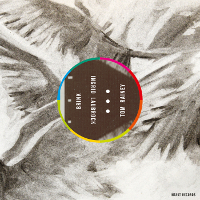 With Brink, their fifth outing as a twosome, the question must be whether saxophonist Ingrid Laubrock and drummer Tom Rainey have anything left to say to us. If the answer was no, then this would be a very short review. Happily, that’s not the case, and as you may guess the response is a resounding yes! They remain a superlatively empathetic pairing blessed with boundless imaginations, as evidenced by the 60 weekly episodes of Stir Crazy, duets recorded at home during lockdown, and still available from Laubrock’s Bandcamp page.
While Laubrock receives exclusive composer credits for eight of the 13 cuts, with joint authorship indicated for the remainder, there is little to differentiate them and they could all pass as on-the-fly extemporizations. That’s not to deny the clear sense of intent and structure the pair impart to almost everything here. Such attention to form is what helps distinguish the truly great improvisers and both Laubrock and Rainey belong in this camp. Of course, Laubrock has a growing reputation as a composer of note too, which makes it all the more pleasurable to hear her in this pared back setting, with the focus on her saxophone.
The astute programming also shows attention to form at the macro scale. Seven saxophone/drum exchanges (with Laubrock mostly on tenor) alternate with six textural mood miniatures of around a minute each (with the saxophonist mostly, or perhaps entirely, on soprano). Everything is lovingly captured, allowing full enjoyment of the pure sound: whether that be subtle changes in inflection, the decay of reverberation from the bass drum, or the squeal of brush end scraped across metal. Both participants are fearless sonic explorers, which manifests in a constant searching that has been thoroughly assimilated into their respective languages.
Laubrock’s simultaneously poised and experimental voice comes through loud and clear, with an elegance and lightness of touch which suggests what it might sound like if Lester Young had wandered into a downtown improv session, though she can break into a passage of explosive skronk or blaring multiphonics, all the better setting off what came before. Rainey meanwhile possesses an armory equal to any approach, whether fulfilling the role of sensitive accompanist or willful provocateur.
They just work so well together. The smooth contours of the opening “Flock of Conclusions” verge on melodic, Laubrock’s phrases cleverly colored by false fingering, as Rainey’s gentle brushwork eases in behind. As the playing opens out, tenor fluttering, hinting at klezmer, the saxophonist moves into a series of continually reworked figures with the drummer, on sticks by now, etching a crisp, propulsive underpinning barrage. Then gradually they find their way back to the initial lovely low-key gambit. There are any number of similar examples. Mention must be made of “Scrunch Repercussions” however, the standout track for any radio hosts reading, which culminates in Laubrock intoning a staccato mantra over a succession of morphing grooves.
Elsewhere by contrast, the spacious, almost forlorn “Liquified Columns” comprises a sequence of sustained tenor overtones, set against a sparse foundation of cymbal shimmer, kick drum rumble, or tolling hit, until the split tones take on a nerve-shredding quality. While crossing comparable terrain, the closing “Said, Been Said” strikes a more meditative pose. Yet more extreme timbral adventuring characterizes each of the half dozen “Brink” pieces, from the almost electronic sine wave soprano paced by gloopy sighs and scuffs of “Brink I” to the breathy ocarina sibilance and rattly percussion of “Brink IV.” However, I must admit that I was glad that the nasal infant/cat in heat yowling of “Brink V” lasted little more than a minute. But regardless, in masterfully finding new ways to operate and interact, while continuously refining existing modes, there is little sign that Laubrock and Rainey are anywhere near exhausting their fount of creativity.
–John Sharpe
Paul Lytton + Georg Wissel
Loose Connections
Confront Recordings CORE 46
 Paul Lytton and Georg Wissel have been working together as a duo for almost two decades now but this recording, capturing a 2021 set they played at LOFT in Koln, appears to be the first document of their project. Lytton has been plying his ample collection of percussion, electronics, and astutely selected resonant detritus in duo formats since the early 1970s with musicians like Evan Parker, Philipp Wachsmann, Paul Lovens, Ken Vandermark, and Nate Wooley. While strategies may differ, each partnership highlights Lytton’s keen ear toward the placement of nuanced sound in expansive, spontaneous interactions. On his web site, Wissel describes himself as sculptor of compressed air via augmented saxophones, clarinet, and other soundsources, honing his approach toward improvisation in solo settings and in collaboration with musicians including Burkhard Beins, Thomas Lehn, and George Cremaschi.
From the first fricative pops and metallic clinks, the two lock in across three improvisations, each ranging from 12 to 17 minutes. They build a taught, propulsive flow of intersecting activity with Wissel’s frayed tones, burred fluttering multiphonics, breathy hisses, clipped flutters, and percussive pad pops and ticks melding effortlessly with Lytton’s subtly deployed brisk spatters, scuffed scrapes, nimbly-placed clangs, rustles, and clatters. The music progresses with incisive focus and measured deliberation, displaying a deft sense of density and velocity. The two deftly weave together sections of stasis and fractured angularity, dynamic minutely juddering gestures and tremors, and sparse timbral detail.
The open arc across the three improvisations balances parallel explorations of textural abstractions with a brisker approach toward gestural activity. Wissel’s pinched, stabbing phrases and bent multiphonics bound across the bent resonance and skittering angularities of Lytton’s percussion. The third improvisation is of particular note. They begin with Wissel’s reeds sounding almost like a shō, with buzzing overtones buoyed by Lytton’s pin-prick attack, stuttering cascades, and bowed shimmers. Gradually, a thread of pointillistic interchange emerges, with velocity that ebbs and flows until a sudden break of silence. That serves as a launching pad for a final section of hushed, calmly coursing deep overtones and whispered, scuffed surfaces bring the set to an adept close.
–Michael Rosenstein
Mother Mallard’s Portable Masterpiece Co./David Borden
Make Way for Mother Mallard: 50 Years of Music
Cuneiform Rune 513/514
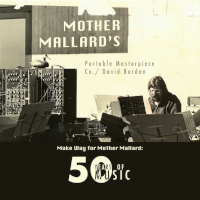 The term minimalism is one of the most overused and misunderstood descriptors in music. Just as its history is really being written – witness On Minimalism, the new primary source volume by William Robin and Kerry O’Brien – we are inundated with more and more sub-par imitations of the timbral and harmonic complexities imbuing early minimalism’s pioneering spirit. Among that zeitgeist’s myriad manifestations, David Borden and his group Mother Mallard’s Portable Masterpiece Co. has received relatively short shrift. Now, as one of the highlights of Cuneiform Records’ 40th anniversary year, they have released a double-disc anthology documenting the synthesizer ensemble’s early recordings and, after fifty years, the project’s culmination.
David Borden’s interviews speak to a compositional vision steeped in several traditions, improvised music and the Western European Art Music canon being two of them. Mother Mallard began its life in 1969, though it’s first album didn’t see release until 1973, on Borden’s Earthquack label. Both of their 1970s albums were reissued on Cuneiform, whose fourth release in 1985 was another Borden effort immediately presaging the staggeringly inventive 3-CD set The Continuing Story of Counterpoint. If ever a work smashes headlong against the supposed boundaries established by the term minimalism, it’s this 12-part epic. Composed between 1976 and 1987 and released in toto between 1988 and 1990, it may be Borden’s magnum opus. In elucidating his approach to counterpoint, Borden makes the comparison with Bach’s cello suites, in which each line of music might imply several simultaneous lines. That would afford complexity enough, but Borden combines up to ten lines, each engaged in this multivalent series of exchanges. However, rather than imitation, Borden uses repetition as he constructs modules that owe a debt to Terry Riley’s In C. Counterpoint is abundantly represented on Make Way... in pristine new interpretations by what would turn out to be the final Mother Mallard incarnation, featuring keyboardists David Yearsley and Blais Bryski along with Gabriel Borden, David’s son. These occupy the second disc, each arrangement somehow more transparent and clearly executed than its late 1980s counterpart, fantastic realizations in their own right. Compare the opening minutes of “Part 6” in its earlier incarnation, distorted electric guitar to the fore and centerstage, with its 2019 foil, where each contrapuntal strand occupies a separate portion of the soundstage. One contains dyads, its juxtaposition with the other more rhythmically active line stark and clear. The model holds true as other threads weave and interweave an endlessly complex tapestry. This is not imitative counterpoint, or not strictly. Rather, centers are established and then switch with surprising rapidity, as sonorities surrounding the pitch C slam into similar structures encompassing E at 4:48. Each musical strand stretches to reveal components without ever loosing direction. The attendant harmonies are as complex as the pallet of sounds purveying them, though in 2019, each component is razor-sharp and absolutely spotless. A similar aesthetic might be observed in recent “historically informed” versions of Bach’s Art of the Fugue. Where the earlier version of “Part 6” is an immersive and viscerally opaque experience, ending with guitar glissandi flanking the pauses, the 2019 remake removes the guitar shredding, none of which is to imply that guitar is lacking in the new versions. David ensures that Gabriel’s work in “Part 5” is even more rawly present than before, especially with his stinging low-register sustain beginning at 8:12. Beyond these matters of detail and power, there are the bass lines, so important to the overall conception as they define the music’s centers even as the surrounding harmonies grow and morph. They are recorded with astonishing depth, like slightly dark chocolate hardening, enriching everything that touches them.
The first disc, prominently featuring Mother Mallard’s first incarnation comprising Borden, Steve Drews and Linda Fisher, provides what might be construed as the blueprint for the Counterpoint series, but of course, that’s as reductionist as calling Borden a minimalist. “Endocrine Dot Patterns,” from 1970, combines synthesizers with Woody Peters’ trumpets in swatches, loops and slithering rhythmic muscularity that justify while never quite signifying the title. The piece is radically different than anything else on offer here. It does, however, illustrate the point, to be made repeatedly throughout the set, that no harmonic punches will be pulled, and that every center lays the groundwork for another, adjacent or otherwise. Dots and loops glide buy with ambiguous complexity, taking any notions of genre down the proverbial garden path as sounds slide and pulse along the stereo spectrum. With 1973’s “CAGE I,” the varied harmonic ingredients and ostinati were gelling to become what we hear as the Mother Mallard sound. The concert version of “Anatidae,” from 1978, including Judy Borscher and Chip Smith, seems to be a more open form than the Counterpoint pieces, sections signaled by varied repetition, though, as the studio version originally released by Cuneiform has yet to appear in the digital realm, I have yet to hear it. There is certainly enough modularly composed material to keep the music flowing, and sonic clarity points the way toward future projects.
The set’s final two pieces are culled from the group’s concluding performances. Unpredictable as ever, “Counterpoint 12B” gets a sonic makeover, drummer Tom Killian and vocalist Louise Mygatt changing the entire feel, and when the music swings into the final E-flat chord, the effect justifies the exuberant applause. It isn’t simply that the composition is as superb as the concept is endlessly intriguing. We are hearing Borden’s history in wonderful palimpsest as the sounds from much of his career align as if in tribute. The Cornell audience witnessed history in the making and understood it, and we are now afforded the same privilege.
–Marc Medwin
Claudio Sanna
Compositori Sardi Contemporanei II
ezz-thetics CD1057
 Annotator Mark Corroto describes the music on Compositori Sardi Contemporanei II, pianist Claudio Sanna’s second such survey, as akin to the wine-tasting experience. It’s a wonderful extended metaphor, but I hear these compositions more as a unified topography, even pictorial, evoking a diverse landscape in which the piano functions as centerpiece and conduit for all that occurs, even when it is not present. In that case, it functions by implication.
The two-disc set is an expertly programmed narrative of discovery in constant flux. The album’s opening piece tells that particular tale in microcosm as bassist Anna Zerlotto pulses, snaps and scratches her way through Adriano Orrù’s “Cosmogonia Semplice,” composed for acoustic bass with preparations. Even the opening seconds reveal the layers hidden beneath the music but propelling it forward along paths of disparate timbral simultaneities. A second listen reveals the layers of overtones, possibly harmonics, that Zerlotto coaxes from the instrument, accumulating even as they change. The miniature is based largely around only a few reiterated pitches, but what is exposed, with majestic virtuosity, is the underlying sonic stratifications harkening back to John Cage’s prepared piano experiments of the early 1940s. Orrù’s tiny masterwork leads into the equally prodigious “Eos-Phobos,” Alessio Carrus’ mythological and dynamically inclusive musings which focus, again, on various pitched reiteration, in octave displacement and with extraordinary dynamic contrast. The second piece might have been written as a sequel to the first, so similar is its initial rhythmic syntax and streamlined complexities. However, as the piano miniature unfolds, it seems to relax, its returns fading into near impalpability in Claudio Sanna’s more than capable hands until its structure is demonstrated to be quite different, a gradual departure toward more silent territories. The final piece, evidently the first in a series called “Beats Etudes” by Michele Sanna, revisits these opening forays in a more orchestral context. It sounds for all the world as if electronics are employed, but no indication is given in the liner notes. There are certainly piano preparations and what sounds like bowing, linking the exploration back to the album’s opener. The final minute of the pithy miniature lays bare the piano’s innards, slowly fading as the piece is drawn toward a luminously mysterious silence.
Focusing on these contributions describes the frame but not the journey. There is no way to chart the vast tracts of sound and silence awaiting the intrepid listener. At one point, the piano suddenly emerges as a toy, a perfect vehicle for Silvia Corta’s “Quattro pensieri per il nuovo anno,” which Corroto compares, insightfully, to Monk’s 1957 use of a celeste. These sparse introspective and, by the sound of it, microtonally inflected vignettes are preceded by the similarly layered “Nodas 14,” on which Gabriele Verdinelli includes ghostly vocals and live electronics, again using the piano as a point of departure, detuning many of the sonorities and completely recontextualizing them in the process. The same types of exploration pervade each stop along this leg of the Sardinian journey, whether involving two pianos, some combination of piano and electronics or simply elucidating the numerous felicities of Sanna’s extraordinary technique and virtuosity. The recording and production are superb, but this fact will surprise no one familiar with ezz-thetics releases. The set is a vivid encapsulation of a scene in obvious and continuing flux, aware of its various pasts but always willing to embrace the sonic expansions and accumulations they imply.
–Marc Medwin
Scarla O’Horror
Semiconductor Taxidermy for the Masses
Bandcamp
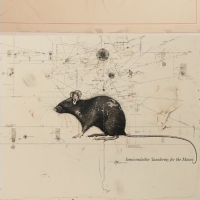 Formal considerations can be paramount, especially when so thoroughly linked with structure. It’s much easier to tell students to provide a strong thesis than it is to ensure that they do it. To suggest that the quartet calling itself Scarla O’Horror would be fine students does not, in any way, suggest that their music is academic. It’s anything but! Rather, like the most convincing use of what Schoenberg might have labeled a grundgestalt, the quartet begins its second album, Semiconductor Taxidermy for the Masses, with just such a thesis, or what the group calls an overture. The usefulness of this opening few minutes in forming the entire listening experience is nothing shy of astounding.
While saxophonist and clarinetist James Allsopp and trumpeter Alex Bonney limit themselves to playing acoustic instruments, drummer Tim Giles is also credited with electronics, and it seems to entail Isambard Khroustaliov’s main contribution. The album was recorded over a day of interacting with computer-driven synthesizers that were trained to listen and respond, the players responding in turn. It’s all certainly more complicated than that, but the group is insistent that nothing is sampled. This multileveled interaction is laid bare on the brief but absolutely essential “Racoon with Wound,” obviously a hat-doff to the late 1970s industrial at its spare core. If those are not sampled key clicks and timbral outgrowths from the trumpet forming the crystalline ooze from which a series of sonic complexes grow, they’re too close for comfort. Each sound particle from trumpet and saxophone, no matter how minute, is absorbed and then given space by the variously layered electronics, pitched, environmental and whatever combination might be required. Like a Webernian aphorism, the fragment is Scarla O’Horror concentrate, a perfect blueprint for the ensuing two pieces’ dialogs.
The stage is set, and the ear quickly acclimates to the longer pieces’ convergence of jazz-adjacent languages of which moments must be indicative in this context. Group size is one of the most interesting purveyors of those transformations. Dig the chamber music vibe beginning at 7:12 of “The Rats of Gillet Square” as machine-learned sounds encircle their live counterparts in hushed pointillism or the way electronic dots and slashes punctuate Giles subtle brushwork 5:35 into “Ermine Chowder.” Yet, the quartet has no trouble letting rip when circumstances demand it. “Gillet Square” documents the group metaphorically exploring 1960s New York, especially 2 minutes in, where all members fire on an equal number of cylinders, groove, line and timbre bound up into a sonic conglomerate that is equal parts Meditations and Jazz Composers’ Orchestra shot through with interplanetary atmosphere.
The net effect is that each instrumentalist’s sound grows in size and scope. As each piece undergoes its changes, never conventionally harmonic at their roots even as oblique harmonies abound, electronics enhance and highlight without monopolizing focus. Like Boulez’s assimilations of acoustic instruments and electronics defining pieces such as “Anthèmes II,” Scarla O’Horror has mastered the use of musical community-building through sonic subtlety. They’ve humanized the machine, so that when the music reaches its conclusion – every bit as convincing as the thesis – its ambient sizzling and gorgeous trumpet solo have been so completely prepared that an authentic cadence seems to lurk in the shadows. Neither too long nor brief, the album combines the best of visceral spontaneity and macro-planning, the results both an accomplishment and a deeply satisfying journey.
–Marc Medwin