Karl Evangelista: Improvised Self-Expression
by Troy Collins
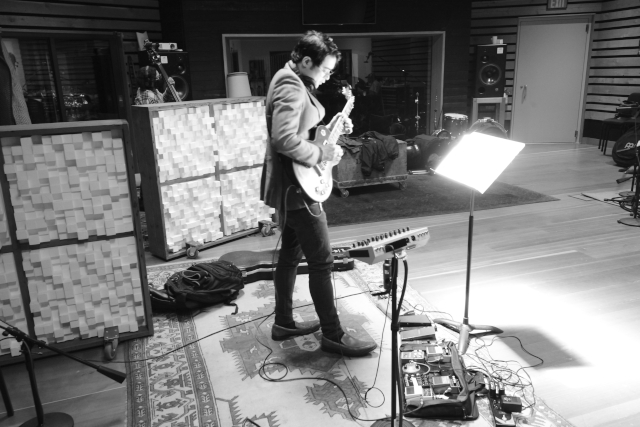
Karl Evangelista © 2025 Myles Boisen
Guitarist and composer Karl Evangelista is a member of the current generation of vanguard improvisers pushing headlong into the future by synthesizing the experimental jazz tradition with the tenets of popular song and 20th century composition. As a Filipino-American, Evangelista also explores concepts of musical multiculturalism with a politicized sense of intentionality.
Evangelista has worked with an impressive list of luminaries, including Bobby Bradford, Fred Frith, and Louis Moholo-Moholo, as well as notable peers like Zoh Amba, Ben Goldberg, and Luke Stewart. He has studied under Myra Melford, Art Ensemble of Chicago co-founder Roscoe Mitchell, and the legendary Milford Graves. Mentored by master saxophonist Francis Wong, Evangelista maintains ties to the influential Asian Improv aRts organization and has an active role among the Bay Area’s BIPOC and Asian American jazz community, working with Jon Jang, Mark Izu, and Chicago bassist Tatsu Aoki, among others.
As a bandleader, Evangelista currently leads Apura with pianist Alexander Hawkins, bassist Lisa Mezzacappa, drummer Andrew Cyrille, and saxophonists Trevor Watts or Francis Wong, along with his partner, Rei Scampavia on keyboard and electronics. Song & Dance Trio features Evangelista and Scampavia with drummer Jordan Glenn, while Evangelista and Scampavia’s co-led duo project Grex is the foundation for most of Evangelista’s current projects. The guitarist’s music has been documented by a wide range of independent record labels, including 577 Records, Asian Improv Records, Astral Spirits, Bridge Records, Edgetone Records, Fundacja Sluchaj, and Geomancy Records.
Evangelista earned his BA in Interdisciplinary Studies from UC Berkeley and an MFA in Improvised Music from Mills College. He currently lectures in the department of Race & Resistance Studies at San Francisco State University, serves as music coordinator for San Francisco Waldorf High School, and teaches privately in the Easy Bay area. I interviewed Evangelista in the late fall of 2025, just after the release of his quintet recording Solace Angles (Asian Improv Records).
* * *
Troy Collins: Some early biographical information might be of interest to readers unfamiliar with your background. How did you get your start playing music?
Karl Evangelista: I started playing guitar relatively late, at 12 years old. Formal music education did not find me naturally, as I come from a family of doctors, lawyers, and politicians. My family emigrated from the Philippines not long before I was born, and the expectations for my sister and I aligned with the typical immigrant values of academic excellence and economic success.
In 1992, my Aunt, Miriam Defensor Santiago, mounted a landmark campaign for the Presidency of the Philippines. She was a hugely popular reformist politician at a time when the country was still finding its way out of the morass of the Marcos years. It is widely believed that she was cheated out of victory, with the vote count being manipulated by power outages.
I think of my Aunt as I do my own grandmother. Appropriately, I felt pressured from an early age to live up to the standard that she set. I found music in a roundabout way – I had to request guitar lessons from parents, as a “break” from rigorous academic studies. I practiced vigorously – 4, 5, 6, hours a day when I started – and later realized that music provided the release and sense of validation that I was desperately seeking elsewhere.
As I entered my teens and discovered the work of John Coltrane, Ornette Coleman, Archie Shepp, Sonny Sharrock, and others, I realized that playing music could be a way of expressing the kind of social consciousness that my Aunt championed.
TC: Did you have any influential teachers or mentors during this time that provided you with previously unknown creative avenues to explore?
KE: I studied private guitar under an individual named Chris Kenney, who operated next door to Norman’s Rare Guitars (immortalized by its association with This is Spinal Tap). My first serious teacher, however, was Myra Melford, whom I met at UC Berkeley.
Myra’s methodology contrasted starkly against the conservative-minded pedagogy of (what was then) Berkeley’s music department. Though I discovered free jazz before I was a teenager, Myra was the first educator I encountered who was invested in incorporating creative music into her curriculum. As such, we’d play the work of Ornette Coleman and the Art Ensemble of Chicago alongside more mainstream post-bop fare. Ted Moore, who led the UC Jazz Ensembles, was also an encouraging presence in these years.
After Berkeley, I enrolled in the graduate music program at Mills College in Oakland. It’s impossible to overstate the importance of the Mills music program, which was one of the first and only institutions of its kind to provide high-level education in improvised music, electronic music, and other cutting-edge disciplines. For decades, it was a feeder school for the Bay Area experimental music scene, and the list of musicians who came through its halls reads like a who’s who of contemporary artists.
At Mills, I studied extensively under Fred Frith and Roscoe Mitchell. I also spent some time with monumental figures like Zeena Parkins, Maggi Payne, Chris Brown, and Muhal Richard Abrams. Fred was an early champion of my work who encouraged me to deeply examine my own creative biases and predilections. Roscoe instilled in me a sense of discipline and rigor, as well as a penchant for contrarianism. It was also at Mills that I met my wife and Grex bandmate, Margaret Rei Scampavia, who is still my closest collaborator.
Finally, I had the honor of knowing Milford Graves toward the end of his life. This wasn’t a proper teacher-student relationship, so much as a brief friendship that was informed by creative learning. I owe a lot of how I perceive music and other creative endeavors to the example that Professor Graves set.
TC: That’s an impressive list of teachers and mentors. I’m curious about this statement: “Fred [Frith] was an early champion of my work who encouraged me to deeply examine my own creative biases and predilections.” What “creative biases and predilections” did you have at the time that he thought you should examine?
KE: Fred was a fantastic teacher. He never taught a method, and he didn’t try to indoctrinate me into a specific system or worldview. Rather, he asked me to examine my own talents in a critical and inquisitive way.
I fell in love with free jazz early. Before Mills College, I only ever saw myself as an improviser that emanated out of the broader jazz continuum. On the one hand, Mills was a fantastic environment for exposure. Jazz musicians were forced to engage with the work of Pauline Oliveros and Robert Ashley. Electronic musicians would have the opportunity to play with Muhal Richard Abrams and Henry Grimes. We would all rub shoulders together in David Bernstein’s tonal analysis class, where we examined Brahms and Schoenberg.
On the other hand, the educators at Mills worked hard at getting students to realize their own skills. Fred would pose simple questions – “Why do free improvisers never play with tonality? Is it enough to simply play a jazz composition well, or does our music have to be challenging and complex?” – and our work would proceed from this sort of inquiry. This course of study ultimately resulted in the formation of my band Grex, which was an attempt to write clear, improvisation-based song structures unencumbered by genre. I would not have arrived at this kind of concept without the nurturing pressure that Fred applied.
It’s surprising what you can learn under the tutelage of masters. A lot of the way that I write atonal or nonfunctional melodies can be traced back to the year I spent in private study with Roscoe Mitchell. A lot of his music can sound prohibitively esoteric, but his own methodologies are fairly easy to understand. It’s all grounded in a fundamental understanding of motivic development, variation, and space. You can listen to a lot of pieces I’ve written, like Grex’s “KD” or “Blood,” to see how these ideas can be applied to music that does not sound like the Art Ensemble of Chicago.
And this is the point: musicians are listeners as well as performers. When we set out to create, we often have internalized biases about how a given piece of music is supposed to sound. Part of what Fred and Roscoe were trying to impart to me is that music can be procedural and creative, rather than simply an exercise in demonstrating mastery in an idiom or style.
TC: Your last statement is intriguing and begs further inquiry. As listeners, I think we all have expectations about how music is “supposed” to sound – even free improvisation (for example), hence Frith’s query “why do free improvisers never play with tonality?”
I have always considered music to be the purest union of art and entertainment – granted, pop music is more entertainment than art, and “art” music (classical, jazz, etc.) is often more art than entertainment, although each utilizes aspects of the other.
But outside of a live performance piece (as in say, an art gallery situation), listeners are rarely presented with music that is procedural, as suggested by your statement: “Part of what Fred and Roscoe were trying to impart to me is that music can be procedural and creative, rather than simply an exercise in demonstrating mastery in an idiom or style.”
Beyond art movements like Fluxus, do you feel this is an approach many others embrace? I think even the most “out” players tend to fall back on certain established patterns, which in their own way makes them traditionalists of a now well-documented idiom and/or style.
KE: This is an interesting question. When I was researching the music of the Blue Notes, I spoke to Evan Parker. At the time, there was an ongoing debate about “idiomatic” vs. “non-idiomatic” improvisation (which was probably instigated by Ben Watson’s Derek Bailey bio). Parker didn’t believe that it was possible to play non-idiomatically. If I understand him correctly, he believed that a given player’s personal approach to improvisation was, almost by default, a defined style or idiomatic approach.
I see Parker’s point. As improvisers, we’re applying embodied knowledge toward the goal of creating a spontaneous musical event. I’ve heard countless improvisers argue that true spontaneity is virtually impossible. The basis of instrumental mastery is practice, and practice is at odds with spontaneity.
One solution to this conundrum, which is the one that Fred and Roscoe present, is to work diligently at the mechanics of improvisation itself. (For example: Anthony Braxton’s “language types” can serve as a basis for learning extended techniques.) If you have enough technique at your disposal, the range of expressivity that you can achieve is maximized. So even if you’re not exercising “Total Improvisation,” the potential for surprise is significant.
At the same time, certain improvisers are extremely good at disabusing themselves of staid and predictable decision making. Louis Moholo-Moholo is my favorite example of this. He had no qualms about trying things, even if they didn’t necessarily work in a structural or conceptual sense. There’s a Peter Brotzmann record, called Opened, But Hardly Touched, that is extraordinary in this way. The improvisations have these seemingly inevitable longueurs, and Brotzmann, Louis, and Harry Miller are remarkable in the way that they can instigate motion, induce interaction, and provoke. They sound like they’re actually improvising, which is to say that the music is refreshingly devoid of cliche. They’re still using conventional techniques, but the logic feels alien and fresh. That’s the end goal, in my opinion.
TC: In a somewhat similar vein of thought, most creative improvised music is instrumental as opposed to vocal/lyric-based. Yet you seem to often favor a balance between the two, incorporating either sung lyrics or spoken word passages into your music. I’m curious what your ideas are regarding this, as far as say, intentionality or subject matter?
KE: It’s interesting – vocal music can assume different meanings, depending on the context. I know some improvisers who are purists about the use of lyrics in a creative music context – which is to say that if the voice isn’t being used as a multifaceted instrument, it undermines the work. At the same time, I come from a long continuum of improvisers – and that includes people like Fred, Roscoe, Louis Moholo-Moholo, and others – who have used lyrics, idiom, and voice as a way of expanding their repertoire of expression.
When Rei Scampavia and I formed Grex back in 2009, the group was intended as a departure from the rigorous new music that I studied at Mills College. Fred encouraged me to tap into the lexicon of rock music that I had cottoned to when I first started playing guitar. And so Grex began as an experiment of sorts, in which Rei and I would construct short song structures and use them as a basis for improvising in a nuanced way. Our earliest record, Live at Home, was essentially a post-punk record in the vein of early Deerhoof or Minutemen – only I imagined I was Sonny Sharrock.
A lot of the music that I make now evolved from the early calculus of Grex, which is to say that it borrows liberally from the worlds of art rock, electronic music, hip-hop, and so on. I only ever think of it as free music. David Murray stopped by a recording session for an as-yet unreleased session with Rei, Andrew Cyrille, Bobby Bradford, Luke Stewart, and William Roper. He said that the spoken word reminded him of Amiri Baraka. This is high praise and humbling, clearly, but I especially appreciated that the music came back around from the world of Death Grips and Moor Mother and returned to something akin to the New York Art Quartet.
TC: That’s an interesting way to view the continuum of tradition. I also often try (as a listener) to “connect the dots” as it were, between past innovations and what I hear in current practices. Since that seems to be an approach towards music making that you’re aware of and interested in, do you ever feel any self-imposed pressure to make music that is essentially “timeless” in that regard, in that it could be heard as part of a long line of creative endeavors with similar antecedents?
KE: I think that the artist’s obligation is to self-expression first and foremost, which means that their music is invariably a reflection of specific social pressures and conditions. Granted that, the exigencies of free music constitute some of those pressures that inform my work. I’m also conscious of the fact that tradition is an important part of being both Filipino-American and a person of color in America.
I have certain projects, like my group Apura, that make a deliberate effort to comment on and engage with the canon of free jazz. In Tagalog, “Apura!” roughly translates to “Very Urgent,” which was the name of an epochal record by the Blue Notes. This project was conceived as a way to bridge the gap between my work and the sound, mechanics, and political energy of Louis Moholo-Moholo’s music.
Later, when Andrew Cyrille joined us, Apura took on some of the qualities of his work. I don’t think that anyone has identified this yet, but the first two tracks of my record Ngayon were modeled after Jimmy Lyons’s Other Afternoons.
In preparation for my first gig with Andrew, I spent months obsessively poring over the music of Cecil Taylor, Maono, Trio 3, and so on – trying to get inside of what made Andrew’s approach to improvisation so special and potent. To me, what’s interesting about a record like Ngayon is the details. I wrote those tunes to be simple and transparent, because I wanted a focus of that record to be Andrew’s playing. Resultantly, that album gives you a good sense of how Andrew can evolve motives, respond to soloists, and change the directional energy of an improvisation.
On the other hand, the Bukas record was written to challenge some of the core mechanics of classicist free jazz. The album makes extensive use of spoken word, and almost every piece is centered on the use of synthesizer and other electronic sounds. Moreover, it’s baldly a guitar record. I wanted to do things on that album that connected the “old” world of Sharrock, Bailey, and Frisell with Cline, Halvorson, or the work of contemporaries like Ava Mendoza. Not everything needs to be a period piece, even if history is always present in the way that I view art.
TC: As you just mentioned, you have a diverse discography, with multiple ensembles to your credit. Do you find it advantageous to maintain separate projects that allow you to focus on different aspects of your artistry, rather than attempting to collect all your various ideas under a more traditionally autobiographical identity? For example, I’m thinking of the difference between Miles Davis’ stylistically varied oeuvre compared with say how James Brandon Lewis has managed to accomplish something similar under the rubric of different (acoustic and electric) band identities.
KE: This is an interesting way to look at it. I don’t necessarily think of my projects as separate entities, although there are practical concerns that might dictate some variation in terms of band names, instrumentation, and so on. This is an unspoken truth, I think, when it comes to modern creative music. When so much of the economics of jazz and art music is centered on obtaining grants, producing recordings, and booking concerts, there’s an incentive to generate new “content.”
For me, the ultimate goal is to create an undeniably personal sound. This doesn’t necessarily mean that every project has to have a sense of monolithic identity in the way that, say, the work of John Coltrane or Frank Wright did, but rather that I want my music to have a consistent sonic throughline. Roscoe Mitchell did this. His music is stylistically diverse, but the way that he approaches elements like space and timbre is deeply idiosyncratic.
One other factor is that it’s extremely difficult to keep a regular band together in this artistic and economic climate. Our industry hasn’t adjusted for inflation in over half a century, and the days of long performance residencies are essentially over. While I’ve played with many of the same musicians for nearly two decades now – from Francis Wong and Asian Improv aRts to Alexander Hawkins and even Mr. Cyrille – my most consistent collaborator has been Rei Scampavia, my partner and bandmate in Grex. Because she has been such a steadfast presence in my bands, the way that I write has adapted to her strengths. In a way, then, the projects that we’ve played in together comprise their own oeuvre.
TC: I’d like to delve a little deeper into the economic and logistic differences between maintaining a longstanding band as opposed to working with multiple, rotating lineups. It is the norm nowadays, but how, specifically, is it more economically difficult to keep a consistent lineup than it is to create new projects? I understand why new projects are more appealing these days (especially for promotional purposes), but don’t they ultimately cost just as much to put together as it is to maintain a long-running band?
KE: I don’t think it’s so much that it’s more expensive to retain consistent personnel as it is that it’s easier to get funding for a new project. So much of the landscape for 21st century creative music relies on grants and commissions, and many of these outlets expressly disqualify preexisting works. This is great for artists who are prolific and interested in generating a diverse portfolio of works, but it can complicate the working conditions for middle-of-the-pack music that can’t command high fees.
On that note, I don’t think that anyone in the trenches can rightly begrudge their colleagues, friends, and heroes for finding imaginative ways to make money. It’s fair to say that while the market share for creative music seems to have grown in the past few decades, our current milieu is overall a hostile environment for the economics of adventurous, independent music. In my opinion, the advent of new media, especially in terms of digital streaming and social media, has had an incredibly deleterious effect on how we make and receive art.
TC: The deleterious effect of new media has been a topic of regular conversation among me and my peers for quite some time now. Assuming remuneration from streaming and/or downloads is insufficient or unfair compared to hard media sales, what are your thoughts on the state of the recording industry at large, especially in regard to archival copies (CDs, LPs) versus more ephemeral formats (downloads, streaming)?
KE: It’s easy to blame the advent of new media as a cause for poor working conditions among musicians, but streaming is just one facet of an industry-wide race to the bottom. I recently saw a statistic that stated that global music revenues have experienced consistent growth over the course of the past several years. This money is not going into the pockets of independent and creative musicians. Our labor is being exploited by large media services, music companies, and other corporations.
This is not a controversial opinion, but revenue sharing for large streaming services is abysmal. In the case of Spotify, it’s outright predatory, disenfranchising smaller creators and disproportionately benefitting large artists and record labels like Sony, Warner, and Universal. At the same time, these services provide so much music to the consumer at such a low cost that they have become the default mechanism of delivery for new music. The artist almost feels as if they cannot field a successful career without purchasing into this system, and the overall network effect is essentially insuperable.
I’ve kept virtually all of my newer music off of Spotify, and I am looking to pull the last of it. I feel vindicated in this stance because at the absolute ground level, I’ve found that audiences who are conscious of the power imbalance between corporations and artists are willing to engage in alternative music economies. In these economies, which often trade in delivery systems like Bandcamp (which, to be fair, is owned by Epic Games), streaming is just another way to access audiences. Physical media like LPs and CDs are viable in this context, because the consumer can support the artists directly – with only marginal revenue going to corporate interests.
In a way, a lot of local creative music operates under the same pretenses that the New York Loft Scene did in the 1970s and ‘80s. Concerts are independently produced, or at least sponsored by sympathetic presenters. The artists either work with smaller labels or self-release their recordings. These same strategies were being implemented at the dawn of free jazz – not just vis-a-vis iconic labels like ESP-Disk’, but also through artist owned operations like Debut or IPS Records. Professor Graves is rightly celebrated as a monumental figure in this music, but he was selling albums like In Concert at Yale University off of his own steam. The last time I met him, he mentioned that he still had original copies on hand.
TC: Based on what we’ve been talking about (and your CV), I assume that your work as a performing artist has to be augmented by teaching and/or some form of academic employment to make ends meet – something I know almost all artists of your creative ilk need to do to survive in this economy (and political climate). Do you find that balance rewarding or limiting? Does the academic work influence and/or inspire your personal creative projects, or do they limit the time you have available for your own work, or, is it a combination of the two?
KE: From my point of view, the simple fact of this business is that it’s virtually impossible to support a lifestyle in creative music without supplementary income. With only a handful of exceptions, the most august members of this community are either performing incessantly or working at educational institutions. Even the most celebrated musicians in this milieu rely on commissions, grants, and awards in order to produce new music.
For younger and less established artists, the choice is between performing commercial music, working outside of the arts, or teaching. In the latter category, artists like Milford Graves and Anthony Braxton established that education has an intrinsic value. My main teachers – Myra, Roscoe, Fred Frith, Francis Wong, etc. – all work (or have worked) in higher education.
On the one hand, this affords the working artist a degree of stability and financial flexibility. On the other, education allows you to develop relationships with like-minded people, cultivating the music through research, practice, and discipline. I’d go as far as to say that most people in the broader realm of creative music teach at least a little bit, and this ethos is partially an extension of strategies for self-determination that originated with Professor Graves, Bill Dixon, the AACM, and so on.
I enjoy teaching. Beyond that, I find the balance between education and performance rather liberating. I’m not truly beholden to commercial pressures, and I work so extensively in so many different contexts that I feel freer in saying no to opportunities that don’t accord with my interests. I think that this dynamic has only benefitted my artistic development.
TC: In conclusion, what musical projects do you have planned for the immediate future?
KE: I hope the doom and gloom doesn’t underplay the fact that there’s plenty to be excited for in the realm of creative music. In terms of sheer diversity of concept, culture, and experience, there are probably more people making interesting music in 2025 than at any other point in the past century. None of this is to say that music today is in any way “better” than it has been – it’s just easier to access and create art now than it was even 10, 15 years ago.
In terms of the immediate future: Grex’s next album, entitled Auntie + Tebs, is slated to release next summer. This has been in the works since 2020. The record melds simple, angular song structures with roving improvisation in a way that is, I think, quite unusual. Bobby Bradford and Zoh Amba guest.
This project has an aggressive political bent, but it tackles topics like equity in a layered way. Most of the songs were written to center on the experiences of two figures: my previously mentioned Aunt, Miriam Defensor Santiago, and Louis Moholo-Moholo (“Tebs”). My Aunt grappled with the legacy of Marcos, Louis with Apartheid. It’s now the burden of modern artists to respond to the specter of extremist conservatism. Auntie + Tebs invokes personal narrative as a way of talking about the cyclical, generational nature of revolution.
In other realms, I’ll be embarking on a short run of repertory projects – performing Sonny Sharrock’s Guitar and Ask the Ages in their entirety. I’m looking to resurrect a project in New York that includes percussionist Nava Dunkelman and keyboardist Michael Colmean. In Fall, I’ll be touring Europe with a brand new quartet that features Alexander Hawkins, John Edwards, and Mark Sanders. Finally, I’ll be continuing my Taglish II ensemble with William Roper, Luke Stewart, Mr. Bradford, Mr. Cyrille, and others – we have an album in the can.
© 2025 Troy Collins