Moment's Notice
Reviews of Recent Recordings
(continued)
Jason Robinson
Tiresian Symmetry
Cuneiform Records Rune 346
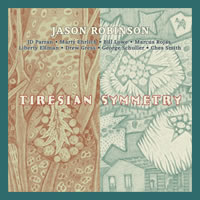 While the details regarding the soothsayer Tiresias, blind prophet of Thebes, vary considerably in Greek mythology, several key allusions remain consistent. Over the course of his seven generation lifetime, Tiresias was rumored to have lived for seven years as a woman after being cursed by Hera for interrupting a pair of copulating serpents; Hera also reputedly blinded Tiresias for siding with Zeus during an argument over who enjoyed more pleasure during sex, man or woman. Consequently, the numbers two and seven factor prominently in such legends, an aspect multi-instrumentalist Jason Robinson utilizes on Tiresian Symmetry, his impressive follow-up to The Two Faces of Janus (Cuneiform), a session similarly inspired by Greek myths. Although the numerical symmetry underscoring Tiresias’ exploits provides the mathematical foundation for Robinson’s intricate writing, the assembled nonet bears a more obvious, contemporary influence – Henry Threadgill’s Very Very Circus of the 1990s, which Robinson acknowledges as an influence in the liner notes. In addition to adopting Very Very Circus’ use of paired tubas (played here by Bill Lowe and Marcus Rojas), the inclusion of guitarist Liberty Ellman – a charter member of Threadgill’s current group, Zooid – further reinforces such comparisons. The unit is rounded out by drummers George Schuller and Ches Smith, bassist Drew Gress and multi-reedists Mary Ehrlich and JD Parran.
Resemblances to Threadgill’s legendary ensemble largely end with the instrumentation however; despite subtle similarities, Robinson’s sophisticated arrangements tend to focus more on cantilevered harmonies than layered polyrhythms. Compounded second line rhythms do occasionally appear – as on the stirring opener, “Stratum 3” – but generally, contrapuntal horn charts take precedence, infusing the proceedings with a vivid multihued palette that recalls the thorny creative music orchestras of Muhal Richard Abrams and Anthony Braxton. Delving even further into the jazz continuum, the subterranean brass and reeds that open the brooding title track allude to Ellington’s evocative pre-war period.
For all Robinson’s attention to tradition, post-modernism eventually materializes on the capricious “Radiate.” The episodic number downshifts from mesmerizing groove to austere pointillism before a brief balladic interlude blossoms into a blistering drum ‘n’ bass passage. Ellman takes a dramatic detour at these futuristic crossroads, amplifying his characteristically clean-toned guitar to emit scrawling shards of phased-out distortion in manic double time, anticipating the horn section’s cacophonous denouement. Robinson manages such novel transitions gracefully, often accentuating changes in time, tempo and density with striking shifts in tone color; Parran’s multiphonic contrabass clarinet introduction to “Saros,” Lowe’s garrulous muted bass trombone proclamations on “Corduroy” and the pastoral woodwinds underscoring Gress’ probing bass excursion on the title track all coincide with dynamic structural transitions.
Expansive arrangements are only one facet of Robinson’s talents. A bold and confident interpreter, Robinson repeatedly structures his solo excursions using a variety of approaches, lending each statement its own unique narrative identity. His unaccompanied “Elbow Grease Introduction” unveils a mastery of extended techniques; controlled altissimo, embouchure manipulation and overblown multiphonics are tastefully used to produce a series of lyrically deconstructed motifs that subtly foreshadow the theme to “Elbow Grease,” which rushes headlong under the thrall of Robinson’s marathon tenor testimonial. Thrilling in its intensity, Robinson’s climactic performance is a remarkable demonstration of creativity, stamina and virtuosity, confirming Tiresian Symmetry as his most complete statement to date.
–Troy Collins
Angelica Sanchez Quintet
Wires & Moss
Clean Feed CF259CD
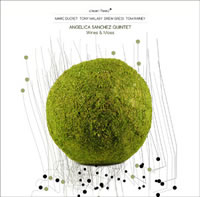 Despite her enviable skills, pianist Angelica Sanchez has maintained a relatively low profile since relocating from Arizona to New York in the mid-1990s with saxophonist Tony Malaby. In addition to numerous collaborations with Malaby, Sanchez’s sideman credits include work with peers like Matt Bauder, Harris Eisenstadt and Rob Mazurek – though her output as a leader has been somewhat limited. Other than Mirror Me, her 2003 Omnitone debut, the only other title in Sanchez’s discography as a bandleader is Life Between (Clean Feed, 2008) – the phenomenal premier of her Quintet with Malaby, renowned French guitarist Marc Ducret and the stellar rhythm section of bassist Drew Gress and drummer Tom Rainey.
Wires & Moss, the band’s sophomore effort, expands upon its predecessor’s deft equipoise, gracefully shifting between open forms and taut written sections. Sanchez’s elegant melodies provide boundless inspiration for her bandmates, facilitating a wide range of individualized expression – especially from Ducret. The guitarist’s dynamic versatility manifests in myriad ways, from the glassy fretwork that underpins the dolorous ballad “Feathered Light,” to the metallic shards and searing maelstroms that dominate the remainder of the album. His introductory soliloquy to the title track unveils the breadth of his wide-ranging approach; he uses fretboard hammering, whammy bar pitch bends and sustained feedback to extrapolate the tune’s sinuous melody into a multitude of abstract variations.
Selectively underpinning Ducret’s salvos, Sanchez demonstrates her mettle as a discerning accompanist whose keen understanding of dynamics provides the group with spacious vistas to explore. Her harmonically unfettered melodic sensibility and pellucid touch imbues the session with robust lyricism, whether plying delicate filigrees on the unassuming “Feathered Light,” issuing cascading neo-classical figures on the expansive title track, or closing the knotty opener, “Loomed,” with a stately cadenza.
Building on years of familiarity with her oeuvre, Malaby’s contributions to Sanchez’s work are deeply affecting. His tender soprano regales with understated sensitivity on the title cut, while his pneumatic tenor fusillades amplify the dramatic contours of “Bushido.” His commitment to Sanchez’s artistry is most telling on “Soaring Piasa.” He invests the rousing melody with soulful ruminations that gradually ascend with irrepressible urgency, inspiring the band to greater heights of controlled fervor.
Veterans Gress and Rainey gracefully navigate stop-start rhythms, unconventional meters and impressionistic accents, their practiced rapport providing magnanimous support. Buoyed by her illustrious sidemen’s stirring interpretations, the vivid panoramas revealed on Wires & Moss are among the most satisfying of Sanchez’s burgeoning career.
–Troy Collins
Alexander von Schlippenbach
Schlippenbach Plays Monk
Intakt CD 207
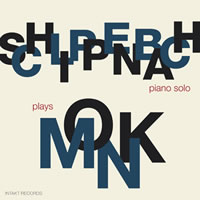 Pianist Alexander von Schlippenbach is primarily thought of as a free improviser by virtue of Globe Unity Orchestra and his trio with Evan Parker and Paul Lovens. But, Schlippenbach is also a long-time champion of Thelonious Monk. Monk pieces were featured on ‘70s Globe Unity albums for FMP like Pearls and Evidence. They’ve popped up on duo recordings with Sven-Åke Johansson, Aki Takase, and Sunny Murray. There is the overlooked trio recording Light Blue: Schlippenbach Plays Monk (Enja) and most importantly, the epic Monk’s Casino: The Complete Works of Thelonious Monk (Intakt) with his quintet featuring Axel Dorner, Rudi Mahall, Jan Roder, and Uli Jennessen, one of the most thorough investigation of Monk as composer to date.
Interpretations of Monk’s music is hardly a rarity – but, like Steve Lacy, Schlippenbach brings a creative invention to the music, at once faithful to the compositional structures of the thematic material while extending the forms with a personal sense of freedom. In his liner notes to the trio CD, the pianist remarks that Monk’s “motifs arise as if born of themselves; self-perpetuating melodic lines and thematic thoughts in a free atonality, that allow playing outside the form ... ” which brings us to this new solo recording; as intimate and reflective an examination of Monk’s music as Schlippenbach has recorded. The pianist frames nine of Monk’s tunes with eleven spontaneous improvisations, weaving together a suite-like homage to the master.
The mood is set with the darkly lush “Reverence,” a fitting prologue that fits together angular, lyrical motifs like pieces of a jigsaw puzzle. From there, he constructs the set with chestnuts like “Epistrophy,” “Brilliant Corners,” “Locomotive,” and “Pannonica,” along with lesser-played pieces. A great example is “Introspection,” which is given two haunting readings back-to-back, providing keen insight in to how he insightfully crafts reinventions out of Monk’s core themes and structures. The first reading navigates closely to the form of the piece while the second refracts it through abstract inversions. He can even find a fresh thread through “Epistrophy,” looping through the theme and then gradually unraveling it and then threading the fragments back together into the form. The spontaneous interludes, all under a minute, interject shards of ideas, micro-studies in velocity, angularity, and trajectory abstractly distilled from the core motifs of Monk’s music. Taken together, Schlippenbach has, yet again, found a way to inhabit Monk’s music while simultaneously, stamping it as uniquely his own.
–Michael Rosenstein
Wadada Leo Smith + Louis Moholo-Moholo
Ancestors
TUM CD 029
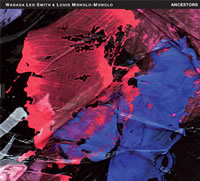 This exceptional meeting with South African free jazz titan Louis Moholo-Moholo is the latest in trumpeter Wadada Leo Smith’s ongoing series of recorded duos with drummers. Smith’s outlook has always been global and the percussionists he’s worked with reflect his world-spanning vision. There are full albums with Americans Ed Blackwell (1986), Adam Rudolph (2002), and Jack DeJohnette (2008), Sabu Toyozumi from Japan, and German Gunter “Baby” Sommer (2006), as well as stray tracks on albums by Mexican American percussionist Gustavo Aguilar and Korean percussionist Park Je Chun. Drummers haven’t been Smith’s only duo partners of course – there have been albums with saxophonists Marion Brown and Anthony Braxton, and pianist Matthew Goodheart, for instance – but perhaps the prevalence of drummers among Smith’s duo releases says something about his esteem for the music of the drums and the importance of rhythm to an artist who, after all, calls one of his composition strategies “rhythm units.”
Throughout the album, Moholo’s steady beat seems to anchor the more kaleidoscopic Smith. The drummer never remains static; it’s just that his music develops in a more linear fashion, while abrupt contrasts are a hallmark of Smith’s. The differences between them generate wonderful creative tension. On “Moholo-Moholo/Golden Spirit,” the heartbeat throb of the bass drum marches the music forward at a slow, steady pace as the light patter of cymbals showers down on the dignified and infinitely tender muted trumpet. It’s like a procession in the rain. Smith’s lyricism is all his own, with unforeseen notes twisting melodies out of their expected trajectories, but always in emotionally revealing ways. On “Jackson Pollock – Action,” Smith sounds momentarily possessed by the tuneful, insouciant joy of Don Cherry, then spins long prayerful stretches of transparent tones as Moholo grows more forceful and polyrhythmic. Moholo’s drumming on “Siholaro” conveys something primal and yearning while undergirding Smith’s colorful, almost vocal, meditation. The five-part improvisation, “Ancesters” brings together the full power of their respective arts. The spontaneous forms bubble and ripple with elegant drum patterns – funky, swinging, unclassifiable – and zig-zag and jump among passages of brilliant timbres, lyric beauty, and startling textures. Separate yet together, contrasting yet complimentary, blurring distinctions between composed and improvised, disciplined and free, Smith and Moholo Moholo play with mutual respect and absolute clarity that welds their musics into a single vital force.
–Ed Hazell